
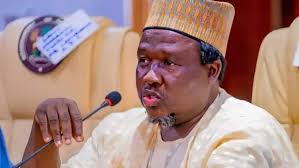
President Bola Ahmed Tinubu has elevated Ibrahim Masari from Senior Special Assistant to Special Adviser on Political Affairs, strengthening his political advisory team at the Presidency.
The announcement was made on Thursday by Bayo Onanuga in a statement released to journalists.
According to Onanuga, Masari will now serve as Special Adviser and work alongside Yau Darazo, who was earlier appointed by the president in July 2023.
The new role places Masari in a more senior position within the presidential advisory structure, giving him greater responsibility in political coordination and strategy.
Masari had previously served as Senior Special Assistant to the President on Political Affairs since 2023.
His elevation to Special Adviser represents a step up in the hierarchy of presidential aides. In Nigeria’s presidential system, Special Advisers are regarded as senior officials who handle important policy and political matters and have closer access to the president.
Senior Special Assistants and other aides often assist with administrative duties, but Special Advisers typically play a larger role in shaping strategy and offering guidance to the president on key national issues.
By promoting Masari, Tinubu is believed to be strengthening the political structure around his administration as it continues to manage governance and party relations across the country.
Masari is widely known as a close political ally of President Tinubu and has been active within the ruling All Progressives Congress (APC).
The Katsina-born politician has played important roles in party organisation and mobilization, especially in the North-West region.
Political observers say his experience in party affairs and grassroots mobilisation has made him a trusted figure within the APC leadership.
Before his appointment into the presidency, Masari served as the welfare secretary of the APC during the tenure of Adams Oshiomhole as the party’s national chairman.
During that period, he was involved in internal party administration and welfare matters affecting party members.
Masari’s relationship with Tinubu dates back several years, particularly during the period leading up to the 2023 general elections.
He was part of the network of party leaders who worked to strengthen support for Tinubu across several regions of the country.
Political analysts note that Tinubu has often relied on trusted allies within the APC to manage political relationships between the presidency, the ruling party, and other stakeholders.
As Special Adviser on Political Affairs, Masari is expected to help coordinate political communication, maintain relationships with party leaders, and advise the president on political developments across the country.
Such roles are important in Nigeria’s political system, where maintaining party unity and managing regional interests can have a major impact on governance.
Masari will work alongside Yau Darazo, who has served as Special Adviser on Political Affairs since July 2023.
Darazo’s appointment came shortly after Tinubu assumed office following the 2023 presidential election.
With the addition of Masari at the same advisory level, the presidency appears to be expanding the political advisory team to handle the complex task of managing relationships within the ruling party and across Nigeria’s diverse political landscape.
Nigeria’s political environment is often shaped by regional alliances, party negotiations, and cooperation between the executive and the National Assembly.
Advisers on political affairs therefore play a critical role in helping the president navigate these relationships.
President Tinubu took office in May 2023 after winning the presidential election under the platform of the APC.
His administration has since focused on economic reforms, governance restructuring, and maintaining stability within the ruling party.
Observers say maintaining strong political coordination is essential for the success of government policies, particularly in a country with multiple political interests and regional concerns.
By appointing experienced political figures to advisory positions, the presidency aims to strengthen its ability to respond to political developments and maintain support across different parts of the country.
Masari’s new role is therefore expected to involve regular consultation with party leaders, political stakeholders, and government officials.
In Nigeria’s presidential system, advisers often serve as key links between the president and political actors outside the formal government structure.
They help monitor political developments, advise on party issues, and support efforts to maintain cooperation between the executive and other arms of government.
Such roles become particularly important when the government is implementing major reforms or policies that require political consensus.
Masari’s promotion signals the president’s confidence in his ability to contribute to these efforts.
With the elevation of Masari, the presidency appears to be reinforcing its political support structure as it approaches the midpoint of its first term.
Masari’s experience within the APC and his connections across the North-West region may also help the administration strengthen relations with party leaders and stakeholders in that part of the country.
For now, the presidency has expressed confidence that Masari’s new role will help improve coordination within the government’s political operations.