
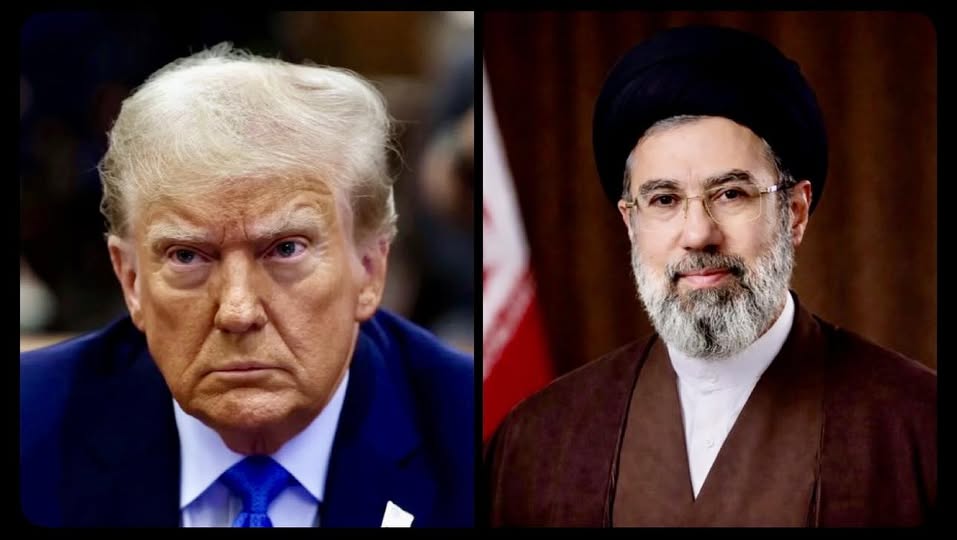
United States President Donald Trump has reacted to the selection of Mojtaba Khamenei as the new Supreme Leader of Iran, saying he is not pleased with the development.
Trump made the remark during an interview with Fox News on Monday, shortly after Iranian state media reported that Mojtaba Khamenei had been chosen to succeed his late father, Ali Khamenei, who had served as Iran’s supreme leader for decades.
According to Trump, the change in leadership comes at a time of rising tension in the Middle East, particularly between Iran and the United States.
“I am not happy Mojtaba Khamenei is selected as Iran’s new Supreme Leader,” the US president said during the interview.
Reports from Iranian state television on Sunday said Mojtaba Khamenei had been selected to take over the country’s highest political and religious position following the death of his father.
The position of Supreme Leader is the most powerful office in Iran’s political system. The leader has authority over the armed forces, the judiciary, state broadcasting, and many key national policies.
The office was created after the Iranian Revolution of 1979, which transformed Iran from a monarchy into an Islamic republic.
Since then, only two people have held the position. The first was Ruhollah Khomeini, the leader of the revolution, who served until his death in 1989. He was succeeded by Ali Khamenei, who remained in power for more than three decades.
The selection of Mojtaba Khamenei marks a new chapter in the country’s leadership, though it has also drawn international attention because of his close family connection to the previous leader.
Speaking during the Fox News interview, Trump said the United States was closely watching developments in Iran.
He claimed that Iran had previously aimed hundreds of missiles at countries across the Middle East, raising concerns about security in the region.
However, the US president also said that the balance of power in the region had changed following recent military actions by the United States.
According to Trump, these actions had weakened Iran’s military capabilities and reduced its ability to threaten neighbouring countries.
“The United States dealt Iran a severe blow,” he said, adding that Tehran’s military strength had been significantly reduced.
Trump did not give detailed information about the military actions he referred to but insisted that the United States remained strong in the region.
Relations between the United States and Iran have been tense for many years. The two countries have disagreed on several issues, including Iran’s nuclear program, regional security, and economic sanctions.
The United States has repeatedly accused Iran of supporting armed groups in the Middle East and of threatening stability in the region.
Iran, on the other hand, has accused Washington of interfering in its internal affairs and imposing harsh economic sanctions on its economy.
These disagreements have sometimes brought the two countries close to military confrontation.
Trump’s latest comments came as tensions continue to rise in several parts of the Middle East, including the Strait of Hormuz, one of the world’s most important oil shipping routes.
During the interview, Trump also spoke about security in the Strait of Hormuz, which lies between Iran and several Gulf countries.
The narrow waterway connects the Persian Gulf to the Gulf of Oman and is a major route for global oil shipments.
A large percentage of the world’s oil exports passes through the strait each day, making it a key area for international trade and energy supply.
In the past, tensions involving Iran have raised fears that shipping in the area could be disrupted.
However, Trump said ships should not be afraid to pass through the strait despite the rising tensions.
He insisted that the United States would continue to protect international shipping and maintain security in the region.
Mojtaba Khamenei is a cleric and political figure who has long been considered influential within Iran’s ruling establishment.
Although he did not previously hold the position of supreme leader, he was believed to play an important role behind the scenes in Iranian politics.
His selection as the country’s new leader has attracted global interest because it represents the first time the position has effectively passed from father to son.
The development has sparked reactions from several countries that closely monitor Iran’s political direction.
Western governments, including the United States, often view Iran’s leadership decisions through the lens of security and diplomacy in the Middle East.
Iran remains an important player in regional politics because of its influence in countries such as Iraq, Syria, and Lebanon.
Changes in its leadership can therefore have wider effects on diplomatic relations, regional alliances, and security policies.
Although Nigeria is geographically far from the Middle East, developments in the region can still affect the country.
Global oil prices, for example, are often influenced by tensions in oil-producing regions such as the Persian Gulf.
Nigeria, being one of Africa’s largest oil producers, sometimes experiences economic effects when global oil markets change due to conflicts or political developments abroad.
For this reason, Nigerian policymakers and analysts often follow major international events involving key oil-producing countries like Iran.
As Mojtaba Khamenei begins his leadership, many observers say the coming months will reveal how his administration plans to handle both domestic and international challenges.
Issues such as economic sanctions, nuclear negotiations, and regional security are expected to remain central topics in Iran’s relationship with the international community.
For now, Trump’s reaction highlights the continuing tension between Washington and Tehran.
While the United States president expressed dissatisfaction with the new leadership in Iran, it remains unclear how the change will affect diplomatic relations between the two countries in the future.