
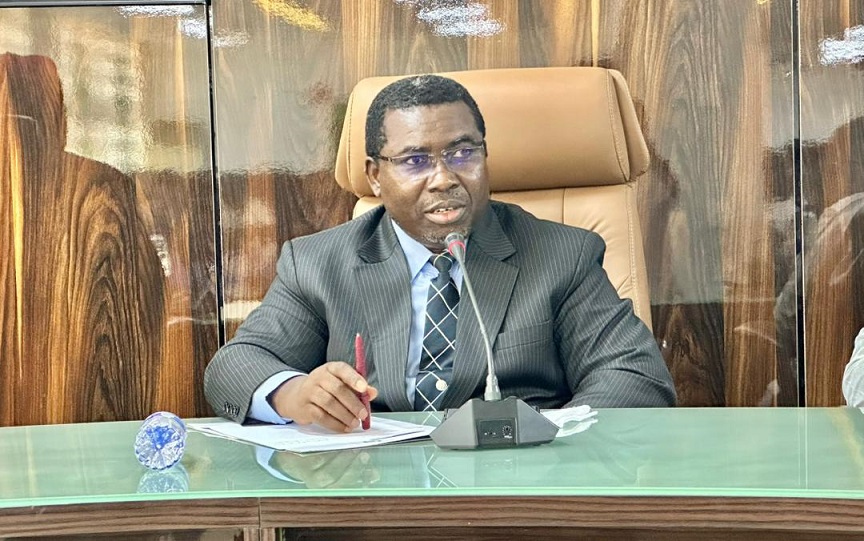
The Independent National Electoral Commission (INEC) has rejected calls for the removal of its chairman, Joash Amupitan, insisting that such demands are unconstitutional and threaten the independence of Nigeria’s electoral system.
In a statement released in Abuja on Thursday night and signed by the Chief Press Secretary to the INEC Chairman, Adedayo Oketola, the commission said recent criticisms from political actors were based on misunderstandings of its actions, particularly its decision to comply with a recent ruling of the Court of Appeal.
The commission noted that while Nigerians and political stakeholders have the right to express their opinions, the process for appointing or removing the INEC chairman is clearly stated in the Constitution. It stressed that no individual or political group has the power to remove the chairman outside the legal process.
“INEC is a creation of the Constitution of the Federal Republic of Nigeria,” the statement said. “The appointment, tenure, and removal of the chairman and national commissioners are governed by law.”
The commission referred to Section 157 of the 1999 Constitution, which outlines the conditions under which the chairman can be removed. According to INEC, any demand for removal that does not follow this process is not only a distraction but also a direct attack on the independence of the electoral body.
INEC also made it clear that its chairman does not serve at the pleasure of any political party or interest group. This independence, it said, is necessary to ensure that elections are conducted fairly and without interference.
The controversy comes amid ongoing tensions over political party leadership disputes, especially within the African Democratic Congress (ADC). A faction of the party led by David Mark has been at the centre of legal battles, with different court rulings complicating the situation.
INEC explained that its decision to step back from recognising any faction of the ADC was based on its obligation to obey court orders. It said the move was necessary to avoid repeating past mistakes seen in states like Zamfara State and Plateau State, where elected officials were removed due to failure to comply with court judgments.
In those earlier cases, election tribunals nullified the victories of some candidates because their parties did not follow valid court rulings. INEC said it wants to avoid a similar situation that could disrupt governance and create uncertainty.
“The commission decided to comply with the judgment of the Court of Appeal to prevent a repeat of past incidents,” the statement said.
The electoral body also pointed out that there was a preservative order from a Federal High Court, which barred actions that could affect ongoing legal proceedings. According to INEC, monitoring the activities of the David Mark-led faction of the ADC would have violated that order.
INEC further explained that it had initially approved the executive committee of the ADC faction led by David Mark on September 9, 2025. However, this was done shortly after a case had already been filed at the Federal High Court, making the situation more complicated.
The commission stressed that decisions of the Court of Appeal are binding on all authorities in Nigeria. It cited Section 287(2) of the Constitution, which requires all individuals and institutions to obey and enforce such judgments.
Beyond the ADC crisis, INEC addressed broader allegations that it is working against the multi-party system in Nigeria. It rejected these claims, saying its recent actions actually show its commitment to fairness and neutrality.
The commission noted that it has recently registered and recognised new political parties, including the Democratic Leadership Alliance, the Nigeria Democratic Congress, and the National Democratic Party. According to INEC, this brings the total number of active political parties in Nigeria to 22.
However, party disputes and legal battles have become common in recent years, affecting major parties such as the Peoples Democratic Party (PDP), Labour Party (LP), and the New Nigeria Peoples Party (NNPP). These disputes often lead to confusion over party leadership and candidates.
INEC maintained that it will not interfere in internal party matters. It said political parties must resolve their own disputes through their internal mechanisms and the courts, rather than relying on the electoral body.
“We will not allow ourselves to be used as a proxy for resolving internal party conflicts,” the commission stated.
The issue of voter registration also featured prominently in the statement. INEC responded to concerns about its planned nationwide voter revalidation exercise, which some critics have questioned.
The commission explained that the exercise is not a new voter registration but a process aimed at updating and cleaning up the existing voter register. It said the plan had been in place even before the appointment of the current chairman.
According to INEC, the revalidation exercise is necessary to improve the accuracy of the National Register of Voters. It will help identify and correct issues such as multiple registrations, outdated records, and the inclusion of deceased persons.
The commission said the exercise will be carried out across all local government areas and polling units in the country. It also plans to introduce digital options to make the process easier for voters.
INEC highlighted that the exercise is purely administrative and not targeted at any region, political party, or group. It warned against attempts to politicise the process, saying this could create unnecessary fear and confusion among voters.
“The revalidation process will strengthen the integrity of the voter register,” the statement said.
Looking ahead, INEC said it is focused on preparing for upcoming off-cycle elections in Ekiti State and Osun State, scheduled for June and August 2026 respectively.
Off-cycle elections are held outside the regular general election period, often due to court rulings or other special circumstances. These elections are closely watched as they can serve as a test of the electoral body’s readiness and credibility.
INEC said it is committed to conducting these elections with “precision” and will not be distracted by what it described as unfounded allegations.
“Our allegiance remains solely to the Constitution and the will of the Nigerian people,” the commission stated.
The electoral body concluded by reaffirming its commitment to the rule of law and democratic principles. It said all its decisions are based on careful evaluation and in line with the legal framework guiding its operations.
As debates continue over the role of INEC and the state of Nigeria’s democracy, many observers say the credibility of the electoral process will depend on the ability of institutions to act independently and transparently.
For now, INEC has made it clear that calls for the resignation or removal of its chairman are “out of place” and will not affect its work as it prepares for future elections.