
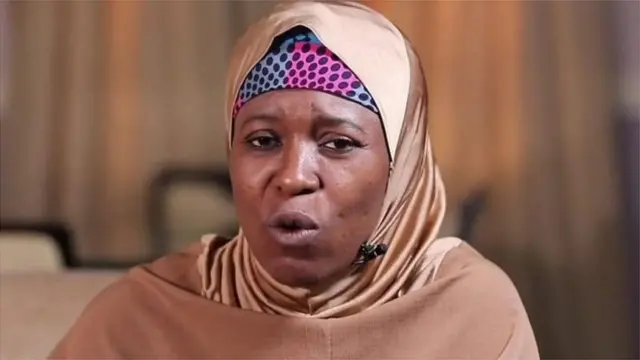
Activist Aisha Yesufu has said that former Labour Party presidential candidate Peter Obi is committed to serving only one term if elected president, adding that she would strongly oppose him if he goes back on that promise.
Yesufu made the statement during an interview on ARISE TV on Monday, where she spoke about her relationship with Obi and her expectations of his leadership style. She also compared Obi’s outlook on governance to that of former South African president Nelson Mandela, known for stepping down after a single term in office.
According to Yesufu, her support for Obi is partly based on his promise to serve only one term and focus on building a lasting legacy rather than holding on to power. She said she had personally discussed the issue with him and received a clear commitment.
“If Mr Peter Obi gets into office and decides to do more than one term, I, Aisha Yesufu, and I repeat it here, I will oppose him with everything in me, because he gave his word,” she said during the interview.
She explained that Obi had first made the one-term promise in 2022, before the 2023 general election. At the time, she said she was surprised by the statement and even tried to persuade him to reconsider.
“In 2022, when he was saying that, I remember saying to him, oh, sir, please, you can’t be serious. You can’t say you’re going to do one term and move on,” she said.
However, Yesufu said that after the election, she met with Obi again and asked him directly to confirm whether he still stood by the pledge. She said she wanted to be sure before continuing her public support for him.
“I need your word on this. I know you had said it before. I want you to repeat it. Is it true you’re going to do just one term?” she recalled asking him.
According to her, Obi responded by reaffirming his position. “Aisha, I told you even in 2023, and I still mean it. I don’t joke with my name. I don’t joke with my integrity. When I say something, I mean it,” she quoted him as saying.
Yesufu said she believes Obi will keep his promise, describing him as a politician who values integrity and keeps his word. She added that his willingness to limit himself to one term shows a different approach to leadership compared to many politicians in Nigeria.
The issue of tenure and re-election has been a major topic in Nigerian politics over the years. While the Nigerian Constitution allows presidents to serve a maximum of two four-year terms, debates often arise over how long leaders should stay in office and whether focusing on re-election affects governance.
Yesufu argued that leaders who are not thinking about a second term are more likely to take bold decisions that benefit the country as a whole. She said such leaders are less likely to make political compromises just to secure future support.
“When you know you’re not coming back, you are able to make decisions that work more for the nation, rather than decisions that work more for a few people,” she said.
She also compared Obi’s approach to leadership with that of Lee Kuan Yew, who is widely regarded for transforming Singapore into a modern and economically strong nation. However, she noted that Obi’s outlook is even closer to that of Nelson Mandela, who chose to step aside after one term despite being widely respected.
Mandela’s decision not to seek re-election in South Africa is often cited as an example of leadership focused on institution-building rather than personal power. Yesufu suggested that Obi shares a similar vision of leaving office after making a meaningful impact.
“When he talks, you see him put himself in the likes of Lee Kuan Yew, in the likes of Nelson Mandela, especially more of Nelson Mandela,” she said.
Peter Obi, who served as governor of Anambra State from 2006 to 2014, became a major political figure during the 2023 presidential election. Running under the Labour Party, he attracted strong support, especially among young Nigerians and urban voters.
Although he did not win the election, his campaign changed the political conversation in the country, with many supporters calling for reforms and greater accountability in governance.
Yesufu was one of Obi’s vocal supporters during the election period. Known for her activism, including her role in the Bring Back Our Girls movement, she has remained an influential voice in Nigeria’s civic space.
In her latest comments, she said she believes Obi has the potential to be remembered as a transformative leader if he follows through on his promises. She said his focus on long-term impact is what stands out to her.
“Sitting down with him is seeing him wanting a Nigeria that not only works, but years from now, probably like a hundred years from now, people will remember him,” she said.
She added that Obi could be seen in the future as a key figure in Nigeria’s development if he stays true to his vision and does not seek to remain in power beyond one term.
Her comments have already sparked discussions among political observers, with some agreeing that a single-term focus could improve governance, while others argue that continuity may also be important for long-term projects.
For now, Obi has not made any new public statement on the issue beyond what Yesufu shared. However, the discussion highlights ongoing debates about leadership style, accountability, and the future direction of Nigeria’s democracy.
As political activities continue ahead of future elections, statements like this are expected to shape public expectations and influence how voters assess potential candidates.
Whether or not Obi eventually runs again, Yesufu’s position is clear: for her, keeping one’s word remains a key measure of leadership.