
The Nigerian Navy has intercepted two vessels carrying 939 metric tons of suspected stolen crude oil valued at over N4 billion, in what officials describe as a major breakthrough in the fight against oil theft in the Niger Delta.
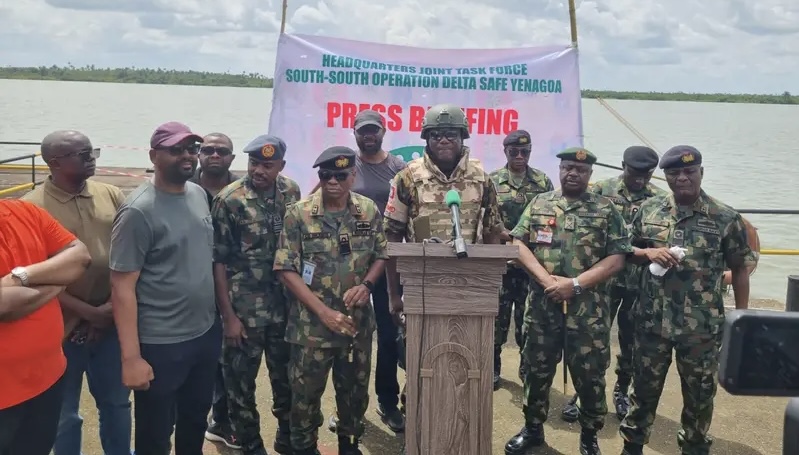
The operation, carried out under Operation Delta Safe, was confirmed on Sunday by the Commander of the Joint Task Force South South, Rear Admiral Olugbenga Oladipo, during a briefing with journalists in Calabar, Cross River State.
According to Oladipo, the vessels were apprehended in the early hours of April 8 at a wellhead located within the Calabar/Akwa Ibom Joint Operation Area. He said the success of the operation was based on credible intelligence gathered by naval authorities and followed a carefully planned overnight mission.
“This operation was intelligence-driven and executed with precision,” Oladipo said. “We received credible information about suspicious activities in the area, which led to the interception of the vessels.”
He disclosed that the two vessels were found to be carrying large quantities of crude oil suspected to have been illegally siphoned from oil facilities in the region. The total volume, estimated at 939 metric tons, has a market value of more than N4 billion.
The Navy also confirmed the arrest of 26 crew members who were on board the vessels at the time of the interception. The suspects are currently in custody and are expected to face further investigation and possible prosecution.
Oladipo noted that the operation received strong support from top security authorities, including the Chief of Naval Staff, the Chief of Air Staff, the Office of the National Security Adviser, and the Chief of Defence Staff.
“The Chief of Naval Staff and the Chief of Air Staff provided us with the necessary assets used in carrying out this mission,” he said. “This shows the level of coordination among security agencies in tackling oil theft.”
He explained that immediately after the vessels were intercepted, additional naval and air resources were deployed to secure the area and ensure that the operation was completed without interference.
A naval ship, Nigerian Navy Ship SHERE, was dispatched to take custody of the vessels at the offshore location, while a military helicopter provided real-time aerial surveillance.
“The helicopter gave us live images of the vessels, helping us monitor the situation closely,” Oladipo added. “This ensured that the suspects could not escape and that the operation remained under control.”
The intercepted vessels and their crew were later moved to a naval jetty with the support of other units for further investigation.
In a related development, the Navy also arrested another vessel, MT Steliosk, on April 10 as part of ongoing enforcement efforts in the region. This, according to officials, shows that the military is maintaining pressure on those involved in illegal oil activities.
The Niger Delta, which is the heart of Nigeria’s oil production, has long struggled with crude oil theft and illegal refining. These activities are often carried out by organised groups who tap into pipelines or operate makeshift refineries in remote areas.
Oil theft has remained a major challenge for Nigeria, affecting both the economy and the environment. The country relies heavily on oil revenue to fund government spending, and any loss in production directly impacts national income.
In recent years, the government has stepped up efforts to combat the problem through military operations, surveillance, and cooperation with local communities.
Operation Delta Safe, a joint military task force, has been at the centre of these efforts. The task force includes personnel from the Nigerian Army, Navy, Air Force, and other security agencies, working together to secure oil installations and prevent illegal activities.
Recent data shows that these efforts are beginning to yield results, although the problem has not been fully eliminated.
According to the Defence Headquarters, troops under Operation Delta Safe destroyed 101 illegal refining sites and arrested 219 suspects in the first quarter of 2026 alone. During the same period, more than 547,920 litres of stolen petroleum products were recovered.
These included crude oil, diesel, kerosene, and petrol, highlighting the scale of illegal operations in the region.
In separate operations, the Navy also recovered over 20,000 litres of suspected stolen crude oil and dismantled several illegal refining sites in Rivers State. Additionally, about 44,000 litres of illegally refined petroleum products were intercepted, with multiple suspects arrested.
Despite these successes, oil theft continues to pose a serious threat to Nigeria’s economy.
Data from the Nigerian Upstream Petroleum Regulatory Commission shows that the country lost about 37.6 million barrels of crude oil to theft in 2021. The figure dropped to 20.9 million barrels in 2022, and further declined to 4.3 million barrels in 2023 and 4.1 million barrels in 2024.
While the reduction is seen as a positive development, experts warn that the persistence of oil theft remains a major concern.
Oladipo assured that the Navy and other security agencies would continue to intensify their efforts, using both intelligence and technology to track down those involved in oil theft.
“We will not relent in our duty to protect Nigeria’s resources,” he said. “Our operations will continue until we significantly reduce, if not completely eliminate, these illegal activities.”
For many Nigerians, the latest interception is a sign that the fight against oil theft is gaining momentum. However, there is also recognition that more needs to be done to address the root causes of the problem, including poverty, unemployment, and weak enforcement systems.
As the investigation into the seized vessels continues, attention will be on how authorities handle the case and whether it leads to convictions that could serve as a deterrent to others.
The ongoing crackdown sends a clear message that the government is serious about protecting the country’s oil resources, which remain a key pillar of the nation’s economy.