
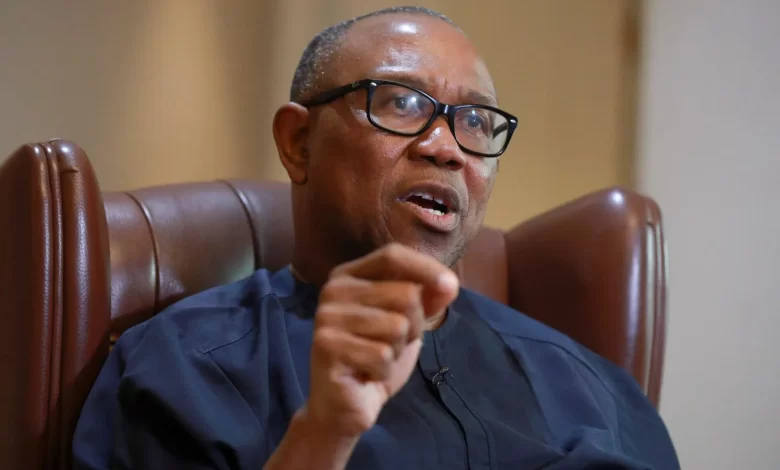
Former presidential candidate of the Labour Party, Peter Obi, has declared that he is best positioned to win the support of northern Nigeria ahead of the 2027 general elections, insisting that his plans for the region are unmatched.
Obi made this statement during an interview on a programme on Arise Television on Monday. In the interview, he spoke at length about his vision for Nigeria, with special focus on the northern region, which he described as the country’s greatest asset.
According to him, the North holds huge economic potential, especially in agriculture, and should be a major driver of Nigeria’s growth if properly developed.
“Nobody can do what I intend to do in the North. We will change the North. Our greatest asset as a country is in the North. We can make more money from agriculture than we make from oil,” Obi said.
His comments come at a time when political conversations around the 2027 elections are beginning to gather momentum, even though the last general election was held in 2023. Political analysts say early positioning by key figures shows that the next election cycle may be highly competitive.
Northern Nigeria, which includes states across the North-West, North-East and North-Central zones, has long played a major role in determining the outcome of national elections due to its large voting population. However, the region continues to face serious challenges such as insecurity, poverty, low school enrolment, and limited access to healthcare.
Obi’s focus on the North appears to be part of a broader strategy to expand his political base beyond the southern regions, where he enjoyed significant support in the last election. During the 2023 presidential race, Obi gained popularity among young voters and urban residents, but faced challenges in securing widespread support in parts of the North.
By promising to invest heavily in agriculture, Obi is aligning with long-standing calls for Nigeria to diversify its economy away from oil. Experts have often pointed out that the country’s overdependence on crude oil has made it vulnerable to global price changes, while sectors like agriculture remain underdeveloped despite their potential to create jobs and boost food security.
Obi’s remarks also touched on governance and democracy. He stressed the need for a stronger opposition, arguing that it is necessary for accountability and good governance.
“The government should protect the opposition. In fact, they should make opposition stronger and make it work,” he said.
His comments reflect ongoing concerns among political observers about the state of Nigeria’s democracy. In recent years, there have been debates about the strength of opposition parties and their ability to effectively challenge those in power.
A strong opposition is widely seen as important in a democratic system, as it helps to check the excesses of the ruling party, offer alternative policies, and ensure that leaders remain accountable to the people.
Obi, who previously served as governor of Anambra State from 2006 to 2014, has built a reputation around fiscal discipline and investment in education and health during his time in office. His supporters often point to his record as evidence of his ability to manage public resources effectively.
Since the 2023 elections, Obi has remained active in national discussions, frequently speaking on economic issues, governance, and national development. His latest comments suggest that he is preparing for another possible run in 2027, although he has not made any official declaration.
At the same time, addressing the challenges facing the North will require more than campaign promises. Issues such as insecurity, especially in the North-East and North-West, have affected farming and economic activities. Many farmers have been displaced, leading to reduced food production and higher prices across the country.
There are also concerns about education, with millions of children in the North out of school. Analysts say that any meaningful development plan for the region must tackle these problems directly.
Obi’s highlights on agriculture could be seen as an attempt to address both economic and social challenges at once. By creating jobs in farming and related industries, he believes the country can reduce poverty and improve stability.
As political activities slowly begin to build toward 2027, Nigerians are expected to hear more from key figures like Obi about their plans for the country. For now, his message is clear: he believes the future of Nigeria lies in unlocking the potential of the North—and that he is the one best prepared to do it.