
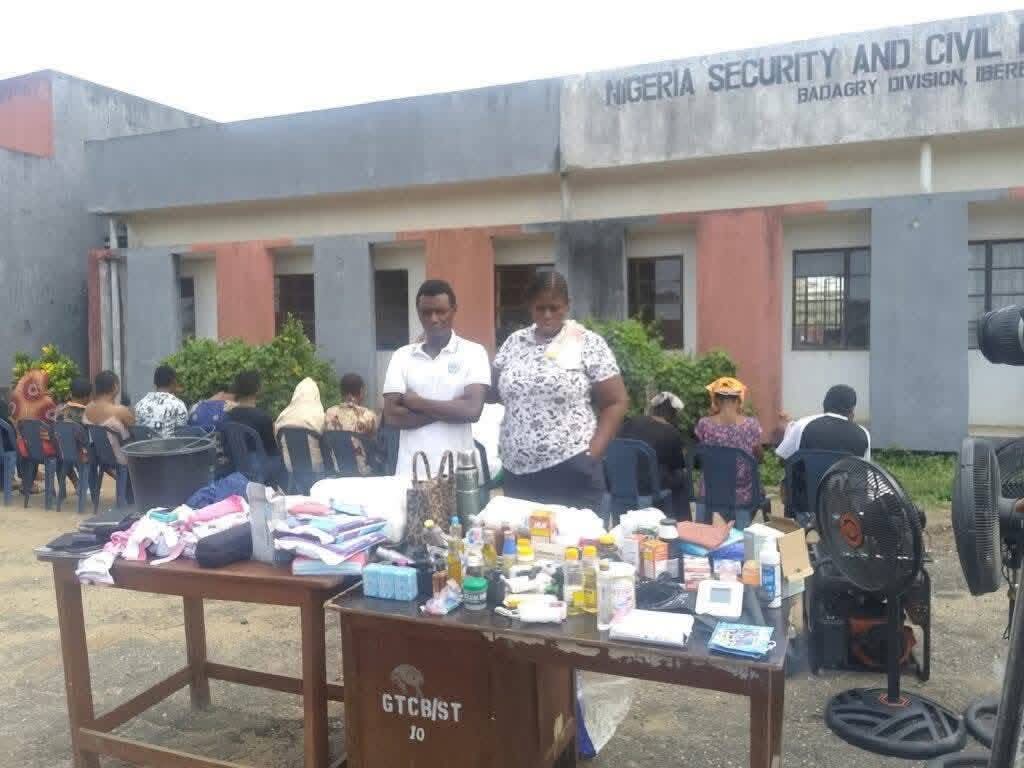
Operatives of the Nigeria Security and Civil Defence Corps, Lagos State Command, have uncovered a suspected baby factory in the Badagry area of Lagos, rescuing 18 pregnant women and 10 children in a late-night operation.
The raid, which took place on Wednesday night into the early hours of Thursday in Okuju, Ilado community, led to the arrest of two suspects identified as Joy Okeke and Raphael Agwu.
Authorities said the victims, mostly young women between the ages of 18 and 30, were lured to the facility through offers made on Facebook, where they were promised financial rewards in exchange for giving up their babies after delivery.
Speaking to journalists at the NSCDC office in Badagry on Friday, the Lagos State Commandant, Adedotun Keshinro, said the raid followed intelligence gathering that lasted for about three weeks.
According to him, operatives stormed a large residential building believed to have been used as a base for the illegal operation. Inside, they found several rooms housing pregnant women and children.
Keshinro described the operation as a major breakthrough in the fight against human trafficking and illegal adoption practices in the state.
“They are operating a baby factory where victims are made pregnant, and when the babies are delivered, they are sold,” he said.
He explained that some of the women were already pregnant before arriving at the facility, while others were allegedly influenced to remain and participate in the scheme.
Investigations revealed that the women entered into agreements with the operators. Under these arrangements, they would carry their pregnancies to term, after which their babies would be taken and sold to interested buyers.
In return, the women were reportedly paid between N500,000 and N1.8 million, depending on the terms of the agreement.
Among the rescued victims, one was said to have suffered a miscarriage, leaving 17 women still pregnant at the time of the raid. Authorities also found several babies and toddlers at the facility, some of whom were allegedly already being prepared for sale.
Disturbingly, some of the women had arrived at the centre with their own children, who were also reportedly being offered to potential buyers.
Items recovered from the building included a pumping machine, generator, cooking equipment, phones, mats, baby care products, and other household items, suggesting that the facility was set up for long-term accommodation.
During the parade of the victims, some of the women claimed that they were treated fairly in terms of feeding and basic care. They said they were allowed to use their phones and could request medical attention when needed.
However, they also revealed that they were not free to leave the premises at will.
One of the women said that although they could leave before delivery, doing so would mean forfeiting any payment.
Another victim explained that many of them agreed to the arrangement due to financial hardship and lack of support.
“They told us we would be taken care of, and when we give birth, we would be paid,” she said.
Speaking to journalists, the main suspect, Joy Okeke, denied any wrongdoing, claiming that the operation was simply a form of child adoption.
She said she moved to Badagry in January from Ikorodu in search of a larger space to continue her activities.
“We are adopting children to give to people who don’t have children,” she said.
However, she refused to provide further details about the operations or the financial arrangements, insisting that she would only speak in the presence of her lawyer.
Her alleged accomplice, Raphael Agwu, also defended the operation, arguing that it provided an alternative for women who might otherwise consider abortion.
According to him, many of the women were already pregnant before coming to the facility and had willingly agreed to give up their babies.
“There are online groups where people discuss adoption and unwanted pregnancies,” he said. “They come to us, and we take care of them until they deliver.”
Agwu added that the promise of financial compensation, often up to N1 million or more, attracted many of the women to the facility.
NSCDC Commandant Keshinro described the operation as a “grievous crime against humanity,” stressing that the suspects would face prosecution.
He said the case would be handed over to the police for further investigation and legal action, while the rescued victims would be transferred to the National Agency for the Prohibition of Trafficking in Persons for proper care and rehabilitation.
Keshinro also noted that the Lagos State Government would decide the fate of the building used for the illegal operation, including the possibility of demolishing it to prevent future use.
The discovery of the baby factory highlights an ongoing challenge in Nigeria, where illegal child trafficking and unregulated adoption practices continue to pose serious risks.
Baby factories, as they are commonly called, are illegal facilities where women are kept, often under questionable conditions, to produce children for sale.
These operations are driven by a mix of factors, including poverty, lack of access to reproductive health services, and high demand for adoption, especially among couples struggling with infertility.
Authorities have repeatedly warned that such practices violate human rights and expose both mothers and children to exploitation and abuse.
This case also draws attention to the role of social media platforms in facilitating illegal activities. Investigators said the victims were recruited through Facebook groups, where discussions about unwanted pregnancies and adoption take place openly.
As investigations continue, authorities are expected to track down other individuals who may be linked to the operation, including agents who allegedly referred victims to the facility.
The rescued women and children are expected to receive medical care, counselling, and support to help them reintegrate into society.
For many Nigerians, the incident is a reminder of the need for stronger enforcement of laws against human trafficking, as well as greater public awareness about the dangers of such schemes.
The NSCDC has urged members of the public to report suspicious activities in their communities, stressing that collective effort is needed to tackle crimes of this nature.