
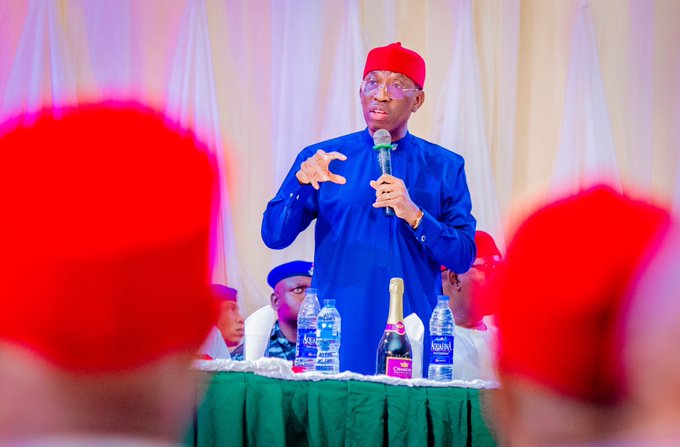
Former Delta State Governor, Ifeanyi Okowa, has spoken on the renewed agitation for the creation of Anioma State, saying that the proposed state remains firmly within the South-South geopolitical zone.
Okowa made his position known on Wednesday during a consultation meeting with political stakeholders in Oshimili South Local Government Area of Delta State. The meeting was part of his ongoing political engagements, which are also seen as preparations ahead of a possible return to the Senate.
The issue of Anioma State creation has been a long-standing political demand by people of Delta North Senatorial District. The area, commonly referred to as Anioma, is made up of nine local government areas and has continued to push for its own state within Nigeria’s federal structure.
At the centre of the renewed push is Senator Ned Nwoko, who has been actively championing the campaign for the creation of Anioma State. His advocacy has recently gained more public attention, sparking fresh debate within political circles in Delta State and beyond.
Okowa, while expressing support for the general idea of creating Anioma State, stressed that the process must be driven by the collective will of the people rather than individual interests or political ambition.
He warned against turning the agitation into a personal political project, saying such an approach could weaken the credibility of the demand and divide opinion among stakeholders.
According to him, any move toward state creation must reflect broad consultation and agreement across all communities in Delta North.
The former governor highlighted that the legitimacy of the demand should come from the grassroots, including traditional rulers, community leaders, political groups, and ordinary citizens across the nine local government areas that make up Anioma.
He noted that while the aspiration for a new state is understandable, it must be handled carefully and responsibly to avoid misunderstanding or unnecessary political tension.
The agitation for Anioma State is not new. It dates back several years and is part of a wider national conversation on state creation in Nigeria. Over time, various regions across the country have called for the creation of new states to address issues of marginalization, improve access to government, and bring development closer to the people.
Supporters of Anioma State argue that Delta North has remained underrepresented compared to other parts of Delta State. They believe that creating a separate state would help improve governance, increase political inclusion, and attract more development projects to the area.
They also argue that a new state would allow for better resource management and give the people more control over their local affairs.
However, critics of state creation in Nigeria often point to the financial burden of maintaining additional states, including the cost of governance, administrative structures, and public service funding.
Nigeria currently operates a federal system made up of 36 states and the Federal Capital Territory. Each state has its own government structure, including an executive, legislature, and judiciary, all of which require significant financial resources to run.
Despite these concerns, calls for new states have continued in different parts of the country, with proponents arguing that decentralisation can help improve development and reduce inequality.
Okowa’s remarks come at a time when political activities are gradually increasing ahead of future elections. His consultation meeting with stakeholders in Oshimili South is seen by many observers as part of efforts to maintain influence within the political landscape of Delta State.
By linking the Anioma State debate to the need for unity and consensus, Okowa appears to be urging caution in how the issue is being handled, especially in the political space.
His comments also highlight the delicate balance between regional aspirations and political interests, particularly in a diverse state like Delta, which is made up of multiple ethnic and cultural groups.
While he did not directly oppose the creation of Anioma State, his emphasis on collective agreement suggests a call for patience and wider consultation before any formal steps are taken.
The Anioma people, who are predominantly Igbo-speaking communities in Delta North, have long argued that their identity and development needs justify the creation of a separate state within the South-South region.
Okowa’s position that Anioma remains part of the South-South geopolitical zone is also significant, as there have been debates in the past about where the proposed state would be classified if created.
For now, the push for Anioma State continues to generate discussion among political leaders, community groups, and stakeholders across Delta State.
As the debate progresses, attention is expected to remain on key political figures and how they shape the direction of the movement.
What remains clear is that the demand for Anioma State is deeply rooted in long-standing aspirations for greater representation and development, even as political leaders differ on the best path forward.