
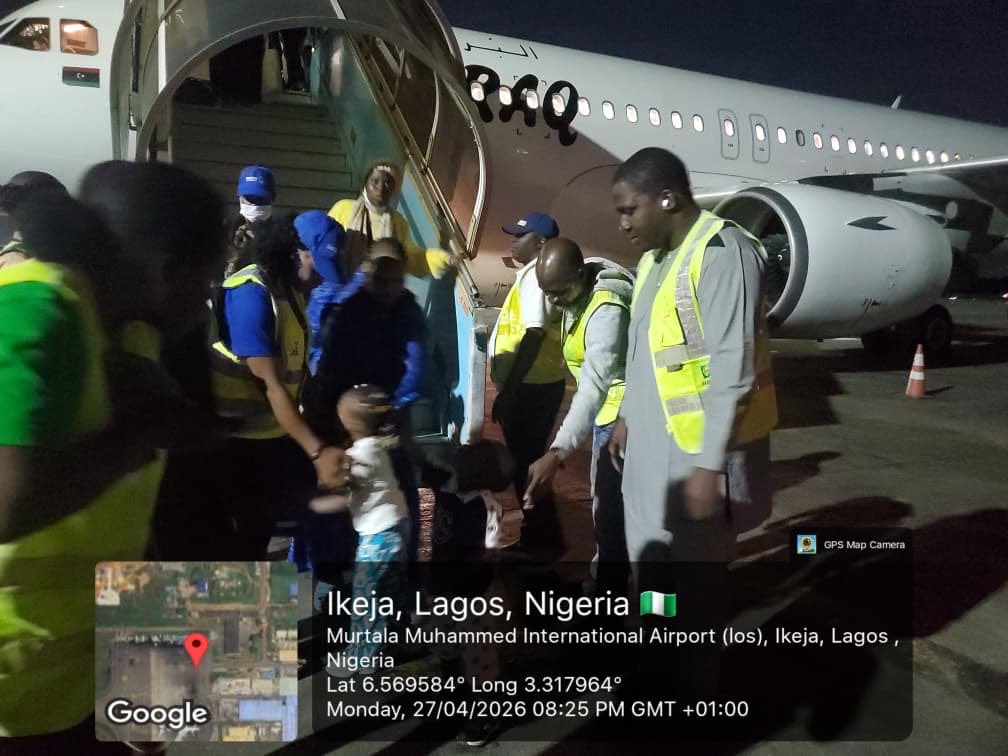
The National Emergency Management Agency (NEMA) has received 181 Nigerian returnees from Libya under an ongoing repatriation program aimed at bringing back stranded citizens.
The returnees arrived in Lagos from Tripoli, the Libyan capital, on the night of April 27, 2026, as part of the Assisted Voluntary Return programs coordinated by the International Organization for Migration (IOM) in partnership with the Federal Government of Nigeria.
In a statement released on Tuesday, NEMA said its Lagos Operations Office handled the reception of the returnees at the cargo terminal of the Murtala Muhammed International Airport, Ikeja.
The agency said the exercise was carried out in collaboration with the National Commission for Refugees Migrants and Internally Displaced Persons and other relevant stakeholders.
According to NEMA, the returnees arrived at about 8:13 p.m. aboard an Air Buraq Airline flight, marking another batch of Nigerians brought back from the North African country, where many have been stranded due to difficult living conditions and irregular migration challenges.
The breakdown of the returnees shows that 159 were adults, including 64 males and 95 females. The group also included 12 children, made up of five boys and seven girls, as well as 10 infants, consisting of six males and four females.
Officials of the Nigeria Immigration Service carried out biometric registration and documentation for the returnees upon arrival. This process, according to authorities, is necessary to maintain accurate records and support their reintegration into society.
NEMA stated that the returnees were provided with immediate humanitarian assistance as part of efforts to ensure a safe and dignified return. The support included food, clean drinking water, medical care, and ambulance services.
Other forms of assistance provided at the point of arrival included help with luggage, logistics support, counselling, and coordination services to prepare them for reintegration into their communities.
“The reception exercise was successfully conducted in an orderly manner through effective collaboration among relevant stakeholders,” the agency said.
The Assisted Voluntary Return program is an initiative designed to help migrants who are stranded abroad, especially in conflict zones or transit countries, to return home safely. It is supported by the IOM and implemented in partnership with national governments, including Nigeria.
Over the years, thousands of Nigerians have been repatriated from Libya and other countries under the program. Many of them had embarked on irregular migration journeys in search of better economic opportunities in Europe but ended up stranded in transit countries.
Libya has remained a major transit point for migrants attempting to cross the Mediterranean Sea into Europe. However, the country’s ongoing instability, combined with reports of abuse, exploitation, and poor detention conditions, has made it a dangerous destination for migrants.
Many Nigerian returnees have in the past shared stories of hardship, including lack of food, unsafe living conditions, and, in some cases, detention by local authorities or armed groups.
The Federal Government has repeatedly warned citizens against undertaking irregular migration, especially through dangerous routes across the Sahara Desert and the Mediterranean Sea.
Authorities say such journeys often expose migrants to serious risks, including human trafficking, forced labour, and even death.
To address the issue, the government, in collaboration with international partners, has stepped up awareness campaigns and reintegration programs aimed at supporting returnees.
These programs often include vocational training, financial support, and counselling to help returnees rebuild their lives and reduce the chances of re-migration.
Stakeholders say that while repatriation efforts are important, more needs to be done to address the root causes of migration, such as unemployment, poverty, and lack of opportunities for young people.
For many of the returnees, the journey home marks the end of a difficult chapter and the beginning of a new phase. However, successful reintegration remains a key challenge, as many returnees must start over with limited resources.
NEMA assured that it would continue to work with relevant agencies to provide support for Nigerians returning from abroad under such program.
The agency also emphasized the importance of coordinated efforts among government bodies, international organizations, and local communities in managing migration and supporting affected individuals.
As more Nigerians continue to be brought back under the Assisted Voluntary Return program, authorities say the focus remains on ensuring that the process is humane, organized, and beneficial to those involved.