
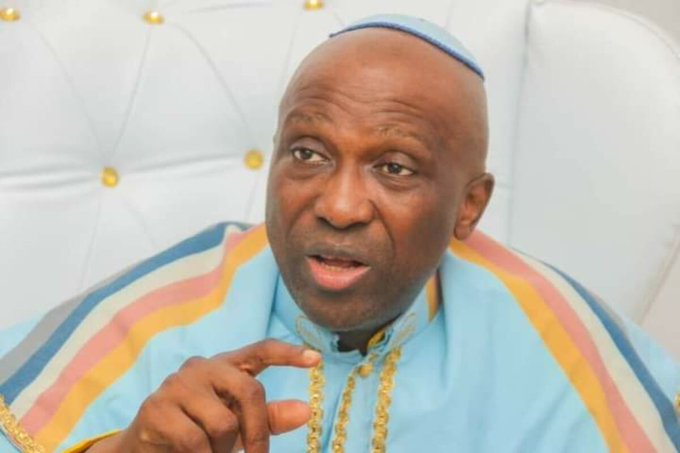
The leader of the INRI Evangelical Spiritual Church, Elijah Ayodele, has warned President Bola Ahmed Tinubu against continued borrowing to fund government projects, saying the country risks serious economic trouble if urgent steps are not taken.
In a statement released through his media aide, Osho Oluwatosin, the cleric expressed concern over what he described as frequent reliance on loans by the Federal Government. He argued that constant borrowing shows that Nigeria is not making proper use of its natural and economic resources.
Ayodele warned that if the trend continues, it could weaken the nation’s economy and place a heavy burden on future generations. According to him, Nigeria has enough resources across different states to support development without depending heavily on external loans.
“Stop borrowing money. We have resources in states like Taraba, Zamfara and others,” he said. “Nigeria will go on sale with the way Tinubu is going about borrowing money. The country will sink if we are not careful.”
Nigeria, Africa’s largest economy by population, has faced growing economic challenges in recent years. These include rising inflation, pressure on the naira, and increasing public debt. Successive governments have turned to both local and foreign borrowing to finance infrastructure projects, support budgets, and manage economic shocks.
Under the current administration, borrowing has remained part of the government’s strategy to fund key sectors such as roads, rail, power, and social programmes. Officials have often defended this approach, saying loans are necessary to close infrastructure gaps and stimulate economic growth.
However, concerns about Nigeria’s debt profile have continued to grow. Economic experts and institutions have warned that while borrowing is not unusual for developing countries, it must be done carefully to avoid long-term risks.
Primate Ayodele’s comments add to the voices calling for caution. He stressed that relying too much on loans without improving local production and revenue generation could create serious problems for the country.
He also claimed that Nigeria is already carrying a level of debt that may be difficult to fully repay. According to him, instead of increasing debt, the government should focus on using the country’s natural wealth to build a stronger economy.
“We are on a debt that can never be fully repaid, but we can use what we have to save the economy instead of these debts,” he said.
Nigeria is rich in natural resources, including oil, gas, solid minerals, and agricultural products. States like Taraba, Zamfara, and Kogi, as mentioned by the cleric, are known for their mineral deposits and farming potential. Experts have often pointed out that better management of these resources could boost government revenue and reduce dependence on borrowing.
Despite this potential, challenges such as insecurity, poor infrastructure, and weak regulation have limited the country’s ability to fully benefit from its resources. Illegal mining, for example, has been a major issue in some northern states, reducing government earnings and creating environmental problems.
Ayodele warned that if Nigeria continues on its current path, it could reach a point where lenders lose confidence in the country. This, he said, would make it harder to access funds when they are truly needed.
“The country is rich already; let us not get to a level where nobody would want to borrow from us money again,” he added.
In recent years, Nigeria’s debt has increased significantly. According to official figures, the country’s total public debt includes both domestic and external loans. While the government has maintained that the debt level is still manageable, critics argue that the cost of servicing these loans is taking up a large portion of national revenue.
This means that a significant part of government income is used to repay debts, leaving less money for essential services such as healthcare, education, and infrastructure. Analysts say this situation highlights the need for stronger revenue generation and better spending control.
The Tinubu administration has introduced several economic reforms since coming into office in 2023. These include the removal of fuel subsidy and efforts to unify exchange rates. The government says these policies are aimed at stabilising the economy and attracting investment.
However, such reforms have also led to increased cost of living for many Nigerians, making economic management a sensitive issue. Public opinion remains divided, with some supporting the reforms and others calling for more immediate relief measures.
Primate Ayodele’s warning reflects wider public concern about the direction of the economy. While religious leaders do not play a direct role in government policy, their statements often influence public debate, especially in a country where religion is an important part of daily life.
The cleric concluded his statement with a strong warning about the future. “Borrowing will kill the Nigerian economy; use resources in some of our states to make the country better,” he said.