
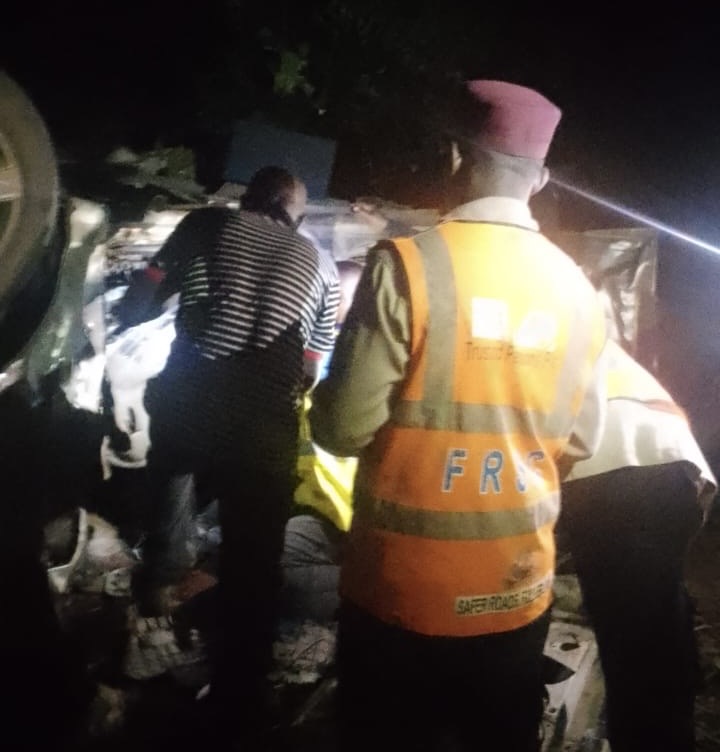
No fewer than 11 persons lost their lives on Sunday night in a tragic road accident at Eruku Bridge along the busy Abeokuta-Lagos Expressway in Ogun State.
The victims, said to be travelling in a gold Toyota vehicle with registration number GGE 722 KJ, died after the vehicle reportedly somersaulted and plunged off the bridge, trapping everyone inside.
Officials of the Federal Road Safety Corps said all the occupants of the vehicle died at the scene of the accident.
The crash has once again raised concerns over reckless driving, overloading and the growing number of fatal accidents on major highways across Nigeria.
Confirming the incident on Monday, the Ogun State Sector Commander of the FRSC, Corps Commander Oludare Ogunjobi, said emergency responders from the Itori Unit Command were immediately deployed to the scene after receiving distress calls.
In a statement issued through the command’s spokesperson, Odunsi Afolabi, the FRSC said the accident involved only one vehicle.
According to the statement, the vehicle lost control, somersaulted several times and fell off the bridge.
The impact of the crash reportedly caused the vehicle doors to lock, making it impossible for the occupants to escape.
“All 11 people on board, comprising 10 adult males and one adult female, lost their lives in the crash,” the statement said.
The FRSC explained that rescue operations were difficult because the victims were trapped inside the badly damaged vehicle.
Officials said FRSC personnel worked together with members of the local community to dismantle parts of the vehicle before the bodies could be recovered.
The corpses were later taken to the State Specialist Hospital morgue in Ifo.
Sector Commander Ogunjobi blamed the accident on dangerous driving practices, especially driving under the influence of alcohol and overloading.
He warned motorists against reckless behaviour on the road, stressing that many accidents could be avoided if drivers obey traffic regulations.
He also advised drivers using the Abeokuta-Lagos Expressway to be extra careful, especially at night when visibility is poor and fatigue often affects concentration.
The tragic incident has thrown families of the victims into mourning and added to the growing list of deadly road crashes recorded in different parts of the country in recent months.
The Abeokuta-Lagos Expressway is one of the busiest roads in the South-West, linking Ogun State to Lagos, Nigeria’s commercial capital. The road is used daily by commuters, commercial transport operators and haulage vehicles.
However, despite its importance, the highway has become notorious for accidents caused by speeding, poor vehicle maintenance, dangerous overtaking and driving under the influence of alcohol or drugs.
Residents and road users have repeatedly called on authorities to improve safety measures along the route, including better lighting, stronger law enforcement and improved road maintenance.
Overloading has also remained a major challenge, especially among commercial drivers trying to maximise profits amid rising fuel costs and economic hardship.
According to the FRSC, overloaded vehicles are harder to control and more likely to lose balance, particularly on bridges and sharp bends.
Driving under the influence of alcohol or drugs has also continued to contribute significantly to road crashes across Nigeria.
Safety officials have repeatedly warned that alcohol affects judgment, coordination and reaction time, increasing the chances of fatal accidents.
Data from the FRSC shows that thousands of Nigerians lose their lives yearly in road accidents, with speeding and human error responsible for a large percentage of the crashes.
In recent years, the agency has intensified public awareness campaigns, roadside patrols and enforcement operations aimed at reducing accidents on highways.
Despite these efforts, many Nigerians still ignore basic road safety rules such as wearing seat belts, avoiding overloaded vehicles and observing speed limits.
Sunday night’s tragedy has once again highlighted the urgent need for stricter compliance with traffic regulations and improved emergency response systems on Nigerian roads.
Some residents of communities around the accident scene described the crash as horrifying, saying the sound of the vehicle hitting the ground drew many people to the bridge area.
Witnesses said local residents joined rescue officials in efforts to save the victims, but all attempts failed because of the severe damage to the vehicle.
Community leaders have since appealed to the government to install stronger protective barriers on bridges along the expressway to reduce the risk of vehicles falling off during accidents.
They also called for increased patrol by road safety officials and security agencies, especially during late-night hours when many drivers engage in reckless driving.
Meanwhile, the FRSC has urged motorists to avoid speeding, drunken driving and overloading, reminding road users that safety must remain a shared responsibility.
The agency also advised travellers to ensure their vehicles are roadworthy before embarking on trips and to avoid unnecessary night journeys whenever possible.