
The Federal Character Commission (FCC) has announced plans to begin strict enforcement of sanctions against government institutions and agencies that violate recruitment rules aimed at ensuring fairness and equal representation across Nigeria.
The decision signals a tougher approach by the commission as concerns continue to grow over allegations of imbalance in federal appointments and employment processes.
The FCC said institutions found guilty of breaching recruitment guidelines could face penalties as authorities move to strengthen compliance with the principles of federal character.
The federal character policy was created to promote fairness in the sharing of opportunities among different states and regions of the country. It seeks to prevent domination of public institutions by any particular ethnic, regional or religious group.
The principle is recognised under Nigeria’s constitution and was introduced to encourage national unity and inclusiveness in government employment and appointments.
Over the years, however, controversies have repeatedly emerged over claims that some agencies fail to properly follow the rules during recruitment exercises.
Many Nigerians have often accused public institutions of favouritism, regional imbalance, political influence and lack of transparency in hiring processes.
The FCC’s latest position suggests the commission intends to move beyond warnings and begin actual punishment of defaulting agencies.
Officials reportedly expressed concern that repeated violations have weakened public trust and undermined the purpose of the federal character system.
According to the commission, recruitment into federal institutions should reflect Nigeria’s diversity and create equal opportunities for citizens regardless of background.
The agency stressed that public institutions must comply fully with approved procedures and avoid practices that unfairly favour certain regions or interests.
Observers say the announcement could affect recruitment patterns across ministries, departments and agencies if enforcement becomes more aggressive.
In recent years, several controversies have surrounded federal recruitment exercises.
There have been complaints from lawmakers, civil society groups and ordinary citizens who argued that some regions appear to receive more opportunities than others in certain government agencies.
At different times, accusations of secret recruitment, political influence and uneven distribution of jobs have generated public debate.
Critics argue that such concerns contribute to feelings of exclusion and dissatisfaction among citizens.
Supporters of stronger enforcement say fair recruitment remains important in a diverse country like Nigeria, where ethnic and regional balance often play sensitive roles in national politics.
Political analysts believe equal representation in government institutions can help reduce tensions and improve citizens’ sense of belonging.
However, others argue that merit should remain a major consideration alongside federal character principles to ensure competent staffing in public service.
The debate between merit and equal representation has remained one of Nigeria’s long-standing governance discussions.
Some experts believe both objectives can be balanced if recruitment systems become more transparent and professionally managed.
The FCC has repeatedly maintained that federal character is not designed to undermine competence but rather to guarantee fairness and inclusion.
Analysts say sanctions against violating agencies could include disciplinary measures, cancellation of recruitment processes or other administrative actions depending on the seriousness of violations.
However, details of how enforcement will work in practice are still expected to emerge.
Public sector recruitment remains highly competitive due to unemployment challenges across the country.
With millions of young Nigerians searching for stable jobs, federal employment opportunities often attract massive applications.
Because of this reality, allegations of unfair recruitment frequently trigger anger and frustration among job seekers.
Many graduates spend years searching for employment and often see government recruitment as one of the few reliable opportunities available.
As a result, concerns about transparency and fairness have remained major public issues.
Labour and governance experts say stricter oversight could help rebuild confidence if recruitment processes become more open and accountable.
They argue that citizens are more likely to trust public institutions when opportunities are distributed fairly.
Meanwhile, some stakeholders have called for stronger monitoring systems, including public disclosure of recruitment statistics and clearer accountability measures.
Civil society groups have also repeatedly advocated reforms aimed at reducing corruption and political interference in public hiring.
For the FCC, the planned sanctions may become a defining moment in determining how seriously government institutions take federal character compliance in the future.
The commission’s move also comes at a time when national conversations around equity, inclusion and representation continue to shape political discussions.
Whether the tougher enforcement strategy will bring lasting reforms remains uncertain, but many Nigerians are likely to watch closely as authorities begin implementing sanctions.
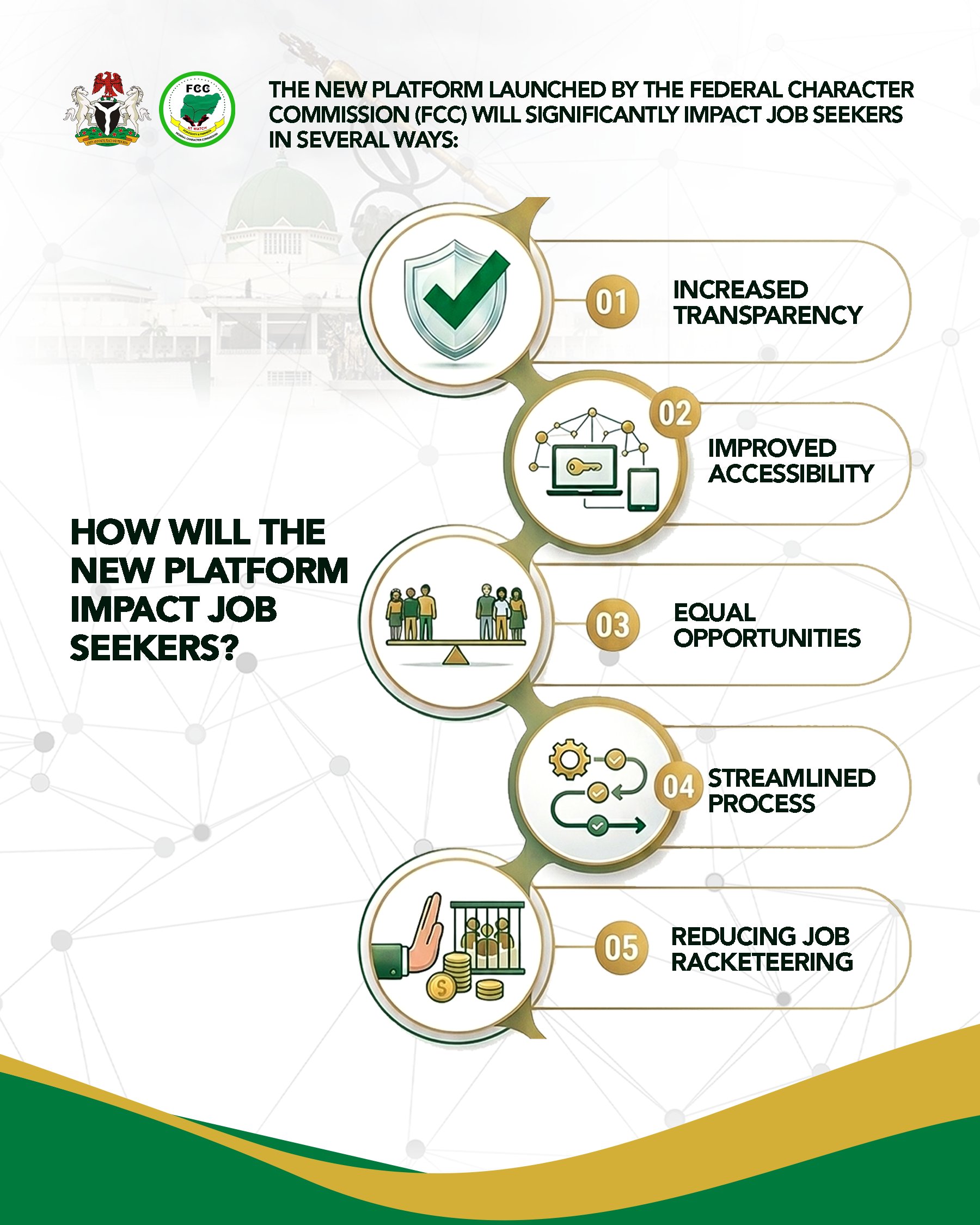
For job seekers and citizens concerned about fairness, the announcement may raise hopes that recruitment into federal institutions could become more transparent and balanced in the years ahead.