
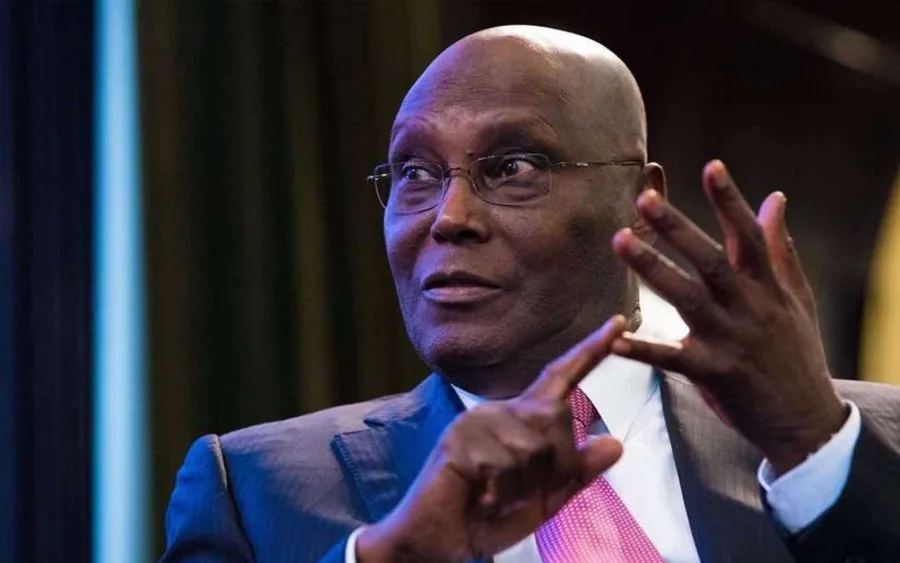
Former Vice President Atiku Abubakar has accused the administration of President Bola Ahmed Tinubu of worsening poverty and food insecurity in the country, saying Nigeria has now become a major hunger hot spot in Africa.
Atiku made the remarks on Monday while reacting to a recent United Nations report which warned that about 35 million Nigerians could face acute hunger in the coming months.
In a statement issued by his spokesperson, Phrank Shaibu, the former vice president described the situation as a “human tragedy” and blamed it on poor governance and economic policies under the current administration.
According to Atiku, the latest report reflects what he called a “catastrophic failure” of the Tinubu government in addressing the economic hardship facing millions of Nigerians.
“This is not just another alarming statistic to be debated on television panels and forgotten by the next news cycle. This is a human tragedy of terrifying proportions,” Atiku stated.
“That is more than the population of many African countries.”
The former presidential candidate further argued that the hunger crisis in Nigeria was not caused by natural disasters or war, but by policy failures and economic mismanagement.
“This is not a famine caused by drought. This is not a war-induced collapse. This is not an earthquake or a natural catastrophe. This is man-made suffering,” he added.
The comments come amid growing concerns over the rising cost of living, inflation, food prices, and worsening economic conditions across the country.
Since the removal of fuel subsidy and the floating of the naira by the Tinubu administration in 2023, prices of goods and services have increased sharply, putting pressure on households and businesses.
Many Nigerians have continued to complain about the high cost of food items, transportation, electricity, school fees, and healthcare services.
In markets across major cities including Lagos, Abuja, Kano, Port Harcourt, Ibadan, and Kaduna, prices of staple foods such as rice, beans, garri, yam, tomatoes, and cooking oil have remained high, forcing many families to reduce daily meals and spending.
Attacks by bandits, kidnappers, and armed groups in parts of the North-West, North-Central, and other food-producing areas have disrupted farming activities and reduced food supply in local markets.
Flooding in some agricultural regions has also affected crop production over the past two years.
The United Nations agencies and humanitarian organisations have repeatedly warned about worsening food insecurity in Nigeria, especially in conflict-affected states in the North-East where insurgency has displaced millions of people.
According to recent projections by humanitarian agencies, millions of vulnerable Nigerians may struggle to access adequate food between the middle of the year and the peak of the lean season.
Atiku said the latest figures should not be treated as ordinary political talking points, warning that the country was facing a serious social and humanitarian crisis.
The former vice president, who was the presidential candidate of the Peoples Democratic Party in the 2023 election, has consistently criticised the economic direction of the Tinubu administration.
Since leaving office as vice president in 2007, Atiku has remained one of the country’s most influential opposition figures and has repeatedly called for alternative economic strategies to address unemployment, inflation, and poverty.
Supporters of the government, however, argue that many of the current economic challenges were inherited from previous administrations and that reforms introduced by Tinubu are necessary for long-term economic recovery.
Government officials have defended the removal of fuel subsidy and foreign exchange reforms, saying the measures were needed to stabilise the economy and attract investment.
The administration has also introduced several intervention programmes aimed at reducing the impact of hardship on citizens, including student loans, food distribution schemes, cash transfers, and support for small businesses.
However, critics insist that the relief measures have not significantly improved the living conditions of ordinary Nigerians.
Labour unions, civil society organisations, and opposition parties have repeatedly called on the Federal Government to take urgent steps to reduce inflation, strengthen food production, and improve security in farming communities.
Public frustration has also increased in recent months as many workers struggle with rising transportation costs and declining purchasing power.
Some states have introduced temporary measures such as food subsidies and reduced transport fares to cushion the effect of economic hardship on residents.
Nigeria, Africa’s largest economy and most populous nation, has continued to face serious development challenges despite its oil wealth and large natural resources.
International organisations have repeatedly urged Nigerian authorities to invest more in agriculture, social protection programmes, infrastructure, and security to reduce poverty and hunger levels.
For many Nigerians, however, the immediate concern remains survival as the cost of daily living continues to rise.
Atiku’s latest criticism reflects the deepening political and public debate over the country’s economic direction and whether government policies are helping or worsening the hardship facing millions of citizens.
As concerns over food insecurity grow, many Nigerians are hoping for practical solutions that will bring down food prices, improve security, and provide relief for struggling households across the country.