
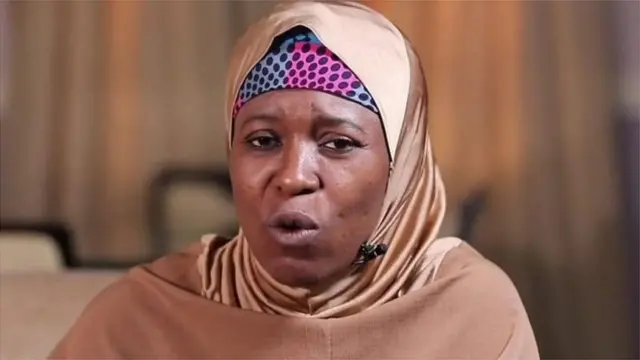
Prominent activist and politician, Aisha Yesufu, has broken her silence following the conclusion of the National Democratic Congress (NDC) primaries, insisting that she did not withdraw from the race for the Federal Capital Territory (FCT) Senatorial ticket and accusing party leaders of conducting a process that failed to meet expectations of fairness and transparency.
In a detailed statement released after the primaries, Yesufu said she remained in the contest until the very end and rejected suggestions that she stepped down before the exercise was concluded.
She also stated that although she disagreed with the conduct of the process, she would not challenge the outcome in court, choosing instead to move forward while sharing what she described as the truth about her experience.
“As the dust settles on the NDC primaries, I want to set the record straight: I did not quit, I did not drop out of the race. I stayed to the end,” she said.
The former Bring Back Our Girls campaigner explained that her decision to enter partisan politics was driven by a desire to move beyond advocacy and participate directly in the process of governance and policymaking.
According to her, meaningful change can only happen when people who believe in reform are willing to contest for positions where laws and public policies are made.
Yesufu said she was fully aware of the challenges associated with Nigerian politics before joining the race.
She noted that candidates who focus on principles and values often struggle in a political environment where influence, power structures and entrenched interests play major roles in determining outcomes.
Despite those realities, she said she entered the race determined not to compromise her beliefs.
“I did not leave advocacy to go into politics. I took advocacy into politics,” she declared.
The activist also used the statement to celebrate what she described as a successful grassroots campaign that attracted support from volunteers and residents across the FCT.
According to her, the campaign was built on direct engagement with communities rather than political deals negotiated behind closed doors.
She praised members of her volunteer network, known as SAY-Nation, for their efforts in mobilising support across the territory.
Yesufu said supporters moved from community to community, engaging residents in discussions about governance, accountability and representation.
She argued that the campaign’s growing popularity and grassroots acceptance made it a significant force during the primary process.
“Street by street, ward by ward, conversation by conversation, we built something real,” she said.
The activist expressed gratitude to volunteers, supporters and young people who believed in her candidacy and worked to promote her message across Abuja.
However, the most serious part of her statement focused on allegations regarding the conduct of the primary election itself.
Yesufu claimed that what was presented as a democratic primary election was, in reality, a process whose outcome had already been determined.
According to her, there were repeated postponements, venue changes and procedural decisions that created doubts about the credibility of the exercise.
She alleged that party guidelines were not followed and that changes were made to the method originally expected to be used in selecting the candidate.
The activist claimed that a delegate-based process conducted at a central location replaced what she said should have been a direct primary conducted across local government areas.
She further alleged that the eventual outcome was not determined through an open contest among delegates but through a closed-door affirmation process.
“What was billed as a primary was, in truth, a predetermined outcome dressed in procedural formalities,” she stated.
Yesufu acknowledged that the party would likely continue to defend the process and insist that the primaries were free and fair.
However, she maintained that her experience suggested otherwise.
She argued that the events surrounding the exercise did not reflect the principles of fairness, justice and transparency expected in a democratic contest.
Despite her criticism of the process, the activist ruled out taking legal action against the party.
According to her, pursuing a prolonged legal battle would not serve any useful purpose.
Instead, she said she preferred to learn from the experience and focus on future political engagements.
“I ran to win. But when the process was subverted, I made a choice: I would not exhaust myself in a grievance process designed to wear people down,” she said.
Yesufu explained that participating in the race gave her a deeper understanding of Nigeria’s political system than years of observation from outside politics could have provided.
She said the lessons gained from the experience were more valuable than any petition she might have filed.
The activist was careful to note that her comments related only to her experience in the FCT senatorial primary and should not be interpreted as a judgment on contests conducted in other states.
According to her, each state had its own political dynamics, and she could not speak authoritatively about events outside Abuja.
While criticising aspects of the primary process, Yesufu stopped short of condemning the NDC as a whole.
She said the party remains important because it has provided a platform for what she described as a stronger presidential alternative ahead of the 2027 general election.
The activist expressed appreciation to members of the party who are working to strengthen internal democracy and promote political change.
She argued that meaningful transformation requires efforts both inside and outside political institutions.
Her statement comes at a time when political parties across Nigeria are facing increased scrutiny over the conduct of internal elections and candidate selection processes.
Concerns about transparency, delegate manipulation, imposition of candidates and internal democracy have remained recurring issues in Nigerian politics for many years.
For Yesufu, however, the chapter appears to be less about the loss of a ticket and more about preserving the movement she believes was created during the campaign.
She insisted that the relationships, trust and grassroots support built during the race remain intact despite the outcome.
“This is not the end,” she said.
“What we built, the network, the credibility, the grassroots trust, cannot be taken away in a backroom.”
With the 2027 elections drawing closer and political activities gathering momentum across the country, her remarks are likely to fuel further debate about internal party democracy, electoral reforms and the future of opposition politics in Nigeria.
For now, Yesufu says she is leaving the contest with clarity rather than bitterness and remains convinced that a better future for Abuja is still possible.