
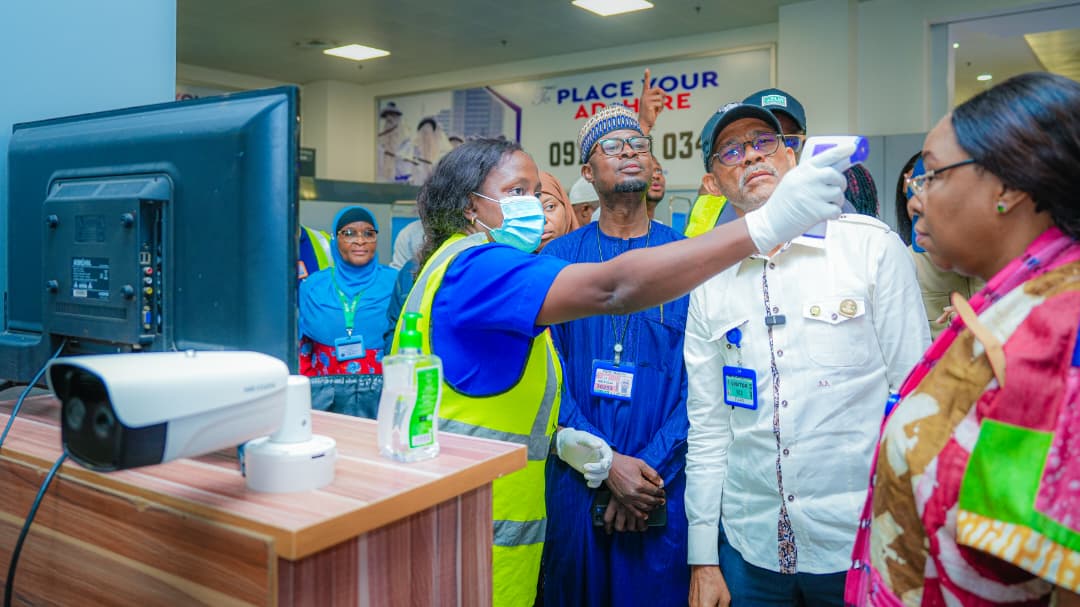
The Lagos State Government has intensified surveillance and preparedness measures at the Murtala Muhammed International Airport (MMIA) as concerns grow over the resurgence of Ebola Virus Disease (EVD) in parts of Central and East Africa.
The state government said stronger monitoring systems are necessary to prevent the deadly disease from entering Nigeria through international travellers, particularly as outbreaks continue to spread in some African countries.
Speaking during a high-level inspection and preparedness visit to MMIA on Sunday, the Commissioner for Health, Prof. Akin Abayomi, said Lagos was taking proactive steps to strengthen its biosecurity system and ensure the state remains prepared for any potential health threat.
Abayomi stressed that Lagos, as Nigeria’s commercial capital and busiest international gateway, could not afford to lower its guard.
He said authorities were considering measures that would reduce contact between passengers arriving from high-risk countries and other travellers while ensuring that airport operations continue smoothly.
According to him, the objective is to strengthen disease detection and response mechanisms without disrupting international travel.
The commissioner led a delegation that included the Special Adviser to the Governor on Health, Dr Kemi Ogunyemi; the Permanent Secretary of the Lagos State Ministry of Health, Dr Dayo Lajide; the Director of Epidemiology, Biosecurity and Global Health, Dr Ismail Abdus-Salam; and senior officials of the Lagos State Public Health Emergency Operations Centre.
The team was received by airport officials led by Airport Manager and Regional General Manager, South-West MMIA, Mr Olatokunbo Arewa, alongside representatives of the Federal Airports Authority of Nigeria (FAAN), the Nigeria Civil Aviation Authority (NCAA), Port Health Services and other agencies.
During the inspection, officials reviewed passenger movement systems, disease surveillance procedures, infection prevention protocols, emergency response plans and opportunities for closer collaboration between state and federal authorities.
Abayomi recalled Nigeria’s successful response to the Ebola outbreak of 2014, which began after an infected traveller arrived in Lagos from Liberia.
The outbreak, which initially raised fears of a major public health disaster, was eventually contained through aggressive contact tracing, surveillance and swift intervention by health authorities.
The commissioner described the containment of Ebola in 2014 as one of Nigeria’s greatest public health achievements.
He paid tribute to frontline health workers, including the late Dr Ameyo Adadevoh, whose actions played a major role in preventing the disease from spreading widely across the country.
According to him, the experience demonstrated the importance of preparedness and constant vigilance in a world where diseases can move rapidly across borders through international travel.
Abayomi warned that infectious diseases such as Ebola, COVID-19 and Lassa fever continue to pose serious risks because of increasing global mobility.
He noted that lessons learned during the COVID-19 pandemic helped strengthen collaboration between Lagos State and federal agencies operating at MMIA, leading to the development of more effective passenger surveillance systems.
The commissioner described MMIA as Nigeria’s most important entry point, handling nearly 70 per cent of international passenger traffic into the country.
Because of this strategic position, he said the airport remains the most likely route through which imported infectious diseases could enter Nigeria.
“Our objective is to create a bottleneck for the virus, not for passengers,” Abayomi said.
He explained that early detection, rapid isolation of suspected cases, safe evacuation procedures and improved digital monitoring of travellers from countries of concern remain top priorities.
The Special Adviser to the Governor on Health, Dr Kemi Ogunyemi, said disease prevention requires cooperation among all agencies operating at ports of entry.
She described airport workers as the first line of defence against imported diseases because they are often the first officials to come into contact with arriving passengers.
“The frontline actually begins here at our ports of entry. As passengers arrive, you are among the very first people to interact with them, making your role critical in our disease surveillance and response efforts,” she said.
Ogunyemi also conveyed the support of Governor Babajide Sanwo-Olu to airport personnel and described health security as an essential component of national security.
According to her, the threat posed by Ebola deserves the same level of urgency given to other major security challenges facing the country.
Permanent Secretary of the Ministry of Health, Dr Dayo Lajide, commended airport agencies for their cooperation and urged frontline workers to strictly observe infection prevention and control measures.
She said protecting airport personnel is critical because their safety directly affects the protection of travellers and the wider public.
Responding, Airport Manager Olatokunbo Arewa assured the delegation that MMIA remains committed to preventing the entry of Ebola into Nigeria.
He disclosed that airport authorities have begun deploying additional preparedness infrastructure, including touchless hand-sanitiser dispensers and temperature-monitoring equipment.
According to him, plans are also underway to strengthen passenger screening procedures.
Arewa revealed that authorities are considering dedicated arrival channels for passengers arriving from countries classified as high-risk.
He said the measure would improve monitoring and enable faster intervention whenever necessary.
“Ebola is a highly dangerous disease and any suspected case must be isolated quickly and professionally to prevent transmission,” he said.
The Head of Port Health Services at MMIA, Dr Lawal Abdullahi, disclosed that the airport reviewed and updated its Public Health Emergency Contingency Plan on March 18, 2026, before the latest Ebola developments in Africa.
He said the Airport Public Health Emergency Management Team has already been activated and that a comprehensive risk assessment has been carried out to identify countries of concern and guide surveillance activities.
According to Abdullahi, passenger screening systems were already in operation before the activation of the national health declaration platform, while information collected from travellers is routinely shared with Lagos State surveillance teams.
He added that discussions are ongoing to improve access to passenger data to strengthen contact tracing and monitoring where necessary.
Also speaking, the Aeromedical Assessor of the NCAA, Dr Abayomi Asunbo, said airlines operating designated international routes have been directed to comply strictly with public health regulations before passengers are admitted into Nigeria.
Similarly, the General Manager of Aviation Medical Services at FAAN, Dr Bilkis Ibrahim, disclosed that additional personal protective equipment, health awareness materials and staff training programmes are being deployed across the airport system.
The Head of Medical Services at MMIA, Dr Uche Ofoegbu, said awareness campaigns have also been intensified to ensure that airport workers understand their responsibilities in disease detection, infection prevention and emergency response.
The renewed alert comes as the World Health Organisation (WHO) reports a growing Ebola outbreak linked to the Bundibugyo virus strain in the Democratic Republic of the Congo and Uganda.
According to WHO, as of May 27, about 906 suspected cases and 223 deaths among suspected cases had been recorded in the Democratic Republic of the Congo.
The organisation also reported that as of May 29, a total of 134 confirmed cases, including nine in Uganda, and 18 confirmed deaths had been recorded across both countries.
WHO further disclosed that one confirmed case involved a United States citizen who treated patients in the Democratic Republic of the Congo and is currently receiving treatment in Germany.
Despite the developments, the Nigeria Centre for Disease Control and Prevention (NCDC) has maintained that there is currently no confirmed Ebola case in Lagos or anywhere in Nigeria.
However, health authorities insist that vigilance, surveillance and cooperation among agencies remain essential to preventing the importation and spread of the disease as outbreaks continue to evolve elsewhere on the continent.