
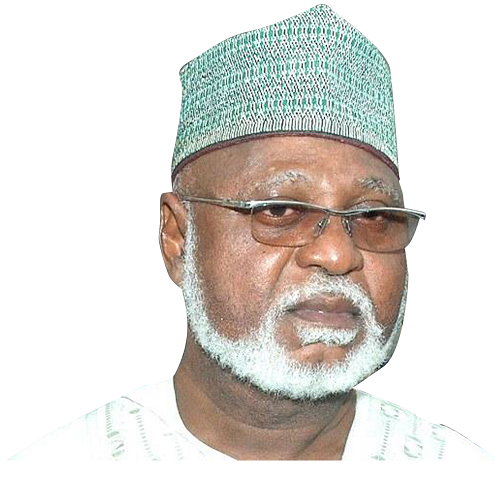
Former Nigerian military Head of State, General Abdulsalami Abubakar (rtd), is today marking his 84th birthday, drawing renewed attention to his historic role in Nigeria’s return to democratic rule in 1999.
Born on June 13, 1942, in Minna, Niger State, Abubakar rose from humble beginnings to become one of Nigeria’s most influential military officers and later a key figure in the country’s political transition from military rule to civilian governance.
He served as Nigeria’s Head of State between 1998 and 1999, following the sudden death of General Sani Abacha, and before that, he held the position of Chief of Defence Staff from 1993 to 1998.
His brief but highly significant leadership period is widely remembered for overseeing the end of decades of military rule and paving the way for Nigeria’s Fourth Republic.
Abdulsalami Abubakar is from the Hausa ethnic group. He was born to Abubakar Jibrin and Fatikande Mohammed in Minna.
His early education began at Minna Native Authority Primary School, where he studied from 1950 to 1956. He later attended Government College, Bida, between 1957 and 1962.
In 1963, he furthered his technical education at Kaduna Technical College, where he studied for a short period before joining the Nigerian Army, a decision that would shape the rest of his life and career.
Abubakar rose steadily through the ranks of the Nigerian Army during a period marked by political instability and repeated military interventions in governance.
Nigeria had been under military rule for many years following the 1983 coup led by General Muhammadu Buhari, which removed the civilian government of President Shehu Shagari. Although elections were attempted in 1993, they were annulled by the military regime of General Ibrahim Babangida, deepening political tensions across the country.
During this turbulent period, Abubakar served in key military positions, including as Chief of Defence Staff, a role he held from 1993 until 1998.
Abubakar was not originally expected to become Nigeria’s leader. However, following the sudden death of General Sani Abacha in June 1998, he was sworn in as Head of State on 9 June 1998.
He reportedly assumed office with some hesitation, but quickly moved to stabilize the country and restore public confidence after years of political uncertainty.
One of his first actions was to declare a week-long national mourning period in honour of Abacha.
Perhaps the most defining aspect of Abubakar’s leadership was his decision to return Nigeria to democratic governance within a short time frame.
Shortly after assuming office, he promised Nigerians that elections would be held within one year and that power would be handed over to a civilian government.
To achieve this, he established the Independent National Electoral Commission (INEC) and appointed former Supreme Court Justice Ephraim Akpata as its chairman.
INEC was tasked with organising a full electoral process, beginning with local government elections in December 1998, followed by state assembly and governorship elections, then National Assembly elections, and finally the presidential election held on 27 February 1999.
Although international observers acknowledged efforts to improve transparency, the elections were not without challenges. Reports of irregularities were recorded in several parts of the country, and some critics questioned the credibility of parts of the process.
However, many Nigerians and international partners still viewed the transition as a major step forward after years of military rule.
One of the most significant moments in Nigeria’s modern political history came on 29 May 1999, when General Abdulsalami Abubakar handed over power to Olusegun Obasanjo, who had been elected president.
The peaceful transition marked the beginning of Nigeria’s Fourth Republic and ended almost two decades of continuous military dominance in governance.
Abubakar’s decision to voluntarily hand over power surprised many critics who had long doubted the military’s willingness to relinquish control.
After completing the transition process, he retired from the Nigerian Army.
Since leaving office, Abdulsalami Abubakar has remained active in national and international peace efforts.
He currently serves as Chairman of the National Peace Committee, a body made up of respected statesmen and religious leaders who work to promote peaceful elections and resolve political disputes in Nigeria.
The committee has played a key role in mediating during tense election periods and encouraging political leaders to commit to peaceful conduct.
Abubakar is widely respected both within Nigeria and internationally for his role in stabilising the country during a critical period and guiding it back to democratic rule.
As he turns 84, many Nigerians continue to reflect on his legacy as a military leader who chose a peaceful exit from power at a time when many feared a prolonged military rule.
Although his time as Head of State was brief, his impact on Nigeria’s political direction remains significant.
From his early life in Minna to his rise as a military general and eventually a transitional Head of State, Abdulsalami Abubakar’s journey reflects a life deeply tied to Nigeria’s modern history.
As celebrations mark his 84th birthday, his role in shaping Nigeria’s return to democracy continues to stand as a defining chapter in the country’s political evolution.