
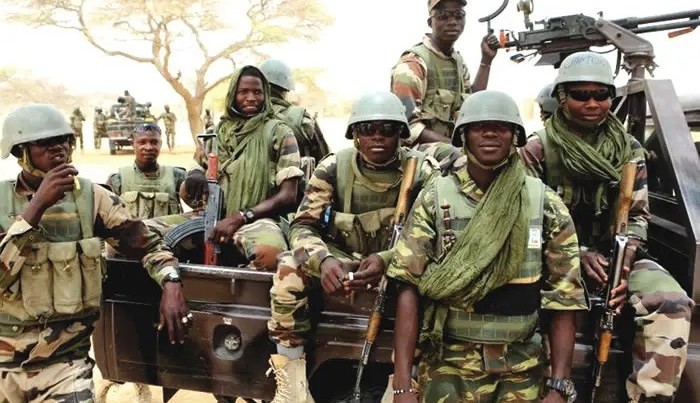
Troops of the Nigerian Army have killed a suspected fighter of the Islamic State West Africa Province (ISWAP) during a night ambush operation in Konduga Local Government Area of Borno State.
The operation, which took place in the early hours of June 15, also led to the recovery of food supplies believed to have been meant for insurgents operating in the area.
Security sources said the successful mission formed part of ongoing military efforts to cut off supply routes and disrupt the movement of terrorist groups across the North-East.
According to the sources, troops of the 222 Battalion (Mechanised) carried out the operation at about 12:15 a.m. after receiving intelligence on the activities of suspected insurgents.
The soldiers reportedly laid an ambush at a suspected terrorist crossing point in Yaleri Kurma Village, an area believed to be frequently used by insurgents moving between communities.
The troops later encountered the suspects, leading to an exchange of fire.
Security analyst and counter-insurgency expert, Zagazola Makama, who cited military sources, said one suspected ISWAP member was killed during the encounter.
“The troops reportedly engaged the insurgents during the operation, leading to the killing of one suspected ISWAP member,” Makama stated.
The remaining suspects were believed to have escaped into nearby bushes under the cover of darkness.
Following the operation, soldiers conducted a search of the area and recovered several items suspected to have been intended for insurgent fighters.
Items recovered included two bags of flour, 12 packs of 500-gram salt and 10 packs of spaghetti.
Military sources said the food items were likely meant to sustain terrorists operating within the area and may have been transported through local supply networks.
The recovered materials have since been taken into military custody for further investigation and analysis.
Authorities are expected to determine the origin of the supplies and identify those involved in transporting them to the insurgents.
Military officials said the operation aligns with broader efforts aimed at denying terrorist groups access to logistics support, which has remained critical to their survival.
Over the years, the military has increasingly focused not only on direct combat operations but also on targeting the supply chains that enable insurgent groups to sustain their activities.
By intercepting food items, fuel, medicines and other supplies, security forces hope to weaken the operational capabilities of terrorist organisations.
“The operation is part of sustained efforts to block food supply chains and movement corridors used by terrorist groups in the region,” the sources said.
Importantly, the military reported that the operation ended without any casualties among the troops involved.
“The operation reportedly ended without any casualties on the side of the troops,” Makama added.
The latest success comes as the military intensifies operations against terrorist groups in the North-East, particularly in Borno State, which has remained the epicentre of insurgency in Nigeria for more than a decade.
Borno has witnessed repeated attacks by Boko Haram and its splinter group, ISWAP, resulting in thousands of deaths and the displacement of millions of people.
Although security forces have recorded several gains in recent years, pockets of insurgent activities continue to pose threats to communities and military formations.
ISWAP emerged after a faction split from Boko Haram in 2016 over ideological and leadership disagreements.
The group has since become one of the most active extremist organisations in the Lake Chad region, carrying out attacks on civilians, humanitarian workers and security personnel.
Unlike conventional military groups, insurgents often rely on informal support networks and hidden routes to move food, ammunition and other necessities through remote communities.
Cutting off supplies can significantly reduce the ability of insurgents to launch attacks and maintain their presence in affected areas.
In recent months, the Nigerian military has sustained offensive operations through coordinated ground assaults, ambushes and air strikes targeting terrorist hideouts across the North-East.
The operations have led to the killing of several insurgents, the arrest of suspects and the recovery of weapons and logistics materials.
However, experts have also urged authorities to complement military action with intelligence gathering, community engagement and humanitarian interventions to address the underlying factors that fuel insurgency.
For residents of Borno and neighbouring states, every successful operation offers renewed hope that peace may eventually return to a region that has endured years of violence and uncertainty.
The latest ambush in Konduga demonstrates the military’s continued determination to deny terrorists freedom of movement and access to supplies.