
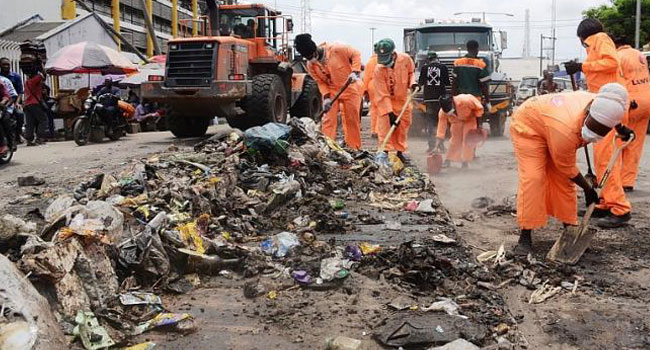
Lagos State Governor, Babajide Sanwo-Olu, has ordered the immediate evacuation of refuse heaps that have accumulated in parts of the state, as the government moves to address growing concerns over waste management in Nigeria’s commercial capital.
The governor announced the directive in a statement posted on his official Facebook page on Thursday, assuring residents that urgent steps were being taken to clear the backlog of waste and restore cleanliness across affected communities.
According to Sanwo-Olu, relevant government agencies have been directed to intensify waste evacuation operations in areas where heaps of refuse have become a source of concern to residents.
He said the Lagos Waste Management Authority (LAWMA), the Lagos State Environmental Protection Agency (LASEPA), and the Ministry of the Environment and Water Resources had already begun coordinated efforts to tackle the situation.
“I have directed the relevant agencies to immediately scale up waste clearance operations in affected areas,” the governor stated.
He disclosed that additional trucks and personnel had been deployed to support ongoing evacuation exercises and speed up the removal of refuse from various parts of the state.
The governor expressed confidence that residents would soon begin to notice improvements as the intensified clean-up operations continue.
“We understand the inconvenience this situation has caused residents, and we are committed to addressing it as quickly as possible,” he said.
The recent build-up of refuse in several Lagos communities had sparked complaints from residents, many of whom expressed fears over the possible health and environmental implications of the situation.
In some neighbourhoods, overflowing waste bins and refuse heaps were reportedly left unattended for days, leading to unpleasant odours and concerns about blocked drainage systems, especially during the rainy season.
Lagos, Nigeria’s most populous city and economic hub, faces one of the biggest waste management challenges in Africa due to its rapidly growing population and expanding urban communities.
Sanwo-Olu acknowledged the enormous task involved in keeping the state clean, noting that Lagos generates more than 13,000 tonnes of waste every day.
He said handling such a huge volume of refuse requires substantial resources, effective planning and the continuous commitment of both government agencies and residents.
“Lagos generates over 13,000 tonnes of waste daily. Managing this volume requires significant resources and sustained efforts,” the governor said.
He, however, assured Lagosians that the state government remained fully committed to overcoming the challenge and improving environmental conditions across the state.
The governor’s intervention comes amid renewed public conversations about the effectiveness of waste collection systems in Lagos.
Over the years, successive administrations in the state have introduced various reforms aimed at improving sanitation and strengthening waste management structures.
LAWMA remains the primary agency responsible for coordinating waste collection and disposal in Lagos. The agency works with Private Sector Participants (PSPs), which are licensed waste operators assigned to collect refuse from households and businesses across the state.
However, the waste management system has occasionally come under pressure due to factors such as population growth, increasing waste generation, traffic congestion affecting evacuation schedules, equipment shortages and poor disposal practices by some residents.
In 2017, the state government attempted to restructure the waste management system through a new initiative that sought to centralise waste collection. The move generated controversy and legal disputes before the government eventually returned to the PSP arrangement.
Since then, authorities have continued efforts to improve the sector through investments in infrastructure, public awareness campaigns and stronger environmental enforcement.
The onset of the rainy season often places additional pressure on waste management operations.
Environmental officials frequently warn residents against dumping refuse in canals, drainage channels and along road medians, as such practices can obstruct the free flow of water and worsen flooding.
Flooding remains a recurring challenge in many parts of Lagos, with blocked drains identified as one of the major contributing factors.
Against this backdrop, Sanwo-Olu appealed to residents to play their part in maintaining a cleaner environment.
He urged Lagosians to dispose of their waste responsibly and avoid practices that undermine the government’s sanitation efforts.
The governor specifically cautioned residents against dumping refuse on roadsides, open spaces and drainage channels.
According to him, achieving a cleaner Lagos requires cooperation between the government and the people.
“We all have a role to play in keeping our environment clean and safe. Residents should support ongoing efforts by disposing of waste properly and refraining from illegal dumping,” he said.
He reiterated his administration’s commitment to protecting public health and ensuring that Lagos remains a safe and attractive place to live and do business.
The governor added that environmental cleanliness is not only important for the image of the state but also essential for the wellbeing of millions of residents who call Lagos home.
As evacuation efforts continue across affected communities, residents are expected to monitor improvements while authorities sustain the intensified operations aimed at restoring normalcy.
For many Lagosians, the government’s latest intervention offers hope that the growing refuse heaps will soon disappear and those stronger measures will be put in place to prevent a recurrence.
With a population estimated at more than 20 million people and thousands of tonnes of waste generated daily, experts say effective waste management will remain one of the defining challenges of governance in Lagos.