
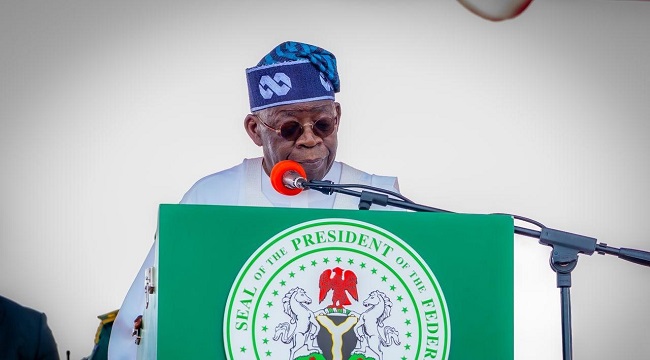
President Bola Ahmed Tinubu has said Nigeria’s economy is recording steady and meaningful progress despite the hardship experienced by many citizens following the economic reforms introduced by his administration.
The President said the reforms, though difficult, were beginning to lay a strong foundation for long-term economic growth and stability. He insisted that his government would continue with policies aimed at improving revenue generation, strengthening public finances and making Nigeria more competitive in the global economy.
Tinubu spoke on Wednesday while receiving a delegation from Deloitte Africa, led by the firm’s Chief Executive Officer for Africa, Ruwayda Redfearn, at the Presidential Villa in Abuja.
The meeting was attended by the Minister of Finance and Coordinating Minister of the Economy, Wale Edun, the Chairman of the Nigeria Revenue Service, Dr Zacch Adedeji, the Chairman of the Presidential Fiscal Policy and Tax Reforms Committee, Taiwo Oyedele, and other senior government officials.
Details of the meeting were contained in a statement issued by the President’s Special Adviser on Information and Strategy, Bayo Onanuga, titled “Our Economy Is On Steady Growth, Says President Tinubu To Deloitte Africa.”
Speaking during the meeting, Tinubu defended the economic reforms introduced since he assumed office in May 2023, saying they were necessary to correct long-standing structural problems in the Nigerian economy.
The President admitted that the reforms had brought temporary hardship to many Nigerians but maintained that they were already producing positive results.
“Yes, reforms are difficult. It has not been a McDonald’s customer relationship but a harvester of good things, if implemented well, and that is what we are about,” Tinubu said.
“The reforms on revenue will continue to stimulate growth. And the effect of the reform? Yes, some issues are difficult, taking the bitter medicine, but it is working well.
“For the economy, Nigeria is making serious foundational progress.”
Tinubu said the reforms had strengthened the country’s fiscal position, improved revenue generation and repositioned financial institutions to support sustainable growth.
According to him, the administration is laying the foundation for an economy that will attract more investment, create jobs and make Nigeria more relevant in international markets.
Since taking office, Tinubu’s administration has introduced several major economic reforms. These include the removal of petrol subsidy, the unification of the foreign exchange market, tax reforms and measures aimed at increasing government revenue.
While the reforms have been praised by many international financial institutions and development partners, they have also triggered rising inflation, higher transport costs and increased prices of food and other essential goods, leading to widespread concerns among Nigerians over the cost of living.
The President, however, maintained that the difficult period was necessary to secure long-term economic stability.
During the meeting, Tinubu also reflected on his early professional career in accountancy, recalling his connection with Deloitte.
“The family of Deloitte, you just reminded me of my cradle years in accountancy and where I cut my childhood accounting teeth in Chicago,” he said.
“Deloitte has a good training program, and I believe you will continue to reflect that.”
The President urged Deloitte to increase its investment in Nigeria by recruiting and training more young Nigerians.
He said the country’s youthful population remains one of its greatest assets and called on global firms to support efforts aimed at developing the skills needed to compete in the modern global economy.
Tinubu stressed that building human capital would help sustain the country’s economic transformation and create opportunities for millions of young people.
Responding on behalf of the delegation, the Chief Executive Officer of Deloitte West Africa, Yomi Olugbenro, commended the Federal Government for the reforms already implemented.
He said the firm believed that the administration had laid a solid foundation for economic recovery and growth.
According to him, the next challenge is ensuring that the benefits of the reforms are felt by ordinary Nigerians.
“We do what we do because of the philosophy that our Africa CEOs talk about, making an impact that matters,” Olugbenro said.
“Where we are at the moment, we believe that the ground has been solidly laid. There is a need to truly extract more value and deliver the dividends of democracy to ordinary Nigerians on the street.
“The bigger work is really about how to cascade some of those big reforms further down.”
Olugbenro assured the President that Deloitte was ready to support Nigeria by sharing experiences gained from assisting governments across the world with economic reforms.
“We have use cases, examples and experiences of how we supported nations all around the world, so Nigeria will definitely benefit from those experiences,” he said.
“That is why we are here, and we welcome the invitation as to where exactly you want us to support you.”
He said Deloitte would continue to work with the Nigerian government in areas where its global expertise could contribute to economic growth, public sector efficiency and improved governance.
Speaking during the meeting, Taiwo Oyedele also highlighted the importance of investing in Nigeria’s young population.
He urged Deloitte to make youth development and skills acquisition a major part of its engagement in Nigeria, describing it as one of the most valuable contributions the firm could make to the country’s future.
According to him, equipping young Nigerians with modern skills will help prepare them for emerging opportunities in the global economy while supporting the government’s efforts to reduce unemployment and promote inclusive growth.
The removal of fuel subsidy has saved the government trillions of naira previously spent on petrol imports, while efforts to reform tax administration are expected to improve revenue collection and reduce dependence on borrowing.
However, the reforms have also contributed to a sharp increase in inflation, with food prices and transportation costs rising significantly over the past two years. Many households and businesses continue to struggle with the higher cost of living, prompting calls for stronger social support measures.
The Federal Government has responded by introducing palliative programs, student loan schemes, support for small businesses and agricultural initiatives aimed at boosting food production and reducing inflationary pressure.
International organisations, including the International Monetary Fund and the World Bank, have welcomed many of the reforms, saying they could place Nigeria on a stronger economic path if sustained. They have, however, urged the government to strengthen social protection programs to cushion the impact on vulnerable citizens.
Tinubu reiterated that his administration remains committed to implementing reforms that will deliver long-term prosperity despite the short-term challenges.
He expressed confidence that as the policies continue to take effect, Nigerians would begin to experience greater economic stability, improved investment, increased job opportunities and stronger national growth.