
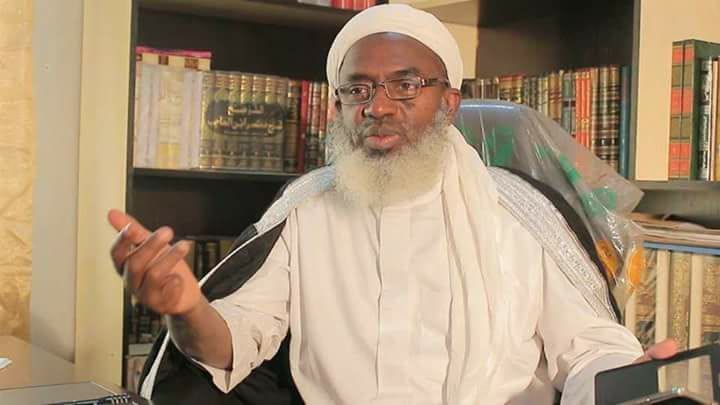
Islamic cleric, Sheikh Ahmad Gumi, has defended Plateau-based cleric, Sheikh Yahya Jingir, over his support for the continued adoption of Muslim-Muslim presidential tickets ahead of the 2027 general elections.
Gumi said Jingir should be excused for his position, arguing that the cleric operates in an environment where Muslims face what he described as excessive religious bigotry.
He made the comments in a Facebook post on Monday while reacting to the controversy generated by Jingir’s recent call for continued support for Muslim-Muslim presidential tickets.
“Shiekh Jingir should be excused for his extreme view in politics, he dwells in the eye of the storm of excessive bigotry against Islam,” Gumi wrote.
Jingir had recently praised President Bola Tinubu for choosing a Muslim running mate in the 2023 presidential election and urged Muslims to continue supporting the arrangement ahead of the 2027 elections.
The Muslim-Muslim ticket became one of the major issues in the build-up to the 2023 presidential election, with the decision by the All Progressives Congress, APC, to field Tinubu, a Muslim from the South, alongside Kashim Shettima, a Muslim from the North, generating strong reactions across the country.
Supporters of the arrangement argued that competence and political representation should be given priority over religious identity.
Critics, however, expressed concern that the decision could deepen religious division in a country with a large Christian and Muslim population.
The issue remains politically sensitive as parties and politicians prepare for the 2027 elections.
Jingir’s recent comments have therefore attracted renewed attention, particularly because of his influence among Muslims in Plateau State and his public involvement in national political discussions.
Gumi, while defending Jingir, said religious sentiments were not limited to one side of Nigeria’s political divide.
He argued that politicians in the opposition also use religion as a tool for political mobilisation and to attract votes.
“Just recently a mere Muslim VC in Plateau State is stirring controversy. On the other hand, the opposition is not also free from using religion to garner votes,” he said.
Gumi’s comments appeared to call for a broader examination of the role of religion in Nigerian politics rather than focusing only on Jingir’s position.
The cleric urged politicians and religious leaders to avoid bringing religious differences into political contests.
He warned that religion should not become a tool for political competition in a country with different faiths and ethnic groups.
“In a multi-religious entity, religion should not be dragged into the quagmire of dirty politics,” he said.
Nigeria is a deeply religious country, with Islam and Christianity being the two major faiths. Religious identity has often played a role in political discussions, particularly when political parties select candidates for major offices.
The debate over presidential tickets has become more intense in recent election cycles, with political parties facing pressure to balance regional, ethnic and religious interests.
In 2023, the APC’s decision to field two Muslims on its presidential ticket broke with the informal practice of balancing the two major religions at the presidential and vice-presidential levels.
Tinubu defended the choice during the campaign, arguing that the decision was based on political considerations and the suitability of his running mate.
His supporters also said religious identity should not be used to determine a candidate’s ability to govern.
Opponents, however, argued that the decision failed to reflect Nigeria’s religious diversity and could make some sections of the country feel excluded.
The debate over the ticket continued after the election and has now resurfaced ahead of 2027.
Jingir’s recent comments supporting the arrangement have placed him at the centre of the latest controversy.
The cleric reportedly praised Tinubu’s decision and urged Muslims to support a similar arrangement in future elections.
Gumi’s response indicates that there are different views among Muslim leaders about how religion should feature in politics.
While defending Jingir’s position, Gumi also warned against the wider use of religion for political purposes.
His comments suggested that both the ruling party and opposition groups should avoid exploiting religious sentiments to win votes.
The debate also comes amid concerns about political divisions across Nigeria.
Religious and ethnic issues have often been used by political actors and their supporters during election campaigns, sometimes leading to heated arguments and tensions among citizens.
Gumi’s call for religion to be kept away from what he described as Nigeria’s “dirty politics” therefore comes as political activities begin to gather momentum ahead of 2027.
Political parties are expected to begin more intense consultations and mobilisation as the election draws closer.
The choice of presidential and vice-presidential candidates is also likely to generate debate over regional and religious balancing.
For voters, the issue could again become an important part of political discussions, particularly in communities where religious identity plays a strong role in political decisions.
Gumi, however, appears to be urging political leaders and religious figures to exercise restraint.
While he defended Jingir’s concerns about what he described as religious bigotry against Muslims, he also cautioned against turning religion into a weapon for political competition.
His position was that Nigeria’s multi-religious nature requires political actors to be careful about using faith to mobilise supporters.