
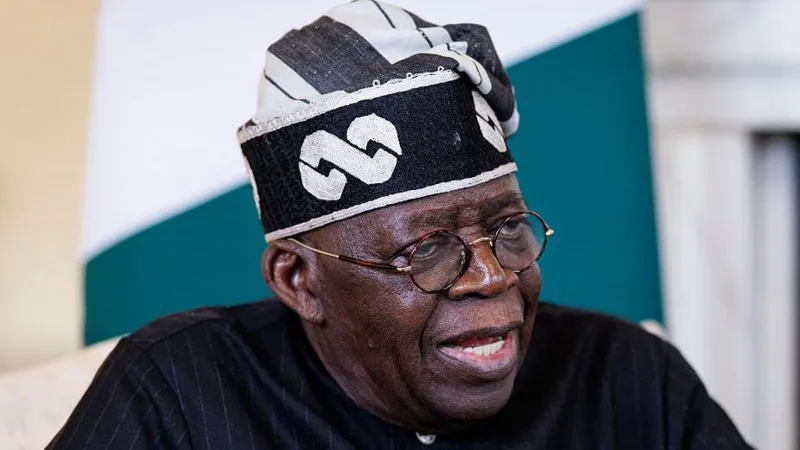
President Bola Tinubu has asked a United States court to reject a request seeking the release of his unredacted records held by the Federal Bureau of Investigation and the Drug Enforcement Administration.
Tinubu, through his lawyers, told the US District Court for the District of Columbia that the records should remain withheld because they are protected by privacy provisions under American law and their release would not serve any recognised public interest.
The President also argued that the request was politically motivated and amounted to an attempt to obtain private information for use in Nigerian politics.
The submissions were contained in filings by Tinubu’s lawyers, Christopher Carmichael, Victor Henderson and Oluwole Afolabi, and were published on Saturday.
The lawyers were responding to a request by American transparency activist Aaron Greenspan, who had asked the court to order the disclosure of records relating to Tinubu under the US Freedom of Information Act.
Greenspan’s request has attracted considerable attention in Nigeria because of the political controversy surrounding information about Tinubu’s activities and dealings in the United States before he became President.
In their latest filing, Tinubu’s lawyers gave several reasons why the court should not order the release of the records.
They argued, first, that the US Freedom of Information Act and Privacy Act protected the information sought by Greenspan.
They also said there was no public interest recognised under the law that could outweigh Tinubu’s privacy rights.
The lawyers further argued that Greenspan had ulterior motives and was seeking the documents mainly because they contained Tinubu’s name and could be used for political purposes in Nigeria.
They also rejected claims that the records could reveal evidence of wrongdoing by US authorities, including an alleged secret prosecution or an agreement by American authorities not to prosecute Tinubu.
According to the lawyers, such claims were speculative and had not been supported with evidence.
The legal dispute is linked to long-running questions surrounding Tinubu’s history in the United States.
The issue became a major political subject during the build-up to the February 25, 2023 presidential election, following the emergence of documents relating to a 1993 civil forfeiture proceeding in the United States.
A US District Court in Illinois ordered the forfeiture of $460,000 held in an account in Tinubu’s name after US authorities alleged that the funds represented proceeds of narcotics trafficking or were connected to prohibited financial transactions.
The development became a major issue during the 2023 presidential election litigation.
The All Progressives Congress, Tinubu’s party, maintained that the case was a civil forfeiture proceeding and did not amount to a criminal conviction.
The Labour Party and its presidential candidate at the time, Peter Obi, took a different position. They argued that the forfeiture amounted to a conviction that should disqualify Tinubu from contesting the presidential election under the Nigerian Constitution.
However, the Presidential Election Petition Court, in its September 2023 judgment, held that the petitioners had failed to establish that Tinubu was arrested, arraigned, convicted or sentenced in a criminal case in the United States.
The issue did not end with the court ruling, as opposition politicians and other interested individuals continued to seek official records relating to the President from US authorities.
Greenspan is among those who have pursued access to the records.
In his arguments, Greenspan said his request was important because it concerned the “sitting President of Nigeria” and a country of more than 230 million people whose lives were affected by Tinubu’s decisions.
Tinubu’s lawyers, however, rejected that argument.
They said the general interest Nigerians might have in the President’s background did not amount to the type of public interest recognised under the US Freedom of Information Act.
They also rejected the claim that there was a public interest in determining Tinubu’s “fitness for office”.
The lawyers said the issue of a public official’s fitness for office was not an interest that the US FOIA was designed to protect.
They relied on a 1989 decision of the US Supreme Court, Department of Justice v. Reporters Committee for Freedom of the Press, to support their position.
According to them, the purpose of FOIA is to allow members of the public to understand what the government is doing rather than to provide unrestricted access to personal information about individuals contained in government files.
The lawyers argued that Greenspan was seeking information about a private individual rather than information about the conduct of the FBI or DEA.
They cited the privacy protection contained in FOIA Exemption 7(C), which generally protects personal information contained in law-enforcement records where disclosure could constitute an unwarranted invasion of personal privacy.
“The redacted information sought by the plaintiff is exempt from disclosure,” the lawyers said.
They also challenged the argument that Tinubu’s privacy rights had been lost because some information concerning the historical investigation was already publicly available.
Greenspan had argued that the general nature of the investigation had been known since the 1993 forfeiture proceedings.
Tinubu’s lawyers disagreed, saying the publicly available court documents did not reveal the details or outcome of any possible criminal investigation involving the President.
They maintained that the fact that some information had entered the public domain did not mean that all other information relating to an individual lost its privacy protection.
The lawyers therefore asked the court to deny Greenspan’s motion for summary judgment and allow the FBI and DEA to continue withholding or redacting the records.
Among the documents being sought by Greenspan are what he describes as the “entire FBI file” on Tinubu, as well as FBI Form 302 interview records relating to him from 1992 and 1993.
FBI Form 302 documents are records used by the bureau to summarise interviews conducted by its agents during investigations.
The case took another important turn in April 2025 when US District Judge Beryl Howell ordered the FBI and DEA to lift their so-called “Glomar” responses.
A Glomar response allows a US government agency to refuse to confirm or deny whether records relating to a particular person exist.
Judge Howell directed the agencies to process the requested records, subject to exemptions allowed under US law.
The FBI subsequently sought to keep parts of the records from public disclosure, citing exemptions covering law-enforcement information, personal privacy, investigative methods and the safety of individuals.
The latest filing by Tinubu’s lawyers is therefore part of an ongoing legal battle over whether the records should be made public or remain protected.
The President’s legal team also argued that Greenspan had not provided sufficient evidence of government wrongdoing to justify access to protected law-enforcement records.
They described allegations of a secret prosecution or a decision by US authorities not to prosecute Tinubu as unsupported claims.
The lawyers said allegations alone could not provide a legal basis for overriding the privacy protections attached to law-enforcement records.
The case has continued to attract political attention in Nigeria because any release of previously undisclosed records could generate fresh debate over Tinubu’s past and could be used by political opponents ahead of the 2027 elections.
However, the legal proceedings in the United States should not be interpreted as a criminal case against the President.
The ongoing FOIA dispute is specifically about access to US government records and whether certain information should be released under American transparency laws.
It does not, by itself, amount to a criminal prosecution or constitute a finding that Tinubu committed a drug-trafficking offence.