
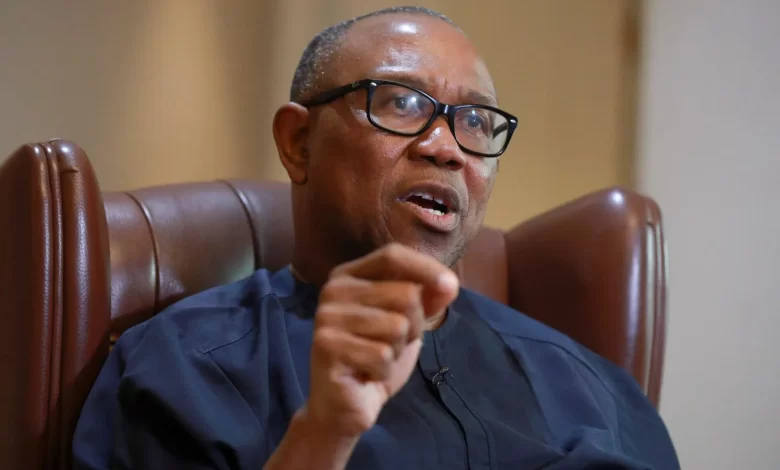
The presidential candidate of the National Democratic Congress, Peter Obi, has blamed politicians and poor leadership for many of the challenges facing Nigeria, saying there is nothing inherently wrong with the country.
Obi, a former Anambra State governor, made the statement on Sunday while speaking at Koinonia Global Church, led by Apostle Joshua Selman.
He appealed to Nigerians to pray for the country’s political leaders, saying the nation’s problems could be solved if those in positions of authority developed the willingness to use public resources for the benefit of citizens.
Obi told the congregation that politicians should be remembered in their prayers, particularly over the need for leaders to change their approach to managing the country’s resources.
“I believe that people like you are the ones keeping our country. The only thing I can ask all of you who are gathered here, because I know he’s praying for the country, is that you remember us, the politicians, in your prayers,” he said.
The former governor then took responsibility on behalf of politicians for the problems facing the country.
“We are the problem of the country. There’s nothing wrong with Nigeria. What is wrong in Nigeria is the leadership, the politicians God created in this country,” he said.
He urged Nigerians to pray for political leaders to develop the right attitude towards public funds and ensure that government resources are used to improve the lives of citizens.
“Let God touch our hearts to use public money for public good. Let God touch us to stop stealing. That is why people are suffering here,” Obi said.
According to him, Nigeria is richly endowed with natural and human resources and could make significant progress if its wealth was properly managed and invested.
He said government revenue and other resources could be used to improve infrastructure, education, healthcare, security and other essential services.
“If we use the wealth of this nation and invest it, it will go a long way. So remember us in your prayers,” he added.
Obi also based his argument on his experiences from travelling to different countries, saying he had seen nations where public systems worked effectively.
He maintained that the difference between Nigeria and countries that have achieved better development outcomes was largely the quality of leadership.
“I’ve been to so many countries of the world. And I’ve seen things work in other nations. It is leadership,” he said.
The comments come as Nigeria continues to face economic and social challenges, including high inflation, unemployment, insecurity and rising living costs.
The country has also struggled with gaps in infrastructure, electricity supply, healthcare and education, while many households continue to face pressure from the high cost of food and transportation.
Successive administrations have introduced policies aimed at addressing these problems, but concerns over corruption, poor implementation and the management of public resources have remained major issues in national debate.
Obi has consistently made accountability, prudent management of public funds and investment in productive sectors central to his political message.
During his tenure as Anambra governor from 2006 to 2013, he frequently highlighted savings, investments and the management of state resources. Since entering national politics, he has continued to argue that government should focus more on production, human capital development and efficient use of public funds.
His latest comments also came against the background of growing political activity ahead of the 2027 general elections.
Obi is expected to be one of the major figures in the opposition camp as political parties and groups position themselves ahead of the elections. He contested the 2023 presidential election under the Labour Party before emerging as the presidential candidate of the National Democratic Congress for the 2027 election.
Political parties are already intensifying efforts to mobilise supporters and present their programmes to Nigerians. The economic situation and the performance of the government are expected to remain major issues during the campaign.
Obi, however, asked Nigerians not to divide their prayers or support for political leaders along party lines.
He urged the congregation to pray for all politicians, regardless of their political parties or positions, saying the country’s problems were not beyond solution.
“Don’t say one is good, the other one is bad. All of us, remember all of us in your prayers, because the problem of the country can be solved. I assure you of that,” he said.
His appeal reflects the broader call by religious and community leaders for Nigerians to seek solutions to the country’s problems while also demanding accountability from those in government.
Nigeria’s political leaders have repeatedly faced criticism over allegations of corruption and the misuse of public resources. Civil society organisations and opposition parties have also continued to demand greater transparency in government spending.
The Federal Government, on its part, has defended its economic reforms as necessary measures to put the country’s finances on a stronger footing and attract investment.
The removal of petrol subsidy and changes to the foreign exchange system introduced under President Bola Tinubu have, however, increased economic pressure on households, even as the government argues that the reforms are intended to deliver long-term benefits.
For Obi, the country’s natural wealth provides enough resources to tackle many of its challenges if properly managed.
He therefore urged political leaders to put the interests of citizens above personal gain and use public resources to improve living conditions.
The former governor said Nigerians should remain hopeful because the country’s problems could be addressed through responsible leadership.
He called for prayers not only for politicians but also for a change of heart among those entrusted with public resources.
Obi’s message at the church was therefore both an admission of responsibility by politicians and an appeal for Nigerians to support efforts to build a better country.