
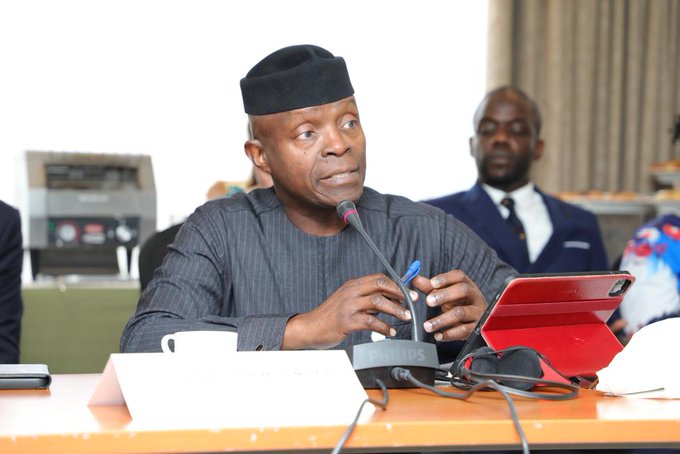
Integrity is fast becoming a rare virtue in today’s world, says former Vice President of Nigeria, Prof. Yemi Osinbajo. Speaking at the matriculation ceremony of MIVA Open University in Abuja yesterday, Osinbajo expressed regret over the scarcity of integrity, calling it a key currency for both business and personal relationships.
While addressing the new students, he stressed the importance of building lives based on integrity, hard work, and collaboration. According to him, these values are critical ingredients for living a purposeful life. Osinbajo urged the students to focus on their educational pursuits but reminded them that what endures beyond one’s lifetime is of greater importance.
He said, “Integrity might sound like a cliché today, but it is the cornerstone of real success. Let your yes be yes, and your no be no. Be known for your consistency in applying high moral values or principles. If you borrow money, pay it back. Don’t make promises you can’t fulfil.”
Osinbajo lamented the decline in integrity, saying that it is getting harder to find people who uphold this virtue. “It’s getting more difficult to find people of integrity, so it’s in high demand,” he said.
In his typically eloquent style, Osinbajo gave a dramatic yet humorous example: “Even thieves are looking for men and women of integrity to keep their stolen money with.” This remark highlighted how deeply integrity is valued, even by those who live outside the law.
Osinbajo’s message was clear—without integrity, lasting success is impossible. He emphasized that life is not a short sprint but a marathon, and those who will last the course are those who are trustworthy. Trust, he said, is the real currency of life and business. “If you are known to have no integrity, everyone will soon know it,” Osinbajo remarked. “Many of the best opportunities you will get will be based on recommendations, so if you lack integrity, it’s easy to become unmarketable.”
Osinbajo didn’t just stop at emphasizing integrity; he also spoke about the evolving nature of education. He said that in today’s world, modular education, which includes micro-credentials and digital badges, has the potential to rival traditional university degrees. Modular education focuses on providing targeted training to equip students with specific skills required in various industries.
He explained that employment criteria are shifting. Today, employers are more interested in problem-solving abilities, tech-savviness, and the capacity to work collaboratively than in how much theoretical knowledge an individual has. “The emphasis is no longer on how much information you have, but on how you can use that information to solve real-life problems,” Osinbajo said.
He pointed out that many existing disciplines in universities are outdated and no longer meet the demands of the modern workforce. “Teaching methods and resources are changing and must continue to evolve,” he said. He suggested that education should be increasingly personalized, allowing students to learn at their own pace.
Osinbajo’s vision of the future includes the possibility of micro-education competing with university degrees. “So micro-education could potentially rival university degrees in the future, especially as the world of work and learning continues to evolve,” he said. He noted that artificial intelligence can now be used to create personalized learning platforms, tailoring coursework to meet the specific needs of individual students.
He challenged the students to adopt new ways of thinking, to be innovative, and to use technology to their advantage. His words reflect a broader call for educational reforms in Nigeria, where the traditional education system has often been criticized for being out of touch with the demands of the 21st-century economy.