
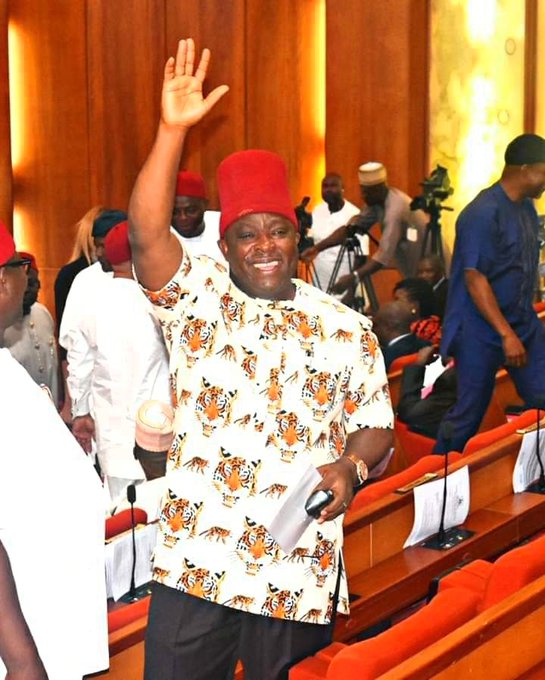
The Labour Party (LP) is currently facing a serious leadership crisis, according to Victor Umeh, Senator representing Anambra Central Senatorial District.
In an interview on Channels Television’s Sunday Politics programme, Umeh revealed that the party is struggling to establish a legitimate leadership structure, leaving it in a state of confusion.
His remarks come amidst growing concerns about internal strife within the Labour Party, which has been without a recognized leadership team for some time.
Speaking on the ongoing issues, Senator Umeh highlighted the absence of a legitimate executive committee within the Labour Party.
He expressed disappointment over the situation, emphasizing that the lack of leadership is preventing the party from moving forward.
“There is no legitimate executive committee in charge of the party at the moment,” Umeh stated.
“Without proper leadership, the issue of whether the Constitution is followed or not becomes unnecessary. We don’t have a legitimate executive committee right now.”
The lack of proper leadership, according to Umeh, is due to the expiration of the tenure of the current officials and their failure to initiate processes for the election of new leaders.
“Those who claim to have power in the party have not informed Nigerians that their tenure has expired. They failed to do what was necessary to bring in a new leadership,” Umeh explained.
The leadership crisis within the Labour Party escalated following a controversial national convention held in Nnewi, Anambra State.
The convention, led by Julius Abure, who headed the National Working Committee (NWC), sparked divisions within the party.
To address these divisions, critical stakeholders within the party, including the 2023 Labour Party presidential candidate Peter Obi and Abia State Governor Alex Otti, convened a National Executive Committee (NEC) meeting in Umuahia, Abia State.
During this meeting, which took place last week, a decision was made to establish an interim National Working Committee (NWC) to take control of the party’s affairs.
Former Minister of Finance, Senator Nenadi Usman, was nominated to lead the interim NWC for 90 days.
During this period, she is expected to oversee congresses and a national convention to elect substantive officers for the party.
However, this decision has not been universally accepted within the party, leading to more friction.
Despite the NEC’s decision to appoint Usman as the interim leader, factions within the party continue to contest the outcome.
Callistus Uju Okafor, a factional acting Chairman of the Labour Party, rejected the decision outright.
In a statement, Okafor described the NEC meeting as illegal and unconstitutional, claiming that it lacked the proper authority to appoint an interim leader.
He urged Nigerians to disregard the meeting and the decision made to appoint Usman, declaring that the move was null and void.
According to Okafor, “The meeting that produced Senator Usman as the interim national chairman of the party was a jamboree, and it holds no legal ground.”
Julius Abure’s group, which previously held control over the party’s leadership, has also rejected the outcome of the NEC meeting, calling it an illegitimate exercise.
These factions represent a significant challenge to any effort to resolve the leadership crisis in the party, as both sides continue to claim control over the party’s affairs.
Despite the opposition from other factions, Senator Umeh has defended the decision taken by the NEC in Umuahia.
According to Umeh, when there is no legitimate leadership in place, party members have the right to come together and make decisions to fill the leadership vacuum.
“The party members have the right to come together and decide to create new leadership when there is no leadership in place,” he said.
Umeh’s defense of the NEC meeting reflects his belief that the party must take action to address the leadership crisis, even if that means bypassing traditional structures.
The Labour Party, which enjoyed considerable popularity during the 2023 general elections under the leadership of Peter Obi, has since struggled to maintain its unity.
The party’s strong performance in the presidential and legislative elections earlier this year raised hopes that it could become a significant political force in Nigeria.
However, the current leadership crisis threatens to undermine those gains and weaken the party’s ability to mount a credible opposition to the ruling All Progressives Congress (APC) and the Peoples Democratic Party (PDP).