
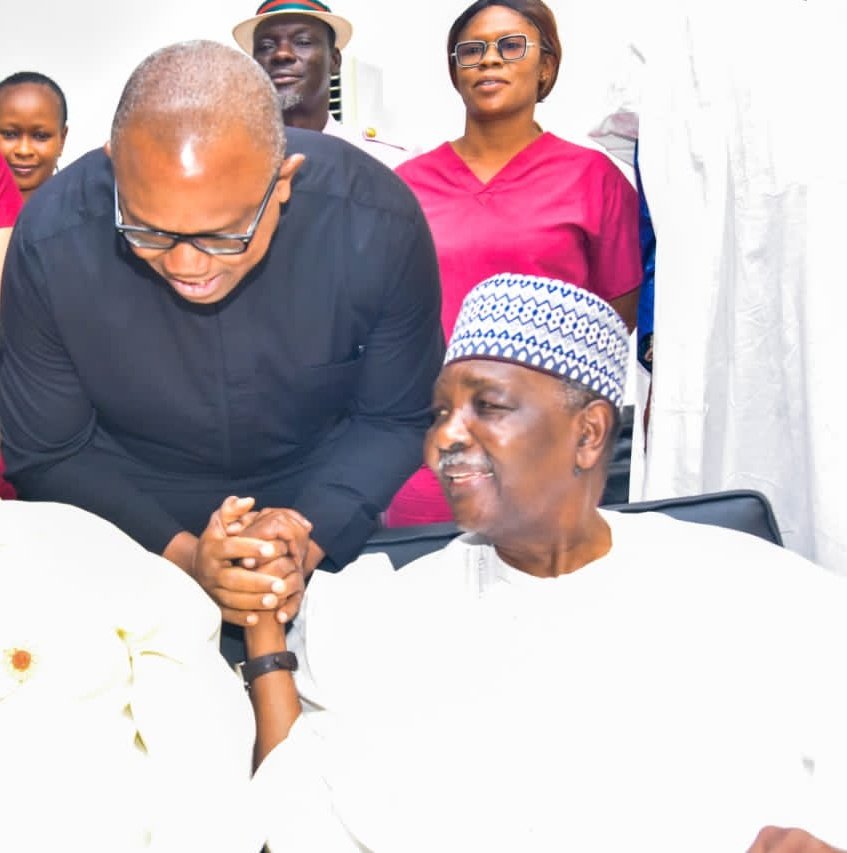
Peter Obi, the former governor of Anambra State and presidential candidate of the Labour Party, has defended his birthday message to Nigeria’s former military head of state, General Yakubu Gowon, who recently celebrated his 90th birthday.
Obi’s message, which was meant to honor Gowon’s milestone, sparked an uproar among his supporters, particularly those from the southeast, who still harbor strong sentiments about Gowon’s role during the Nigerian Civil War.
Despite the backlash, Obi maintains that his message was rooted in a spirit of forgiveness and national reconciliation, as he seeks to lead Nigeria toward a united and peaceful future.
Peter Obi’s decision to publicly congratulate General Yakubu Gowon on his 90th birthday surprised many, especially among his supporters known as “Obidients.”
Gowon, who was the head of state during Nigeria’s bloody civil war from 1967 to 1970, remains a controversial figure, particularly in the southeastern region of the country.
For many, the scars of the war are still fresh, and the conflict, which claimed the lives of over a million Nigerians, remains one of the darkest periods in the country’s history.
In response to the mixed reactions his congratulatory message received, Obi explained his reasons for acknowledging Gowon’s birthday.
He said he believed it was necessary to show the world that true heroism lies in forgiveness and moving forward, despite past grievances.
Obi acknowledged the painful history of the Nigerian Civil War, referring to it as “the darkest part” of Nigeria’s 64-year journey as a nation.
He described the 30-month conflict as a period that claimed millions of lives and left deep wounds that still affect the country today.
However, he emphasized that God must have had a reason for keeping both General Gowon and Chief Olusegun Obasanjo, the man who saw the end of the war, alive to witness Nigeria’s ongoing efforts toward reconciliation.
Obi further noted that Nigeria had shown signs of moving beyond its painful past, pointing to the heroic national burial given to Biafra’s leader, Dim Chukwuemeka Odumegwu Ojukwu, in 2012.
Obi, who was governor of Anambra State at the time, described Ojukwu’s burial as a bold statement that Nigeria is ready to embrace reconciliation and move forward as one nation.
In his defense, Obi highlighted the importance of forgiveness in healing the wounds of the past.
He acknowledged that many people, particularly those who suffered during the civil war, may not agree with his decision to honor Gowon.
However, he stressed that holding onto anger and bitterness only serves to fuel division and violence, both in Nigeria and around the world.
“There are various ways human beings can respond to acts of evil, especially one that claimed millions of lives,” Obi said.
He explained that while some may choose the path of revenge, he has opted for forgiveness, guided by his Christian faith.
Citing the teachings of Jesus Christ and passages from the Bible, Obi emphasized the importance of letting go of bitterness, rage, and anger in order to move forward.
Obi expressed his belief that forgiveness, while not easy, is a powerful process that frees individuals from the weight of hatred and allows societies to heal and progress.
Obi’s message of forgiveness is part of a larger vision he holds for Nigeria’s future.
He believes that the hatred and division that have plagued the country for decades must come to an end if Nigeria is to reach its full potential as the “greatest land in the black world.”
Reflecting on the civil war, Obi noted that most of his supporters, many of whom were born after the war, should not be dragged back into the darkness of that period.
He explained that he did not want to derail the message of hope and unity that his campaign has championed by harboring bitterness toward past events.
“It’s hate that has put our society, blessed by God to be the greatest land in the black world, down, but this hate has to stop,” Obi said.
He added that a new Nigeria, where political vices such as ethnic and religious segregation are eliminated, is only possible through forgiveness and understanding.
Despite Obi’s heartfelt explanation, many of his supporters have not been convinced.
Some have criticized him for offering public congratulations to a man they see as responsible for the deaths of millions of Igbos during the war.
“Must you greet him? Why didn’t you keep quiet?” some of his supporters have angrily asked.
Obi acknowledged these criticisms but reiterated that his decision to extend greetings to Gowon was part of his broader vision for a united and reconciled Nigeria.
He explained that staying silent would only hinder the country’s progress toward a new era of peace and understanding.