
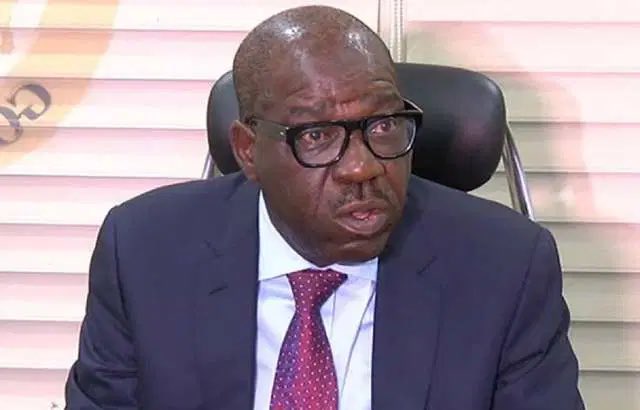
The Edo State Government has accused the Economic and Financial Crimes Commission (EFCC) of deliberately attempting to disrupt governance and sabotage democracy.
This accusation comes after the EFCC detained top government officials from the Edo State Treasury Office, including the Accountant General, Julius Anelu.
The officials were invited to the EFCC’s Benin Office on October 28, 2024, to answer questions regarding an agricultural loan obtained by the state from the Central Bank of Nigeria (CBN) and the Nigeria Incentive-Based Risk Sharing System for Agricultural Lending (NIRSAL).
The Edo Government claims this loan has already been repaid.
Despite this, the EFCC detained the officials and has reportedly demanded the appearance of another officer who was not initially listed on the invitation letter.
Accusations of Political Sabotage
In a statement signed by Chris Osa Nehikhare, the Edo State Commissioner for Communication and Orientation, the government condemned the EFCC’s actions as “devious” and “reprehensible.”
Nehikhare stated that the EFCC’s actions appear calculated to “cripple governance in Edo State” and “portend grave danger to democracy.”
He further alleged that the EFCC’s intention is to keep these civil servants in custody until November 12, the final day of the Obaseki administration’s tenure.
“This is nothing short of political interference,” Nehikhare said. “It appears the EFCC is acting out a script aimed at grounding the government.”
The commissioner warned that, starting from Monday, the state government could become unable to fulfill its basic responsibilities due to the EFCC’s interference.
A Transparent Government, Says Edo State
The Edo State Government emphasized that its operations under Governor Godwin Obaseki have been transparent and accountable.
“Our government has been open about its finances and has already settled the agricultural facility in question,” Nehikhare explained.
He added that the timing of the EFCC’s action appears suspicious, given that it coincides with the end of Obaseki’s term.
“Our tenure legally ends on November 12, and any unconstitutional interference to disrupt our administration is unwelcome,” he said.
A Threat to Democracy?
Observers have noted that this confrontation could represent a broader tension between state governments and federal agencies.
Political analysts warn that actions like these could have severe implications for Nigeria’s democracy.
If true, such moves could set a dangerous precedent where federal agencies are used to target political opponents, they argue.
Professor Okechukwu Agbaje, a political analyst, explained the potential fallout: “Using anti-graft agencies to undermine opposition-controlled states erodes public confidence in democracy and the independence of these institutions.”
He warned that the EFCC must be cautious to avoid the perception of bias, especially when handling politically sensitive cases.
“Federal agencies must act responsibly and stay out of local politics,” Agbaje stressed.
EFCC’s Role Under Scrutiny
This is not the first time the EFCC has been accused of political interference.
The anti-corruption body has faced similar criticisms in the past, with some alleging it is used to intimidate opposition politicians or state governments that differ from the ruling party’s stance.
Several state governors, particularly those in opposition, have voiced concerns about what they see as EFCC overreach.
In this instance, the Edo State Government’s claim of a deliberate plot to weaken its administration has stirred public interest, with many Nigerians questioning the EFCC’s motives.
The accusation has also caught the attention of lawmakers, with the House of Representatives issuing a four-day ultimatum to the EFCC chairman to explain the agency’s actions.
Call for the Immediate Release of Edo Officials
The Edo State Government has demanded the immediate release of its detained officials.
“We urge the EFCC to act responsibly in the interest of democracy, justice, peace, and the wellbeing of Edo people,” Nehikhare said.
He added that the detention of these officials could create chaos in the state and disrupt essential government operations.
Nehikhare called on the EFCC to “consider the grave consequences of their actions” and not throw Edo State into what he described as “needless turmoil.”