
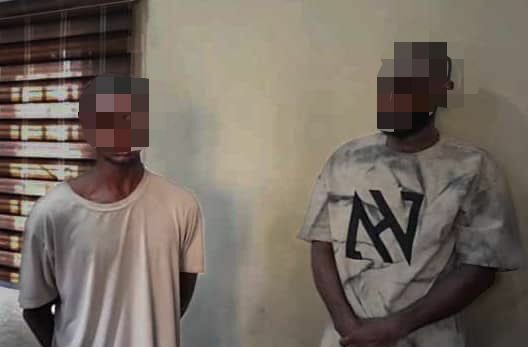
Rivers State Police have arrested two men in connection with a high-profile scam that defrauded a Canada-based Nigerian woman, Sandra Austin, of a staggering N140 million through a fake housing project. The suspects, Michael Onyedikachi and Akachukwu Benedict, were apprehended after an extensive investigation into an elaborate fraud operation that spanned over two years.
The crime was initiated by Onyedikachi, who set up a fake Facebook profile under the name “Engineer Desmond Chibuike Okechukwu” to lure Austin into the fraudulent deal. The scam unfolded in 2022, when Sandra Austin, a resident of Canada, accepted the fraudulent friend request and began conversing with the alleged “construction engineer.” What followed was a series of manipulated interactions and financial transactions that would leave Austin emotionally and financially devastated.
The Deceptive Tale
According to the Rivers Police Command spokesperson, SP Grace Iringe-Koko, the fraudster built an elaborate story about himself, presenting himself as a reputable construction engineer with an impressive portfolio. “The individual behind the account claimed to be a construction engineer with an impressive portfolio of luxurious homes allegedly built for clients,” Iringe-Koko explained. To make his claims seem legitimate, the fraudster shared images of high-end properties, supposedly located in Ajah, Lagos.
Seeing the luxurious homes, Austin grew interested in purchasing one. “Sandra expressed interest in one of the properties, and the scammer told her it would cost N150 million to purchase land and complete the development,” Iringe-Koko noted.
Believing the scammer’s story, Austin proceeded with the transaction, making several large payments as instructed by the fraudster. By February 2024, Austin had transferred a total of N110 million, followed by a final installment of N30 million. However, after receiving the last payment, the fraudster blocked all communication channels with Austin, disappearing without a trace.
Emotional and Financial Toll
The scam had a profound impact on Austin. Describing the aftermath, Iringe-Koko disclosed that Austin was left traumatized by the ordeal. “The incident left Sandra unable to contact the fraudster, and she developed hypertension, which led to a prolonged hospital stay,” she revealed.
To make matters worse, the fraudster intensified Austin’s distress by threatening to kill her family members if she went to the police. “Sandra was under the impression that her family’s lives were at risk, which made her hesitant to report the case,” Iringe-Koko said.
It was only after Austin had recovered from her health crisis that she contacted her family in Nigeria, who promptly alerted the authorities. This led to an investigation by the Rivers State Police, who utilized intelligence-driven techniques to track down the fraudsters.
The Arrest of the Suspects
The breakthrough in the investigation came on August 24, 2024, when police operatives arrested Michael Onyedikachi in Enugu. Onyedikachi, a 29-year-old from Nkanu West, Enugu, had been living in a three-bedroom bungalow in Ama-Okponike, Enugu, which the police discovered was funded through his fraudulent activities.
Onyedikachi confessed to operating the Facebook account and deceiving Austin by sending her pictures of properties that didn’t exist. “He admitted to using the fake account and claimed that he had been sending images of properties to manipulate the victim into believing progress was being made on her supposed property,” Iringe-Koko said.
Further investigation revealed disturbing details about Onyedikachi’s methods. During a raid on his residence, police discovered a shrine, which they suspect was used for ritual purposes. The police also learned that Onyedikachi had spent several months in Accra, Ghana, where he trained in online fraud techniques. “He told us that he spent eight months in Ghana, learning the tricks of online fraud,” Iringe-Koko stated.
Onyedikachi, in his confession, also revealed the involvement of his accomplice, Akachukwu Benedict, who is from Ngo-Okpala Local Government Area in Imo State. Benedict, who had been involved in scamming activities since 2022, was arrested shortly after in a luxurious hotel in Enugu, where he had booked a suite for an entire year.
A Global Web of Deception
Benedict, a 29-year-old, admitted to introducing Onyedikachi to online fraud. He also confessed to a previous scam in 2021, in which he defrauded an American woman, Molissa, of 600 US dollars. Iringe-Koko explained that the suspects employed sophisticated tactics to conceal their identities. “The suspects acquired cloned SIM cards, which they used to evade detection, and they received payments from their victims via cryptocurrency wallets to avoid tracking by authorities,” she said.
Investigators also learned that the duo relied heavily on social engineering, manipulating victims into trusting them by creating fake personas online. This method, known for its psychological manipulation, enabled them to operate with relative impunity for an extended period.
Evidence Recovered
During the raid, police seized several items, including a Toyota Corolla vehicle, land documents, laptops, and mobile phones. These items are expected to play a key role in the ongoing investigation.
“The investigation is still ongoing, and we are determined to bring all involved parties to justice. These criminals thought they could evade detection, but our intelligence network is working effectively to track them down,” Iringe-Koko added.
Public Warning and Prosecution
The police spokesperson urged the public to be vigilant when interacting with unknown individuals online, particularly on social media platforms. “We advise Nigerians to be cautious when engaging with people they don’t know, especially those who request large sums of money under suspicious circumstances,” she said.
Both suspects will face prosecution once the investigation is concluded, and further legal actions are expected against others who may be implicated in the fraud network.
In light of this case, law enforcement agencies have reiterated the importance of digital literacy and awareness in helping to protect individuals from online scams, which are becoming increasingly sophisticated.