
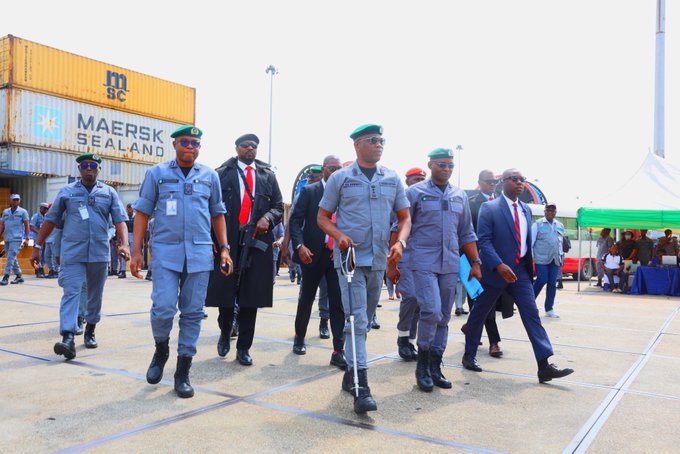
The Nigeria Customs Service (NCS) has forcefully rejected allegations made by a 70-year-old United States returnee, Mr. Olukayode David-Albert, who claimed that officials at the Lagos ports demanded a staggering N76 million for the clearance of his two vehicles and personal belongings.
In an official statement issued by the NCS, the service emphasized that the claim was “baseless” and misrepresented the actual charges assessed. Mr. David-Albert, who had recently returned to Nigeria after spending several years in the United States, had alleged that Customs officers initially charged him N76 million for clearing his items, only to later reduce the amount to N53.5 million following negotiations.
According to David-Albert, the Customs officers imposed exorbitant fees for his two vehicles—a 2011 Chrysler and a 2024 Hyundai SUV—along with additional charges for his personal household items. “They initially demanded N3.3 million for my Chrysler, N70.8 million for the Hyundai, and N2 million for my household goods, bringing the total to N76 million,” David-Albert explained in an interview.
The returnee further recounted how, after heated discussions with the Customs officers, the amount was reduced to N53.5 million. This “compromise value” still included various additional charges, such as valuation fees, approval fees, and other undisclosed payments. David-Albert expressed his frustration, saying, “It felt like I was being extorted. I had no choice but to pay, as they made it clear that this was the only way to get my property cleared.”
However, the NCS has categorically denied these claims, providing a breakdown of the actual duties owed. According to Ngozi Okwara, Public Relations Officer for the Tincan Island Command of the NCS, David-Albert’s personal belongings were exempt from import duties, in accordance with the ECOWAS Common External Tariff (CET) 2022–2026, which allows Nigerian citizens who have resided outside the country for at least nine months to bring in their personal effects duty-free. However, the two vehicles in David-Albert’s consignment did not qualify for duty exemption as they were classified as “goods intended for sale, barter, or exchange.”
Okwara further explained that while the 2024 Hyundai SUV was subject to import duties, the total value of the customs duties levied on the two vehicles amounted to N34.9 million. This figure includes 20% import duty, a 20% levy, and a 7.5% Value Added Tax (VAT). Okwara stated, “The N34,969,374 determined by the Customs Service for the two vehicles is well below the N53.5 million figure mentioned in the report. The accusation of a bribe or extortion is simply untrue.”
For many Nigerian returnees, the customs process can be a source of tension, with confusion surrounding what is allowed under duty exemptions and the fees required for clearing personal belongings and vehicles. David-Albert’s case has brought to light the challenges many Nigerians face when returning from abroad with personal effects and vehicles. While some have faced similar difficulties, others have successfully navigated the system without issue, highlighting a growing need for clearer communication and transparency from customs authorities.
Despite these reassurances from the NCS, critics are questioning whether the customs process, particularly regarding the clearance of vehicles, is overly complicated and prone to inconsistencies. Some Nigerians have pointed to the high fees associated with vehicle importation as a deterrent for citizens wishing to return home with their property. The discrepancy between the official customs duties and the alleged “compromise” amount has led many to believe that there may be an underlying problem with the system.
“This situation highlights the opaque nature of Nigeria’s importation processes,” said political analyst Dr. Chigozie Nwachukwu. “While customs officials have the right to charge duties according to the law, the lack of a clear and accessible system for returnees can lead to confusion and frustration. This is compounded by reports of widespread bribery and corruption within the system.”
For his part, David-Albert remained resolute in his stance, claiming that the Customs officers’ demands were not only unreasonable but also unlawful. He pointed out the disparity between the initial demand of N76 million and the eventual “reduced” amount, which he believes was nothing more than a forced compromise. “I have spent years abroad and thought I would return to a better Nigeria, but this experience has shown me how deeply corruption runs,” he said.
The NCS has promised to investigate any claims of misconduct among its officers, with Okwara assuring the public that the service remains committed to maintaining integrity in its operations. “The Nigeria Customs Service has zero tolerance for corruption,” she affirmed. “We will not condone any actions that undermine the trust of Nigerian citizens. We urge anyone with credible evidence of bribery or unethical behavior to report it to our internal affairs unit.”
While the controversy continues to spark debate, the situation underscores broader concerns about Nigeria’s customs and importation systems. For many Nigerians returning from abroad, navigating these complex regulations can feel like an uphill battle. With import duties often seen as prohibitively high, and unclear guidelines for customs exemptions, the current system may be leaving room for exploitation and frustration among returnees like David-Albert.