
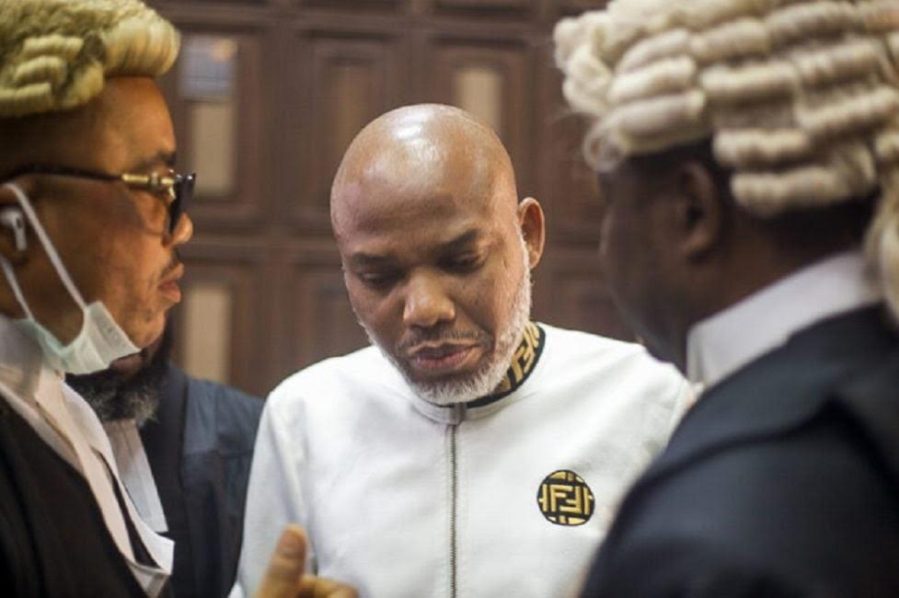
The family of Nnamdi Kanu, the detained leader of the Indigenous People of Biafra (IPOB), has accused President Bola Ahmed Tinubu of failing to honor an alleged pre-election agreement to secure Kanu’s release.
In a dramatic revelation, Kanu’s brother, Kanunta Kanu, disclosed details of a meeting purportedly held with Tinubu’s son, Seyi, during the buildup to the 2023 presidential election. According to Kanunta, the meeting, which reportedly had Tinubu’s approval, was aimed at ensuring IPOB’s non-interference in the general election in exchange for Kanu’s release upon Tinubu’s victory.
“A Pact Made in Good Faith”
Kanunta Kanu explained that the discussions with Seyi Tinubu were initiated through a former state governor who acted as an intermediary.
“Before the last election, I received a message from an ex-governor that Seyi, the son of President Tinubu, wanted to see me,” Kanunta revealed.
The meeting, held in Abuja, reportedly involved a witness chosen by Kanunta for transparency. During their discussions, Seyi allegedly assured him that the agreement had the blessing of his father, then-presidential candidate Bola Tinubu.
“Seyi confirmed to me that his father sanctioned the meeting and that I should consider any agreement we reach as binding on the then-candidate, Senator Bola Ahmed Tinubu,” Kanunta stated.
The agreement reportedly centered on IPOB refraining from boycotting the 2023 elections or engaging in civil disobedience. This understanding was communicated to Nnamdi Kanu, who reportedly endorsed the decision.
Campaign Promises Revisited
According to Kanunta, Tinubu reinforced this commitment publicly during a campaign stop in Owerri, the Imo State capital.
“When President Tinubu as a candidate visited Owerri during his campaign, he too reiterated his commitment to facilitate the release of my brother if elected,” Kanunta said.
He claimed that these assurances motivated IPOB to abstain from any actions that could disrupt the election.
However, more than a year into Tinubu’s presidency, Nnamdi Kanu remains in detention, a situation that Kanunta described as “defying logic.”
Legal Stalemate
Kanu’s prolonged detention continues to generate controversy, particularly as the IPOB leader has been held without formal charges since his extraordinary rendition from Kenya in June 2021. Justice Binta Nyako, who had been presiding over his case, recused herself in 2023, leaving the matter in limbo.
“It’s been over three months now that Justice Binta Nyako recused herself from the case, yet no new judge has been assigned the case,” Kanunta lamented.
Political and Legal Implications
Nnamdi Kanu’s detention has remained a flashpoint in Nigeria’s sociopolitical landscape, fueling tensions in the southeast and sparking criticism from human rights groups. IPOB, which Kanu leads, has been at the forefront of agitations for the independence of Biafra, a cause rooted in the region’s historical grievances and perceptions of marginalization.
Observers have noted that Kanu’s detention has complicated Tinubu’s relationship with the southeast, a region where he already faced significant political challenges.
Some analysts believe the alleged agreement, if true, underscores the complexities of balancing pre-election promises with governance realities. “This situation highlights how political deals can backfire if not carefully managed,” said political analyst Dr. Emeka Obinna.
Calls for Justice
IPOB and other advocacy groups have repeatedly called for Kanu’s release, citing court rulings that dismissed charges against him. In October 2022, the Court of Appeal in Abuja ruled that Kanu’s rendition from Kenya was unlawful, thereby invalidating the federal government’s case against him.
Despite the ruling, the government has continued to detain Kanu, citing national security concerns. Critics argue that this stance undermines the rule of law and risks escalating tensions in the southeast.
Human rights lawyer Mike Ozekhome, who represents Kanu, has decried the government’s actions, describing them as a “brazen disregard for judicial authority.”
IPOB’s Stance
The IPOB leadership has remained vocal in its criticism of Tinubu’s administration, accusing it of perpetuating the marginalization of the Igbo people.
“The southeast cannot continue to bear the brunt of oppressive policies,” said Emma Powerful, IPOB’s spokesperson. “President Tinubu must demonstrate leadership by addressing this injustice.”
A Political Gamble?
The allegations by Kanu’s family add a new dimension to the ongoing debate over Tinubu’s handling of the southeast. While the president has made overtures to the region, including appointments of Igbo individuals to key positions, critics argue that these moves fall short of addressing core grievances.
The revelation of a possible pre-election agreement raises questions about Tinubu’s commitment to fulfilling campaign promises, particularly those made in private settings.