
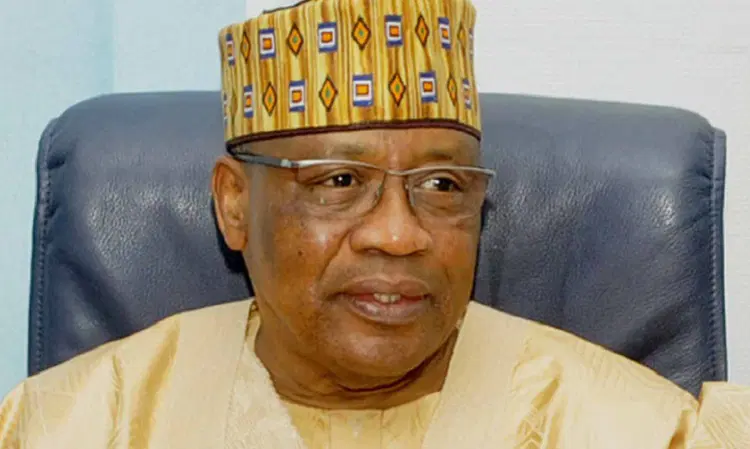
President Bola Ahmed Tinubu has extended warm birthday wishes to former military president, General Ibrahim Badamasi Babangida (rtd), as he marked his 84th birthday.
In a statement issued on Sunday by his Special Adviser on Information and Strategy, Bayo Onanuga, President Tinubu described Babangida, popularly known as IBB, as a central figure in Nigeria’s history whose contributions to national development remain significant.
According to the president, Babangida played an influential role in shaping Nigeria’s political, economic, and security structures, both as a military officer and as the country’s leader from 1985 to 1993.
“President Tinubu sends his heartfelt congratulations to General Ibrahim Badamasi Babangida on the occasion of his 84th birthday and wishes him continued good health, strength, and long life,” the statement read.
The president went on to reflect on the military career of the former head of state, noting his rise through the ranks and the leadership positions he held. Babangida served as an instructor at the Nigerian Defence Academy (NDA), Commander of the 4 Reconnaissance Regiment, head of the Armoured Corps, and Director of Army Staff Duties and Plans, before becoming Chief of Army Staff.
These roles, President Tinubu said, positioned Babangida as a highly respected and strategic thinker within the Nigerian Armed Forces.
While celebrating Babangida’s leadership qualities, Tinubu also highlighted several major infrastructure and institutional reforms initiated during IBB’s time as Nigeria’s military president.
Among the most notable was the construction of the Third Mainland Bridge in Lagos, which at the time was the longest bridge in Africa and remains a vital part of Nigeria’s transport system today.
President Tinubu also praised Babangida’s economic liberalisation policies, which opened up Nigeria’s economy and encouraged private sector participation in several areas of national life.
He said Babangida’s vision to reposition Nigeria also led to the relocation of the Federal Capital Territory from Lagos to Abuja, a move that reflected a broader national outlook and the intention to promote unity among Nigeria’s diverse ethnic and regional groups.
Additionally, Tinubu credited Babangida for founding several key national institutions that continue to play crucial roles in Nigeria’s governance and security architecture. These include the:
State Security Service (SSS)
National Intelligence Agency (NIA)
Defence Intelligence Agency (DIA)
Federal Road Safety Corps (FRSC)
These agencies, established during Babangida’s administration, have remained integral to Nigeria’s internal security, intelligence gathering, and road safety management.
The president also acknowledged Babangida’s political reforms, including the creation of several new states and the attempt to transition Nigeria to a democratic system through the two-party model. Although the transition was not completed during his time, it laid the groundwork for the return to civilian rule in 1999.
Tinubu expressed appreciation for Babangida’s lifelong commitment to Nigeria’s unity, stability, and progress, adding that the elder statesman has continued to offer wise counsel and maintain a respectable presence in national discourse.
“General Babangida remains a respected voice in Nigeria’s journey to progress and development. His service to the nation, both in and out of uniform, continues to inspire many,” the president said.
President Tinubu’s message joins a series of goodwill messages from across Nigeria’s political and military circles as IBB turns 84.
Born on August 17, 1941, in Minna, Niger State, Ibrahim Babangida joined the Nigerian Army in 1962 and quickly rose through the ranks due to his intellect, discipline, and strategic vision. He served in various capacities during the Nigerian Civil War and eventually became one of the most influential military officers in the country.
He took power in 1985 after a palace coup that ousted then Head of State, General Muhammadu Buhari. Babangida ruled Nigeria for eight years, overseeing a period of both reforms and controversies. His administration is remembered for its ambitious infrastructure projects, economic restructuring, and the establishment of several institutions still in use today.
However, his government also faced criticism for human rights abuses and the annulment of the June 12, 1993 presidential election, which is widely believed to have been won by Chief Moshood Abiola. The annulment triggered a national crisis and remains one of the most discussed decisions of his regime.
Despite the controversies, Babangida has maintained relevance in Nigeria’s political space and is frequently consulted on national matters by politicians, military leaders, and traditional rulers.
As the former military leader celebrates his 84th birthday, Nigerians from different walks of life continue to reflect on his contributions, his legacy, and his impact on the nation.