
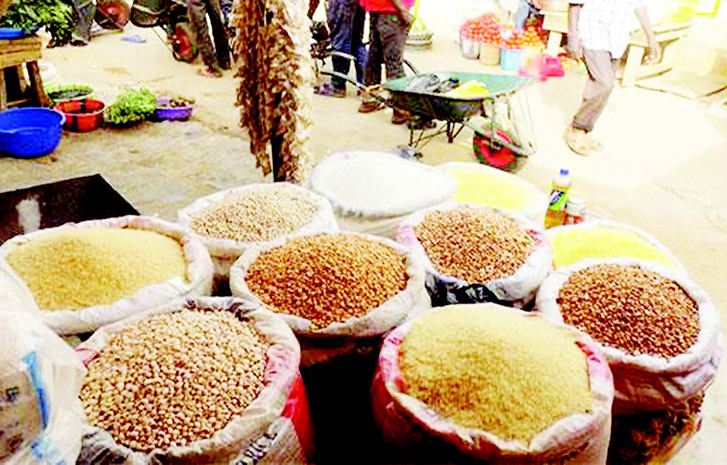
Nigerians saw a slight reduction in the prices of several major food items in October 2025, according to new data released by the National Bureau of Statistics (NBS). The agency said the prices of brown beans, white garri, tomatoes, and local rice declined compared to the same period last year, offering a small measure of relief to households struggling with high food costs.
The NBS disclosed this in its Selected Food Prices Watch report for October 2025, published on Friday in Abuja. The report tracks the retail prices of common food items across the country and is considered one of the most reliable indicators of how rising or falling food prices affect Nigerians on a daily basis.
Brown beans, one of Nigeria’s most consumed staple foods, recorded the sharpest annual decline. According to the NBS, the average price of 1kg of brown beans dropped by 37.09%—from ₦2,798.50 in October 2024 to ₦1,760.53 in October 2025.
On a month-to-month basis, the price also fell by 1.74%, down from ₦1,815.76 in September 2025.
Beans are an important protein source in many Nigerian homes, especially as the price of animal protein remains high. A significant fall in beans prices could help low-income families maintain a balanced diet at a lower cost.
The report also revealed a drop in the price of 1kg of white garri, another popular food item consumed across the country. On a year-on-year basis, the average price dropped by 29.33%—from ₦1,198.05 in October 2024 to ₦846.69 in October 2025.
Month-on-month, the reduction was 2.88%, down from ₦871.78 in September.
Garri remains a key staple for millions of Nigerians due to its versatility and affordability. Any reduction in garri prices generally has an immediate impact on household spending.
Tomato prices, which often fluctuate due to supply shortages and seasonal changes, decreased by 13.43% year-on-year. A kilogram of tomatoes cost ₦1,269.17 in October 2025, compared to ₦1,465.99 in October 2024.
The month-on-month reduction was 0.83%, reflecting a gradual easing in supply pressure. Tomato prices tend to rise during periods of pest infestation or transportation challenges, but the October numbers suggest more stable supply conditions.
The average price of 1kg of local rice fell slightly by 2.01% year-on-year—from ₦1,944.64 to ₦1,913.78.
On a monthly basis, the decline was 1.59%, down from ₦1,952.94 in September.
Rice remains Nigeria’s most consumed grain, and even small changes in price directly affect household budgets, especially during festive periods when demand increases.
Despite the reductions in some food items, not all prices went down. The NBS report showed that the average price of 1kg of onion bulbs increased by 4.66% year-on-year, rising from ₦1,251.52 to ₦1,368.32.
However, on a month-on-month basis, onion prices fell by 9.33%, indicating a recent improvement in supply after earlier shortages.
Beef prices continued their upward trend. The average cost of 1kg of boneless beef rose by 16.93% over the past year—from ₦5,858.58 to ₦6,850.51. Month-on-month, beef prices also increased slightly by 0.16%.
Rising beef prices have been linked to insecurity in cattle-rearing regions, high transportation costs, and the general increase in livestock feed prices. As a result, many Nigerians have reduced their consumption of beef, relying more on plant-based proteins like beans.
The report also provided detailed analysis of food prices across states, showing wide differences in costs depending on region and local market conditions.
Brown Beans
Highest price: Imo — ₦2,174.09
Lowest price: Yobe — ₦1,263.68
White Garri
Highest: Bayelsa — ₦1,165.30
Lowest: Plateau — ₦490.10
Tomatoes
Highest: Ebonyi — ₦2,148.04
Lowest: Plateau — ₦687.09
Local Rice
Highest: Ogun — ₦2,163.23
Lowest: Yobe — ₦1,523.47
Onion Bulb
Highest: Abia — ₦2,353.05
Lowest: Kwara — ₦833.07
Boneless Beef
Highest: Abia — ₦8,984.43
Lowest: Benue — ₦5,419.03
These differences highlight the impact of local production levels, transportation costs, and market access.
Regional Trends Show Mixed Patterns
According to the NBS, food prices also varied significantly across geopolitical zones:
Brown Beans
Highest: South-East (₦2,105.94) and South-West (₦2,081.33)
Lowest: North-West (₦1,349.23)
White Garri
Highest: South-East (₦1,066.85) and South-South (₦980.44)
Lowest: North-Central (₦630.44)
Tomatoes
Highest: South-East (₦1,807.92)
Lowest: North-West (₦898.21)
Local Rice
Highest: North-Central (₦2,021.70) and South-West (₦1,966.89)
Lowest: North-East (₦1,803.38)
Onions
Highest: South-East (₦1,950.88)
Lowest: North-West (₦997.58)
The data shows that foods tend to be more expensive in the southern regions, where transportation and supply chain costs are higher. Northern states, which serve as major producers of many staples, generally record lower prices.
Although the October numbers show relief in several food items, the reductions follow months of rising prices across most commodities. Nigeria has been battling high inflation driven by currency depreciation, fuel price increases, insecurity in farming areas, and transportation challenges.
Food inflation in the last two years has remained a major concern for households, with many families cutting down on quantities or switching to cheaper alternatives. The slight price drops reported in October may help cushion the pressure but are still far from restoring affordability to pre-inflation levels.