
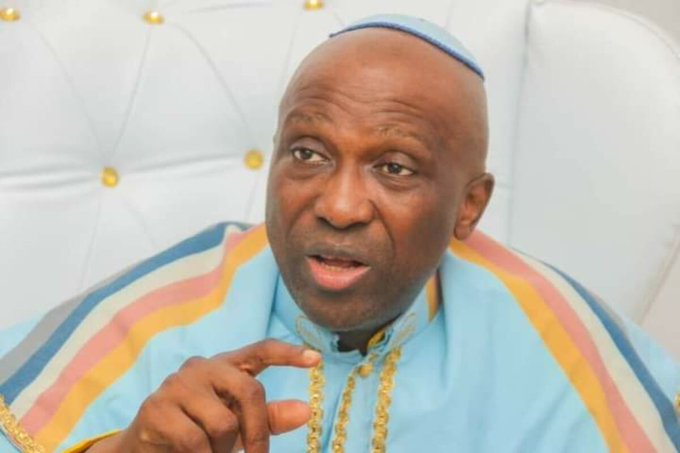
A fresh controversy has erupted between Primate Elijah Ayodele, founder and head of INRI Evangelical Spiritual Church, and the Minister of Power, Chief Adebayo Adelabu, following allegations of attempted extortion and counter-accusations exchanged by both parties.
The dispute came into the open after Adelabu reportedly petitioned the Department of State Services (DSS), accusing the cleric of blackmail and an attempt to extort ₦150 million from him under the guise of “spiritual intercession” to help him become the governor of Oyo State.
Reacting strongly to the allegation, Primate Ayodele, during a church service at his headquarters in Oke Afa, Lagos, on Sunday, dismissed the claim and described the minister as a “small boy” who does not understand what he is saying. In a statement that has since generated widespread reactions, the outspoken cleric said that ₦150 million could not even buy the shoe he was wearing.
“The shoe I wear, can ₦150 million buy it?” Ayodele asked his congregation. “Can ₦150 million buy my car? Leave that person alone. He is a small boy. He knows he has lost, that is why he is pained.”
According to Ayodele, Adelabu is angry because he is aware that his ambition to become the governor of Oyo State will fail again. Adelabu, who is currently serving as Minister of Power, has contested the Oyo governorship election twice in the past but was unsuccessful. He has, however, openly declared his intention to run again in the 2027 governorship election.
The cleric’s comments were a direct response to details contained in Adelabu’s petition to the DSS. In the petition, the minister alleged that Ayodele demanded ₦150 million from him to carry out prayers and spiritual work that would guarantee his victory at the polls.
Adelabu also claimed that the cleric demanded 1,000 pieces of saxophones or trumpets as part of the alleged request. He stated that the cheapest option, which involved fairly used Nigerian-grade instruments, would cost about ₦50 million, while imported grade-one instruments from China would cost up to ₦130 million.
According to the minister, his refusal to meet these demands led to what he described as false prophecies by Ayodele, which were allegedly aimed at damaging his reputation and political ambition ahead of the 2027 election.
In Nigeria, religious leaders, especially self-styled prophets, often play influential roles in politics. Many politicians are known to seek prayers, endorsements, or prophecies ahead of elections, believing such spiritual backing can improve their chances of success. This has, over the years, led to frequent controversies, especially when prophecies fail to come true or when disagreements arise between politicians and clerics.
Primate Ayodele is one of the most popular and controversial religious figures in the country. He is known for making bold prophecies about political leaders, elections, and national events. While some of his past predictions are believed by followers to have come true, others have been criticised or dismissed by those affected.
In a statement released on Saturday, Ayodele had earlier denied Adelabu’s allegations, insisting that he never attempted to extort money from the minister. According to him, it was Adelabu who came to him seeking spiritual help out of desperation to become governor.
“The minister came to me and said he would do anything to become governor,” Ayodele claimed. “I did not invite him, and I did not ask him for money.”
During the church service on Sunday, the cleric repeated this position, stressing that he does not force prophecies on anyone or use them to attract money or influence.
“I am not doing prophecies to impress you or invite you to me,” Ayodele said. “I don’t do prophecies for you to come and do enquiries. Take it or leave it.”
He also claimed that if he had collected money from Adelabu or anyone else, he would openly admit it. “If I collected money, I would say I collected money,” he told his congregation. “But I did not collect money, and I did not invite him.”
Ayodele further said that his prophecies are guided by divine instruction and not personal interest. “I can’t disappoint you. I can only disappoint you when you are not a good person,” he said. “I carry something bigger than me.”
The cleric’s strong language, including describing the minister as having “mouth diarrhoea,” has drawn mixed reactions from the public. While some of his supporters praised him for speaking boldly, others criticised his choice of words and questioned the growing influence of religious leaders in political matters.
On the other hand, Adelabu, a former Deputy Governor of the Central Bank of Nigeria and a well-known political figure in Oyo State, has remained firm on his claims. His petition to the DSS suggests he is seeking official investigation into what he described as an attempt to exploit him using religion.
The involvement of the DSS has added a serious dimension to the matter, as the agency is responsible for internal security and intelligence in Nigeria. Many observers believe the outcome of any investigation could set an important example on the limits of interaction between politicians and religious figures.
As the 2027 general elections draw closer, political activities and alliances are expected to intensify across the country. In Oyo State, the contest for the governorship is already generating interest, with potential candidates positioning themselves early.