
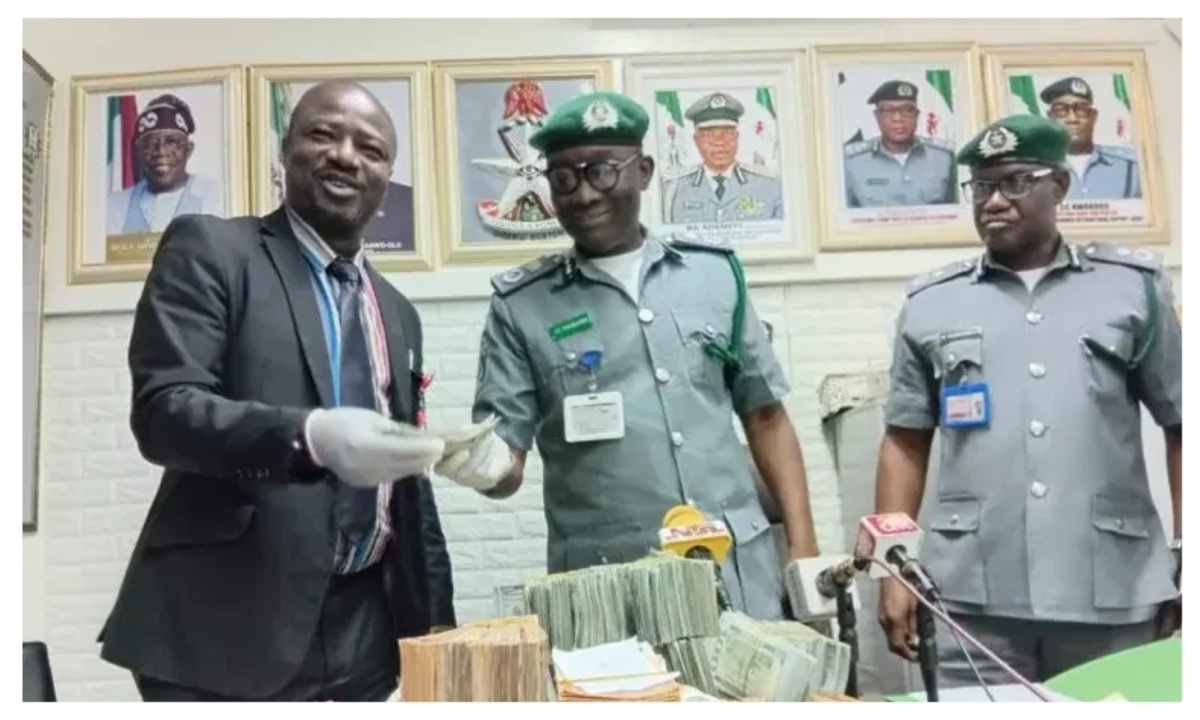
The Nigeria Customs Service (NCS) has intercepted undeclared foreign currencies worth over N2.28 billion at Murtala Mohammed International Airport (MMIA), Lagos, underscoring its commitment to tackling financial crimes and protecting Nigeria’s economic stability.
The seizure was announced on Tuesday, 16 December 2025, by the Customs Area Controller of the MMIA Command, Comptroller Chidi Nwokorie, during a media briefing. He revealed that the funds consisted of €651,505 and $800,575.
According to Nwokorie, the interception demonstrates the NCS’s firm resolve to block illicit financial flows and enforce laws aimed at curbing money laundering, terrorist financing, and other financial crimes. He also hailed Nigeria’s recent exit from the Financial Action Task Force (FATF) Grey List, describing the achievement as a milestone resulting from effective leadership and strong inter-agency collaboration.
“This interception underscores the professionalism and alertness of our officers, particularly the Anti-Money Laundering and Counter-Financing of Terrorism Unit of the MMIA Command,” Nwokorie said. “Their diligence led to this successful operation.”
The Comptroller explained that the incident occurred at approximately 2:45 pm on Saturday, 23 December 2025, at Departure Terminal 2 of MMIA. The suspect, an Austrian national identified as Mr. Kavlak Onal, was preparing to board an Emirates Airlines flight to Dubai when he allegedly failed to declare the foreign currencies in his possession.
Customs officers, acting on their legal mandate, questioned Onal, and a detailed search of his luggage uncovered the undeclared funds. Nwokorie noted that the action violated Nigerian regulations requiring all travellers entering or leaving the country to declare foreign currencies or negotiable instruments exceeding $10,000 or its equivalent.
He highlighted that possession of foreign currency above the approved threshold is not in itself illegal, but failure to declare, false declaration, or under-declaration constitutes a punishable offense under Nigerian law. Penalties may include prosecution, fines, or forfeiture of the currency.
“The NCS will continue to enforce anti-money laundering laws and prevent illicit financial movements across our borders,” Nwokorie said. “We advise all travellers and businesspersons to ensure full and accurate disclosure of all foreign currencies to avoid legal consequences.”
The NCS operates under the Nigerian Customs Service Act and various financial regulations that empower it to prevent smuggling and curb financial crimes. These laws require travellers and cargo operators to declare any amount exceeding $10,000 or its equivalent in foreign currency when entering or leaving the country.
The intercepted currencies were immediately documented, and the suspect, along with his international passport and luggage, was formally handed over to the Economic and Financial Crimes Commission (EFCC) for further investigation.
Receiving the items on behalf of the EFCC, Assistant Commander Richard Adejumo confirmed that the Commission had taken over the case and assured the public of a thorough and comprehensive investigation. He commended the sustained collaboration between the EFCC and the Nigeria Customs Service, noting that such partnerships are crucial in combating financial crimes.
“The EFCC will ensure accountability and take appropriate legal action where necessary,” Adejumo said. “The fight against illicit financial flows is ongoing, and we will continue to work with sister agencies to protect Nigeria’s economy.”
Over the past decade, Nigeria has intensified efforts to combat financial crimes, particularly money laundering and illegal currency movements. The country’s inclusion in the FATF Grey List highlighted vulnerabilities in its financial system, prompting reforms across multiple agencies, including the NCS, EFCC, and the Central Bank of Nigeria (CBN).
The Grey List identifies jurisdictions with deficiencies in anti-money laundering and counter-terrorist financing measures. Nigeria’s removal from the list is a recognition of improved regulatory frameworks, stronger enforcement, and enhanced cooperation among government agencies.
Comptroller Nwokorie praised the leadership of the Comptroller-General of Customs, Adewale Adeniyi, for implementing reforms that strengthened inter-agency coordination and improved operational efficiency. He noted that the officers’ vigilance in this case reflects the effectiveness of these reforms.
This interception serves as a warning to travellers and business operators attempting to move large sums of foreign currency without declaration. Customs authorities have repeatedly emphasized that full transparency is critical in preventing legal complications and maintaining national economic security.
“Travellers must understand that declaring foreign currencies is not optional; it is a legal obligation,” Nwokorie stressed. “Failure to comply will attract prosecution under the law.”