
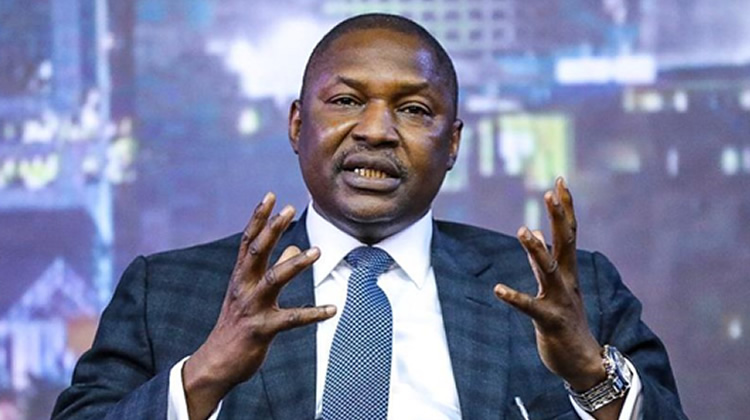
Abubakar Malami, SAN, former Attorney-General of the Federation and Minister of Justice, has accused the Chairman of the Economic and Financial Crimes Commission (EFCC) of pursuing a personal vendetta under the guise of law enforcement. Malami made the claims in a detailed statement released by his media aide, Mohammed Bello Doka, in response to ongoing investigations against him.
The dispute revolves around Chapter 9 of the Justice Ayo Salami Judicial Commission of Inquiry Report, which was established during Malami’s tenure as Attorney-General to investigate allegations of corruption and administrative abuse within the EFCC. According to Malami’s office, the current EFCC Chairman served as Secretary to the commission during the inquiry, and the chapter in question highlighted accountability lapses and professional conduct issues of senior EFCC officials.
Malami’s office argues that the present investigation against him is influenced by historical animosity arising from Chapter 9, and therefore the EFCC Chairman should recuse himself.
The Justice Ayo Salami Judicial Commission of Inquiry was tasked with examining allegations of corruption and mismanagement within Nigeria’s anti-graft institutions. Chapter 9 specifically addressed the conduct and responsibilities of senior EFCC officers, focusing on institutional accountability.
Malami’s statement claims that certain individuals, including the EFCC Chairman, became personally exposed by the report. “Viewed against this background, the present actions of the EFCC cannot reasonably be interpreted as neutral law enforcement. They amount to retaliatory persecution driven by historical animosity and personal vendetta,” the statement reads.
Malami’s office emphasised that under Nigerian law, any individual with prior personal involvement in a matter cannot oversee an investigation or prosecution. The test for recusal, the statement explains, is the “reasonable apprehension of bias,” and not proof of actual malice.
“It is therefore legally untenable, morally indefensible, and constitutionally impermissible for the EFCC Chairman to continue handling this matter,” the statement said.
The statement also highlighted alleged violations of Malami’s constitutional rights. These include:
Breach of the right to personal liberty as guaranteed under Section 35 of the Constitution.
Violation of the right to fair hearing under Section 36 of the Constitution.
Conducting a “trial by media” through selective leaks and public commentary aimed at generating public condemnation before any judicial determination.
According to Malami’s office, these actions undermine both the credibility of Nigeria’s anti-corruption institutions and the rule of law.
Malami’s statement paints a picture of systematic targeting by the EFCC under its current leadership. It lists concerns such as:
Persistent media trials and selective disclosures without following due process.
Restrictions on liberty and harassment without timely court arraignment.
Attempts to criminalise lawful policy decisions taken while Malami held office, rather than investigating actual criminal offences.
“This conduct confirms a shift from institutional accountability to the settlement of personal scores under the guise of law enforcement,” the statement reads.
Despite the ongoing investigation, Malami maintains his willingness to cooperate with an independent and neutral process. He insists that he should only be tried before a competent court where evidence, not vendetta, will determine the outcome.
“We are ready and willing to submit to a neutral and independent investigative process,” the statement added. “We reject political settlements, intimidation, or compromise.”
Malami’s office has made specific demands:
The immediate recusal of the EFCC Chairman from all matters involving him.
Intervention by the Attorney-General of the Federation to ensure that the case is transferred to a neutral authority.
Prompt institution of charges, if any, before a competent court of law.
The statement concludes that this is not merely a personal dispute but a constitutional matter. Malami’s office stressed that allowing the EFCC to operate as an instrument for personal vendettas would imperil the rule of law in Nigeria.
The EFCC, established in 2003, is Nigeria’s primary anti-corruption agency. Its mandate includes investigating financial crimes, prosecuting offenders, and promoting institutional accountability. Over the years, the EFCC has faced scrutiny and allegations of selective prosecution, political interference, and media-driven investigations, which critics argue compromise its independence.
Malami, a Senior Advocate of Nigeria, served as Attorney-General from 2015 to 2023. His tenure was marked by high-profile prosecutions and several controversies involving anti-corruption institutions, including the EFCC. The current standoff highlights tensions between former officeholders and the EFCC, raising questions about impartiality, governance, and the enforcement of anti-corruption laws in Nigeria.
As of now, the matter remains under scrutiny, and it is unclear whether the EFCC will respond to Malami’s demands. The controversy is likely to continue attracting public attention, especially given Malami’s prominence and the sensitive nature of the allegations.
The release of Malami’s statement marks a new phase in a long-standing tension between former government officials and Nigeria’s anti-corruption institutions.