
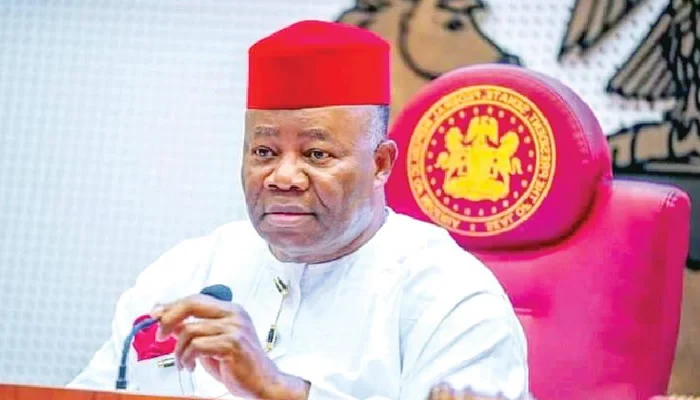
The President of the Senate, Senator Godswill Akpabio, has defended the close working relationship between the 10th National Assembly and the Executive arm of government, saying such cooperation is necessary for Nigeria’s growth and stability. He spoke on Friday at a joint sitting of the National Assembly during the presentation of the 2026 Appropriation Bill by President Bola Ahmed Tinubu.
In his welcome address, Akpabio responded to criticisms from some quarters that the legislature has become too friendly with the Executive. Critics, he noted, have described the relationship as a “sell-out” by the National Assembly. The Senate President rejected this view, arguing that history has shown that nations make progress when the arms of government work together in the national interest.
According to Akpabio, cooperation between the legislature and the executive does not mean a lack of independence or oversight. Rather, he said it reflects a shared commitment to national development within the limits of the constitution.
He explained that budgeting, especially at a time of economic pressure, requires trust, dialogue, and joint responsibility. “Major national decisions such as the budget only gain real meaning when institutions work together,” he said.
To support his argument, Akpabio referred to examples from global history. He cited the United States during the Great Depression in the 1930s, when President Franklin D. Roosevelt worked closely with Congress to implement the New Deal. According to him, that cooperation led to wide-ranging reforms that helped stabilise the American economy and restore public confidence.
He also mentioned post-war Britain, where the government of Prime Minister Clement Attlee worked closely with Parliament to rebuild the country after World War II. That period, he said, produced major social reforms, including the creation of the National Health Service, which still serves millions of people today.
“In each of these cases, progress did not come because everyone agreed on everything,” Akpabio said. “It came because leaders chose to work together in the national interest, even when decisions were difficult.”
By contrast, the Senate President warned that constant conflict between the legislature and the executive often leads to slow growth and poor governance. He pointed to the later years of the Roman Republic, where power struggles weakened institutions and eventually led to collapse.
He also referred to repeated government shutdowns in the United States caused by budget disagreements between Congress and the White House. According to him, such deadlocks disrupted public services, slowed economic activity, and hurt ordinary citizens.
“Across history and across continents, the lesson is clear,” Akpabio said. “When government institutions treat each other as enemies, the nation suffers. But when they act as partners under the constitution, stability grows and reforms take root.”
The Senate President said it was in this spirit of partnership that the 10th National Assembly has worked with the Tinubu administration over the past year. He noted that the current Senate has recorded one of the highest levels of legislative activity in Nigeria’s history.
According to him, lawmakers have passed a record number of bills covering key areas such as security, the economy, governance, justice, elections, infrastructure, energy, and social welfare. He said these laws were designed to support reforms and address long-standing national challenges.
On security, Akpabio said the National Assembly passed laws aimed at improving coordination among security agencies, strengthening intelligence sharing, and providing a stronger legal framework to tackle terrorism, banditry, kidnapping, and cross-border crimes. He noted that insecurity remains one of the biggest concerns for Nigerians and requires sustained legal and financial support.
He stressed that lawmakers do not see reports of insecurity-related deaths as mere numbers. “These are real people from our communities,” he said, adding that the National Assembly remains committed to supporting security agencies through appropriate laws and funding, while also ensuring proper oversight and accountability.
In the area of economic reform, Akpabio said the Senate and House of Representatives passed bills to support fiscal discipline, improve revenue generation, and promote transparency in the management of public funds. He said these laws provide legal backing for difficult but necessary reforms, including subsidy changes and efforts to reduce waste in government spending.
He also highlighted reforms in governance and the justice system. According to him, new laws have helped modernise court administration, reduce delays in legal processes, and improve access to justice for ordinary Nigerians. He added that steps have been taken to strengthen democratic institutions and protect their independence.
On elections, Akpabio said the National Assembly enacted reforms aimed at improving transparency and restoring public trust in the electoral process. He noted that credible elections are essential for democracy and national stability.
The Senate President further said that laws passed in the areas of infrastructure, energy, housing, and social protection have laid the foundation for faster development. He explained that these laws support power sector reforms, road and housing projects, and targeted support for vulnerable groups.
“Together, these laws are not just words on paper,” Akpabio said. “They turn reform ideas into enforceable policies and provide the legal support needed for national recovery and long-term growth.”
However, he admitted that despite these efforts, many Nigerians are still facing serious challenges. He acknowledged that high living costs, unemployment, and insecurity continue to affect daily life for millions of citizens.
Akpabio said the National Assembly understands the hardship faced by Nigerians and believes that the success of reforms should be measured by how much they improve people’s lives. He stressed that passing laws is only one step and that effective implementation is equally important.
He called on Nigerians to remain patient and to continue supporting the administration of President Bola Ahmed Tinubu. According to him, meaningful change takes time, especially after years of structural problems.
The presentation of the 2026 Appropriation Bill by President Tinubu marked another key moment in the relationship between the Executive and the National Assembly. The budget is expected to focus on economic growth, security, infrastructure, and social welfare, building on policies introduced in previous years.
As the budget process continues, Akpabio assured Nigerians that the 10th National Assembly will carefully examine the proposals, engage with relevant agencies, and ensure that national priorities are properly addressed.
He concluded by reaffirming the commitment of the National Assembly to serve the country with dedication and responsibility. “Our duty is to Nigeria and to the Nigerian people,” he said. “We will continue to work, debate, and decide in the national interest.”

