
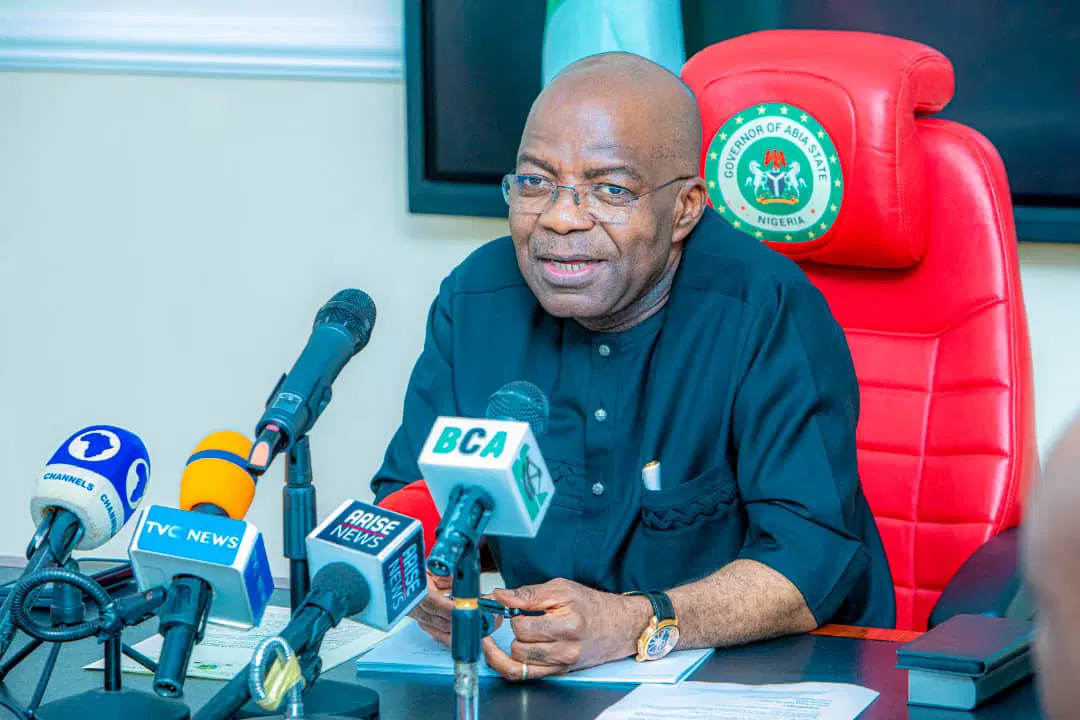
Abia State Governor, Dr. Alex Otti, has explained the reason behind his recent visit to the detained leader of the Indigenous People of Biafra (IPOB), Nnamdi Kanu, who is currently serving a jail term in Sokoto. The governor said his visit was guided by the need for dialogue and peace, not political ambition or personal interest.
Governor Otti made this clarification on Friday while receiving members of the Abia Diaspora Commission and a medical team from the state’s Global Medical Mission 2025 at the Government House in Umuahia. His explanation followed public reactions, including a video circulating on social media in which a man criticised the governor for visiting the IPOB leader.
Addressing the issue directly, Otti said the visit had been misunderstood by some people, especially on social media. He stressed that the decision to see Nnamdi Kanu was taken in the interest of peace and unity, not for political gain.
According to the governor, Nigeria is a democratic society where people are free to express different opinions. He noted that disagreement is normal in a democracy and that opposing views do not automatically make one person right and the other wrong.
“The video making the rounds represents a different opinion,” Otti said. “That is how democracy works. People will always see issues differently, and that is normal.”
Nnamdi Kanu, the leader of IPOB, has been a controversial figure in Nigeria’s political and security discussions over the past decade. IPOB is a group that has been pushing for the independence of the South-East region, a movement that has generated strong reactions from the Federal Government and the wider public. The group has been linked to unrest and security challenges in parts of the South-East, leading to arrests, trials, and military operations in the region.
Kanu’s detention has remained a sensitive issue, especially among his supporters, who continue to call for his release. At the same time, the Federal Government maintains that he is facing legal consequences for actions considered against national unity and security.
Governor Otti’s visit to Kanu in Sokoto prison therefore attracted public attention and mixed reactions. Some viewed it as a bold step toward dialogue, while others questioned the motive behind it.
Responding to claims that the visit was politically motivated, Otti firmly denied having any plans beyond his current role as governor. He said he has no intention of contesting any election after completing his tenure.
“One of the issues raised in the video was my ambition after serving as governor,” Otti said. “I have said this before, and I will say it again. By the time I complete my tenure as governor, I will retire from public office.”
The governor recalled that he had earlier made this position clear in October when he received representatives of President Bola Ahmed Tinubu. According to him, public service should be about making impact, not holding onto power.
Otti, a former banker and first-time governor, came into office with promises of reforms, transparency, and improved governance in Abia State. Since assuming office, his administration has focused on rebuilding infrastructure, improving healthcare and education, and restoring public confidence in government.
Political observers say Otti’s comments about retiring after his tenure are unusual in Nigeria’s political environment, where many politicians seek higher office after serving as governors. His statement, they say, appears aimed at calming speculation about his long-term political plans.
On the issue of his visit to Kanu, the governor said dialogue remains a key tool in resolving conflicts, especially in a country as diverse as Nigeria. He argued that listening and engaging, even with those holding opposing views, can help reduce tension and promote understanding.
“Peace does not come by ignoring difficult issues,” Otti said. “Sometimes, it requires sitting down, talking, and finding common ground.”
He did not disclose details of his discussion with Kanu but stressed that the visit should be seen within the broader context of seeking peace and stability. He also avoided making comments that could interfere with ongoing legal processes.
The Abia Diaspora Commission delegation and the medical team that visited the governor were in the state as part of preparations for the Global Medical Mission 2025. The programme is expected to bring medical professionals from the diaspora to provide healthcare services and training across Abia State.
While addressing the delegation, Otti used the opportunity to reflect on leadership, responsibility, and the need for unity at all levels of society. He said leaders must sometimes take difficult decisions that may not be popular with everyone but are necessary for long-term peace and development.
Public reaction to Otti’s explanation has remained mixed. Some residents of Abia State and the wider South-East have praised him for speaking openly and standing by his actions. They believe that engagement and dialogue are better approaches to addressing long-standing grievances in the region.
Others, however, remain sceptical and argue that visits to high-profile detainees can send mixed signals, especially at a time when security remains a concern in parts of the country.
Analysts say the debate reflects deeper national issues around unity, justice, and how to handle agitations in a democratic society. They note that Nigeria has often struggled to balance law enforcement with dialogue, especially in regions with strong feelings of marginalisation.
Governor Otti’s remarks also come at a time when governors across the country are being urged to play greater roles in peacebuilding and conflict resolution. With states facing challenges such as insecurity, unemployment, and economic hardship, many believe that dialogue at different levels can help reduce tension.
By clearly stating that he has no further political ambition, Otti appears to be drawing a line under speculation about his motives. Whether this assurance will calm critics remains to be seen, but his statement has added a new dimension to discussions around leadership and service in Nigeria.
As the debate continues, Governor Otti has maintained that his focus remains on governing Abia State and delivering on his promises to the people. He said history would judge leaders not by rumours or online criticism, but by the impact they make while in office.

