
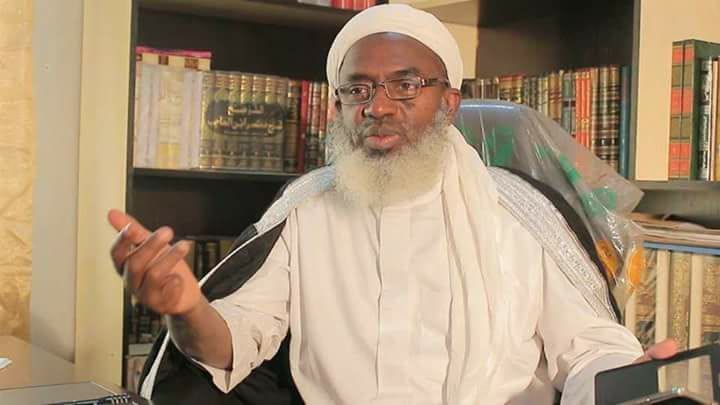
Controversial Islamic cleric, Sheikh Ahmad Gumi, has said that no individual or group can hold Nigerians to ransom, as political activities ahead of the 2027 general election continue to gather momentum.
Sheikh Gumi made the statement while reacting to the recent defection of former Labour Party presidential candidate, Mr Peter Obi, to the African Democratic Congress (ADC). His comments were shared on his official Facebook page, where he reflected on the state of Nigerian democracy and warned politicians to pay attention to the voices of ordinary citizens.
According to Gumi, the Nigerian political system is gradually improving, and voters are becoming more aware of their power.
“Nigerian democracy is maturing,” he wrote. “Politicians should listen to the people’s cry and do the right thing. Time is fast approaching. No one can hold Nigerians to ransom.”
The remarks have attracted attention across the country, especially as they come at a time when political realignments and party defections are becoming more frequent ahead of the next general election.
Peter Obi, who was the presidential candidate of the Labour Party (LP) in the 2023 election, officially announced his defection to the ADC on Wednesday in Enugu, the capital of Enugu State. Obi said his decision was based on his desire to rescue and transform Nigeria.
Speaking at the event, Obi explained that he believes the ADC offers a platform that aligns with his vision for good governance, accountability and economic reform. He added that the challenges facing Nigeria require bold decisions and fresh political thinking.
Obi’s move came as a surprise to many of his supporters, especially young Nigerians who rallied around him during the 2023 elections under the Labour Party. His campaign at the time was driven by strong youth support, calls for change and dissatisfaction with the two major political parties, the All Progressives Congress (APC) and the Peoples Democratic Party (PDP).
Although Obi did not win the 2023 presidential election, he finished strongly in several states, especially in the South-East and parts of the South-South. His performance reshaped Nigeria’s political conversation and showed that alternative voices could challenge the long-standing dominance of major parties.
The African Democratic Congress, which Obi has now joined, is a smaller political party with limited national influence compared to APC and PDP. However, recent developments suggest that the party may be positioning itself to attract reform-minded politicians and voters ahead of 2027.
Sheikh Gumi’s reaction to Obi’s defection was seen by many as a broader comment on Nigeria’s political future rather than a direct endorsement of any candidate or party. Known for his outspoken views on national issues, Gumi often comments on security, governance and leadership in Nigeria.
Over the years, Sheikh Gumi has been both praised and criticised for his bold statements, especially on issues related to insecurity in the North and dialogue with armed groups. Despite the controversies, he remains an influential voice, particularly among Muslim communities in Northern Nigeria.
In his latest comment, Gumi stressed that politicians must no longer ignore the suffering of Nigerians. He said poverty, insecurity, unemployment and rising living costs have pushed citizens to demand better leadership.
Since the end of the 2023 elections, Nigeria has faced serious economic challenges, including high inflation, fuel price increases and a weak currency. These issues have placed pressure on households and businesses, leading to widespread complaints and protests in some parts of the country.
In this context, political movements ahead of 2027 are being closely watched. Citizens are paying more attention to party defections, alliances and policy promises than ever before.
Supporters of Obi say his decision shows courage and determination to find a platform that truly reflects his values. Critics, however, question whether the ADC has the structure and reach needed to compete effectively at the national level.
For Sheikh Gumi, the focus appears to be less on party politics and more on accountability. His warning that “no one can hold Nigerians to ransom” suggests that leaders who fail to perform may face rejection at the polls.
“This is a message to all politicians,” said a political analyst in Abuja. “Nigerians are watching more closely now. They are comparing promises with actions.”
Nigeria returned to democratic rule in 1999, and since then, it has held several general elections. While the process has improved over time, issues such as vote buying, violence and lack of trust in institutions have continued to affect public confidence.
However, the 2023 election marked a turning point for many citizens, especially young voters, who became more involved in political discussions and monitoring of the electoral process.
Sheikh Gumi’s comment that Nigerian democracy is “maturing” reflects this growing awareness and participation. Social media, civil society groups and independent observers now play stronger roles in shaping political debate.
As preparations for 2027 slowly begin, calls for leaders to listen to the people are becoming louder. Many Nigerians say they want leaders who will focus on unity, economic stability and security rather than personal power.
For now, Peter Obi’s defection and Sheikh Gumi’s response have added fresh energy to the national conversation. Whether this will lead to real change remains to be seen.