
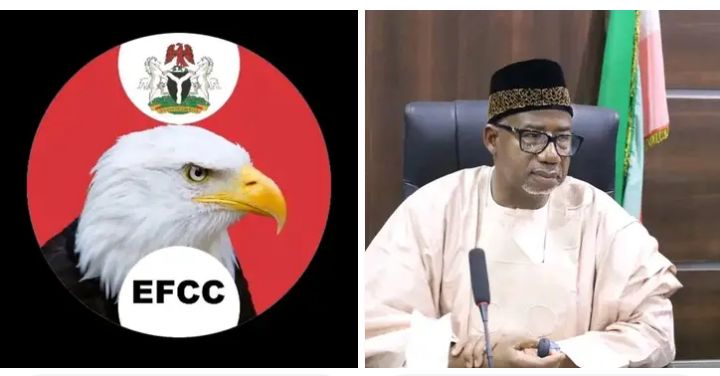
The Economic and Financial Crimes Commission (EFCC) has dismissed allegations by Bauchi State Governor, Bala Mohammed, that the agency is being used by political opponents to persecute him and officials in his administration.
In a statement posted on its official X handle on Friday, the anti-graft agency described the governor’s claims as “wild” and “far-fetched”, insisting that it operates independently and without political influence.
The EFCC was responding to comments credited to Governor Mohammed, in which he alleged that the commission was being deployed by political interests—particularly by Minister of the Federal Capital Territory, Nyesom Wike—to target him and his aides.
“The EFCC is an independent agency created to fight economic and financial crimes. The commission is non-partisan and discharges its mandate without affection or ill will,” the statement read.
The anti-graft agency said it was mischievous and condemnable for anyone to portray it as a pliable organization that pandered to the demands of political figures.
“The attempt to portray it as a pliable agency that panders to the demands of certain political interests is therefore mischievous and condemnable,” the statement added.
The commission described it as derogatory for the governor to link its activities in Bauchi State to the influence of any political officeholder.
“It is derogatory for Mohammed to ascribe the commission’s activities in Bauchi State to the influence of Mr. Wike. It is important to state that no political office holder is in a position to influence the investigative activities of the commission,” the EFCC said.
The agency further noted that if Governor Mohammed wanted to be fully transparent with Nigerians, he would have disclosed that he was standing trial for money laundering at the time he won the election as governor. The case was reportedly put in abeyance due to the constitutional immunity that comes with his office.
“Who also influenced the commission to investigate him in 2016 and charge him to court?” the EFCC added.
Regarding the ongoing cases involving some Bauchi State government officials, the EFCC said that all relevant facts had been submitted to the court, and that members of the public could access the charge sheets to verify whether the matter is politically motivated or the result of proper investigation.
The agency also dismissed claims that it was exaggerating matters by linking the cases to terrorism financing, insisting that it was merely enforcing the law.
“It would be a failure of duty if the commission did otherwise. We are guided by the law, and all our actions are consistent with existing legislation,” the statement read.
The EFCC criticized opposition politicians for quickly claiming persecution whenever an opposition figure is investigated, while remaining silent when members of the ruling party face similar charges.
“Recently, the commission arraigned a ranking member of the ruling party in court for alleged corruption, and not a whimper of persecution was heard from any of the political divide,” the EFCC noted.
The anti-graft agency urged Governor Mohammed to focus on governance rather than politicizing its actions, stressing that its mandate is to sanitize the nation’s financial system and ensure accountability.
“The EFCC calls on the governor to allow the agency to carry out its duties without politicization,” the statement said.
The EFCC is Nigeria’s primary anti-corruption agency, responsible for investigating and prosecuting economic and financial crimes. Since its establishment, it has been involved in high-profile cases against politicians, public officials, and business figures accused of corruption, money laundering, and other financial crimes.
The commission has often faced accusations of political bias from various quarters, particularly when investigating high-ranking politicians. However, the EFCC insists that it operates independently of political influence, as reinforced in Friday’s statement.
Governor Mohammed, a member of the Peoples Democratic Party (PDP), had previously accused the EFCC of targeting his administration to pressure him into defecting to the ruling All Progressives Congress (APC). He claimed that legal action against some of his aides was politically motivated.
Governor Mohammed alleged that the EFCC’s actions in Bauchi State were influenced by political rivals, particularly Minister Wike, a key figure in opposition politics. He suggested that investigations and prosecutions were aimed at undermining his administration and weakening the PDP in the state.
While such claims are common in Nigeria’s political landscape, the EFCC insists that all investigations are evidence-based, following due process, and are free from interference by any political officeholder.
The EFCC highlighted that all charges and investigations are filed in court, and members of the public can examine the charge sheets to verify the legitimacy of the proceedings. This transparency, the commission said, is proof that cases are not politically motivated but the result of legitimate investigations.
By providing public access to legal documents, the EFCC seeks to enhance public trust and counter claims of persecution or political targeting.
Nigeria’s political environment is highly competitive, with frequent tension between ruling and opposition parties. Allegations of selective prosecution are often raised when government agencies investigate figures aligned with opposition parties.
In this instance, the EFCC’s statement reflects an effort to counter political narratives, reaffirm its independence, and remind the public that its mandate is apolitical and legally grounded.
The EFCC urged Governor Mohammed and other political figures to focus on governance and policy delivery rather than politicizing investigations. By doing so, they said, officials would contribute to strengthening Nigeria’s anti-corruption framework and improving public confidence in institutions.
The commission also reminded Nigerians that it is committed to accountability and transparency, investigating all allegations of financial wrongdoing irrespective of party affiliation or political status.
“The EFCC remains steadfast in its mission to fight corruption, recover stolen funds, and ensure that no one is above the law,” the statement concluded.