
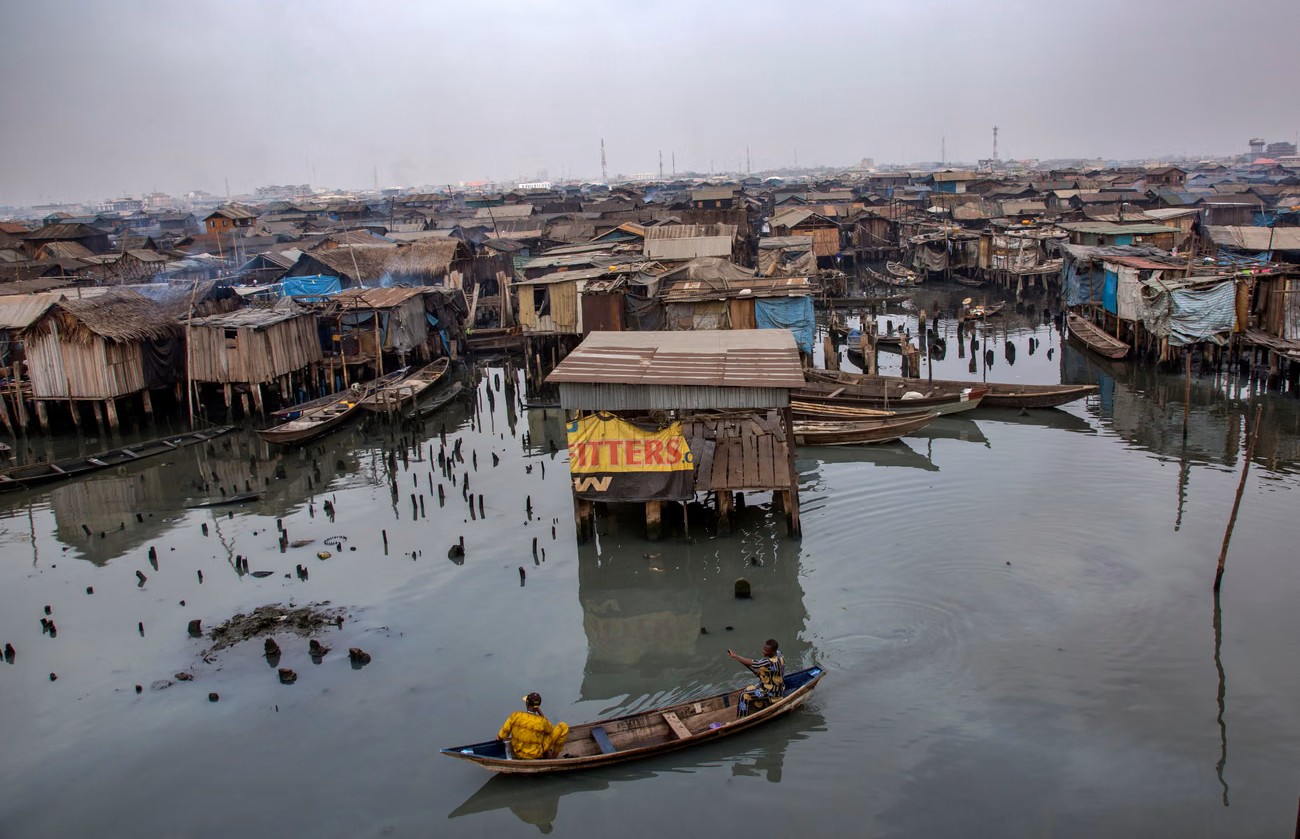
A public disagreement has emerged between Lagos State Governor, Mr Babajide Sanwo-Olu, and former Minister of Education, Mrs Oby Ezekwesili, over the recent demolition of buildings in the Makoko area of Lagos. The exchange has drawn national attention, raising questions about governance, human rights, urban development and the treatment of poor communities in Nigeria’s largest city.
Makoko is a densely populated waterfront settlement located along the Lagos Lagoon. For decades, it has been home to thousands of low-income residents, many of whom depend on fishing, petty trading and small businesses for survival. The community has long faced challenges such as poor housing, lack of basic services and repeated threats of eviction due to its location and informal status.
The latest demolition exercise, carried out by the Lagos State Government, was explained by authorities as a safety measure. According to the government, structures built under and around high-tension power lines pose serious risks to lives and property and must be removed to prevent accidents.
However, Mrs Ezekwesili strongly disagreed with this explanation. In a detailed memorandum addressed to President Bola Ahmed Tinubu and Governor Sanwo-Olu, she accused both the Federal and Lagos State governments of acting outside the law and causing unnecessary suffering to vulnerable citizens.
Ezekwesili described the demolitions as unconstitutional, inhumane and a form of state-backed oppression. She argued that the use of government power to remove poor people from their homes without adequate protection or alternatives reflects deeper problems in Nigeria’s democracy.
She raised broader questions about citizenship and governance in Lagos. According to her, the situation in Makoko forces Nigerians to ask whether Lagos operates as a city for all citizens or only for those with economic power. She questioned whether human dignity is being sacrificed for land value and urban development.
Ezekwesili stressed that Makoko residents are not illegal occupants or outsiders. She said they are Nigerian citizens whose rights should be protected under the Constitution, regardless of their income level or living conditions.
“Many of these residents have lived and worked in Makoko for generations,” she argued. “They contribute to the city’s economy through fishing, trading and other informal work, yet they are treated as if they do not belong.”
According to her, years of neglect and repeated demolitions have created a pattern where poverty is treated as a reason to deny people their basic rights. She warned that this approach deepens inequality and weakens trust in government.
The former minister, who now leads the School of Politics, Policy and Governance, said the recent demolition also broke earlier promises made by Lagos State officials. She claimed that before the exercise began, community leaders were told that only buildings within a 30 to 50-metre safety zone around high-tension power lines would be affected.
Based on this understanding, she said, residents cooperated with authorities and expected the operation to be limited. However, she alleged that the demolition later went far beyond the agreed boundaries.
According to Ezekwesili, structures located hundreds of metres away from the power lines were also pulled down. These included homes, schools, small clinics and business places that did not pose any safety risk.
“A government that changes the rules in the middle of an operation and expands demolition without notice is not enforcing the law but abusing its power,” she said.
She further alleged that the demolition led to loss of lives, though the Lagos State Government has not confirmed this claim. Ezekwesili described the operation as a forceful land takeover aimed at clearing poor communities from valuable waterfront areas for the benefit of the elite.
She referred to the situation as “class cleansing,” arguing that safety and urban planning were being used as excuses to push the poor out of prime locations.
Beyond the legal issues, Ezekwesili warned that the demolitions had created a serious humanitarian crisis. She said thousands of families had been displaced, leaving many without shelter, food or access to healthcare.
She also pointed out that children’s education had been disrupted, as schools were destroyed and families forced to relocate suddenly. According to her, women, children and the elderly are now exposed to hunger, disease and insecurity.
Ezekwesili argued that once government actions result in homelessness, the state has a constitutional and moral duty to provide immediate care, shelter and protection for those affected.
In response to these criticisms, Governor Sanwo-Olu strongly defended the actions of his administration. Speaking to journalists, he rejected the claim that the demolitions were illegal or inhumane.
Instead, the governor accused some local and international non-governmental organisations, NGOs, of exploiting the situation for their own benefit. He said the state government was closely monitoring the activities of these organisations and would soon present evidence.
“We are aware that some NGOs are trying to profit from this situation,” Sanwo-Olu said. “We are monitoring them and we will provide evidence to support our claims.”
According to the governor, these organisations had received large amounts of funding from international donors, claiming they would support affected communities. However, he alleged that they failed to deliver real help on the ground.
“They have collected substantial grants and resources, yet they have not met the commitments they made,” he said. “What we are seeing now is an attempt to hide those failures by attacking the government.”
Sanwo-Olu suggested that this alleged profiteering explains why some voices have been very loud in criticising the demolition exercise.
“That is why you see some people protesting louder than those who were directly affected,” he said. “We are ready to address these issues openly and explain why certain decisions had to be taken.”
The governor maintained that the demolition was necessary to protect lives. He said buildings under high-tension power lines pose a serious danger, as accidents involving electricity can lead to loss of lives and property.
According to him, the government has a responsibility to prevent such disasters, even when the decisions involved are difficult.
The clash between Sanwo-Olu and Ezekwesili reflects a long-standing debate in Lagos and other Nigerian cities. As urban areas expand and land becomes more valuable, governments often face pressure to redevelop informal settlements. At the same time, civil society groups continue to push for the protection of the poor and the inclusion of all citizens in development plans.
For Makoko residents, the debate is not just about policy or politics. It is about homes lost, livelihoods destroyed and uncertainty about the future.