
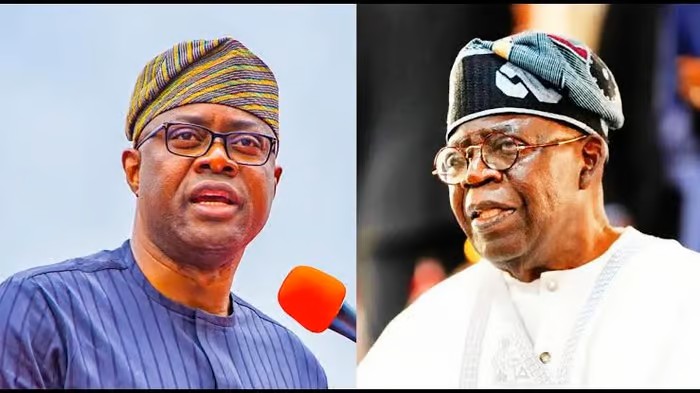
Former Ekiti State Governor, Ayodele Fayose, has revealed what he described as the “untold story” of Governor Seyi Makinde’s recent visit to the Aso Rock Presidential Villa, shedding light on the dynamics between the Oyo State governor and President Bola Ahmed Tinubu.
In a post shared on social media Wednesday, Fayose said the meeting underscored the political realities confronting Makinde, especially regarding his positioning within the ruling All Progressives Congress (APC) ahead of the 2027 general elections. According to Fayose, Makinde reportedly sought support from President Tinubu on political issues but was confronted with the limits of the President’s willingness to intervene in partisan matters.
Fayose claimed that Governor Makinde demonstrated that he “lacked the courage” to confront the President alone, reportedly enlisting the support of Plateau State Governor Simon Lalong to accompany him. The former Ekiti governor said that during the meeting, Tinubu made it clear that official state matters would be listened to, but political disputes were outside the scope of their discussion.
“If it had to do with politics or any claim regarding Rivers State Governor Nyesom Wike, who had previously accused the President on television of plotting a one-party state, it is better, as usual, to address it publicly rather than privately,” Fayose quoted Tinubu as saying.
According to Fayose, the President reportedly stressed that he could not entertain political disagreements in private while Makinde publicly said something different.
Fayose further claimed that Tinubu told Makinde he should not expect support from him in the 2027 elections. “He should also expect that the President will support his party,” Fayose wrote. The former governor added that Tinubu highlighted Governor Wike’s political consistency and influence, emphasizing that Makinde’s issues with Wike were personal and should not involve the Presidency.
This, Fayose said, may explain why Makinde publicly stated he is comfortable remaining in the People’s Democratic Party (PDP), despite speculation about possible political realignment. Fayose interpreted Makinde’s position as recognition of the political reality that there is “nothing for him in APC.”
In addition to the political context, Fayose raised concerns over transparency regarding federal intervention funds. He asked whether Makinde has returned N30 billion that he reportedly received from the Federal Government as assistance following the January 2023 Ibadan explosion, a tragedy that affected hundreds of residents and drew national attention.
The January 2023 Ibadan explosion, which occurred in the capital of Oyo State, prompted widespread calls for government intervention. Fayose suggested that Makinde should update the people of Oyo State on how the funds were utilized or returned, especially after his meeting with the President.
Governor Seyi Makinde has been a notable figure in southwestern Nigeria, known for his technocratic approach and public-oriented policies in Oyo State. However, his political influence beyond Oyo has sometimes been questioned, particularly in the context of national politics and inter-party dynamics ahead of the 2027 elections.
The meeting with Tinubu, as described by Fayose, comes amid speculation about Makinde’s potential moves in national politics. Observers have long noted the complex relationship between governors of opposition parties and the ruling APC, especially in critical swing states like Oyo.
Fayose’s revelations paint a picture of a political reality in which even a high-profile governor like Makinde must navigate carefully when engaging with the Presidency. While the meeting reportedly addressed state-level issues, political matters—including disputes involving influential PDP figures like Wike—were clearly off-limits.
The disclosure by Fayose is expected to fuel discussions on social media and political commentary platforms. Many analysts believe it highlights the limits of negotiation for opposition governors within the context of a ruling party-led federal government.
Some political watchers suggest that Makinde’s insistence on remaining in the PDP may have been influenced by his realization that joining APC would not automatically guarantee political advantage. Others point out that the meeting underscores Tinubu’s political strategy: maintaining party loyalty and prioritizing strategic alliances while discouraging interference in internal conflicts among opposition leaders.
For Oyo State residents, Fayose’s revelation raises questions about leadership priorities and accountability. Beyond political maneuvers, issues like the proper use of federal intervention funds remain critical to public trust. Transparency and communication about such funds are seen as essential to maintaining confidence in governance, particularly in the aftermath of crises like the Ibadan explosion.