
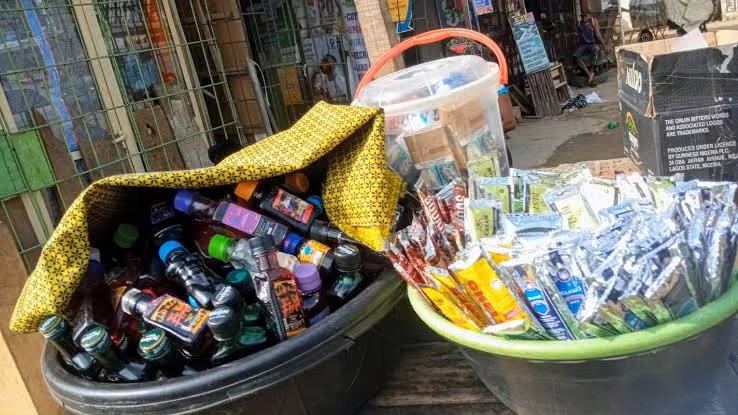
Workers and operators in Nigeria’s distillery and beverage sector have raised serious concerns over the enforcement of a ban on sachet alcohol and small-sized alcoholic drinks, warning that the policy could lead to massive job losses across the country.
Members of distillers’ associations, operating under the Food, Beverages and Tobacco Senior Staff Association (FOBTOB) and the National Union of Food, Beverages and Tobacco Employees (NUFBTE), on Friday protested at the Lagos office of the National Agency for Food and Drug Administration and Control (NAFDAC). They accused the agency of enforcing a policy that could displace no fewer than 5.5 million Nigerians from their sources of livelihood.
The unions, which are affiliates of the Trade Union Congress (TUC) and the Nigeria Labour Congress (NLC), said the action by NAFDAC threatens both direct and indirect jobs in the distillery, brewery and distribution value chain.
The protest followed NAFDAC’s renewed enforcement of a ban on the production, distribution and sale of alcohol packaged in sachets and polyethylene terephthalate (PET) bottles below 200 millilitres. The agency said the ban was aimed at protecting public health, especially young people.
NAFDAC had earlier announced on November 11, 2025, that it planned to enforce a total ban on sachet alcohol and small PET bottles by December 2025. The plan was said to be in line with a directive from the Senate, which raised concerns about the easy access of such products to minors.
However, the enforcement was later suspended after the Federal Government, through the Office of the Secretary to the Government of the Federation (SGF), directed NAFDAC to halt all actions on the proposed ban. The suspension was meant to allow further consultations with stakeholders and await a final government decision.
Despite this earlier suspension, the Director-General of NAFDAC, Prof. Mojisola Adeyeye, announced during a media briefing on Wednesday that the agency had received a fresh matching order from the Senate to proceed. She said enforcement had already begun across the country.
This development triggered strong reactions from workers and manufacturers, leading to Friday’s protest in Lagos.
Speaking at the protest ground, the Executive Secretary of FOBTOB, Mr Solomon Adebosin, said the enforcement would have devastating consequences for Nigerian workers and the economy.
According to him, about 500,000 Nigerians are employed directly in the distillery and related sectors, while more than five million others depend on the industry indirectly through distribution, transportation, retail and other support services.
“We are here today to protest the sudden seizure of our companies in the distillery sector by NAFDAC over sachet drinks and PET bottles that are less than 200ml,” Adebosin said.
“We have over 500,000 Nigerians working directly in this sector and more than five million working indirectly. All of them are going to be affected if this policy continues.”
He argued that the ban contradicts the Renewed Hope Agenda of President Bola Tinubu, which focuses on attracting investment, supporting local industries and creating jobs.
Adebosin also challenged NAFDAC’s claim that sachet alcohol and small PET drinks are easily accessible to minors, saying there was no clear data to support the allegation.
“Access and control are what we should be talking about. Let us put proper controls in place so that children and minors do not have access to these products,” he said.
He added that distillers and manufacturers have invested heavily in advocacy, education and sensitisation to ensure that only adults consume alcoholic products.
Also speaking at the protest, the Head of Department, Brewery and Tobacco, of NUFBTE, Mr Azeez Razaq, accused NAFDAC of undermining the growth of indigenous manufacturers.
Razaq alleged that the agency’s actions amounted to sabotage of local businesses that have invested heavily in Nigeria despite economic challenges such as high inflation, rising energy costs and foreign exchange difficulties.
He also criticised NAFDAC for allegedly acting against the earlier directive of the SGF, which ordered a pause on enforcement.
“The decision to shut down these companies will lead to massive job losses, and this will only worsen insecurity in the country,” Razaq said.
According to him, unemployed youths are more vulnerable to crime and social unrest, and policies that increase unemployment should be carefully reviewed.
While reading out the demands of the protesting unions, a member of FOBTOB, Mr Anthony Oyagha, called on President Tinubu to urgently intervene in the matter.
“We call on the Presidency to ensure that NAFDAC aligns its actions with government policy, legislative oversight and the broader national interest,” Oyagha said.
“Local manufacturers deserve honour, protection and partnership, not punitive actions that destroy investments, livelihoods and confidence in Nigeria’s business environment.”
He urged the President to act decisively to protect indigenous industries, safeguard jobs and ensure that regulatory agencies operate in the interest of Nigerians.
The sachet alcohol debate has been ongoing for several years. Supporters of the ban argue that cheap, small-sized alcohol products make it easier for underage persons to access alcohol and encourage abuse. They also raise concerns about public health and social problems linked to excessive drinking.
On the other hand, manufacturers and labour unions insist that the products serve millions of adult Nigerians who cannot afford larger and more expensive bottles. They argue that banning the products without proper alternatives will hurt low-income earners and small traders.
Industry players also point out that sachet packaging is common in Nigeria across different products, including water, beverages and household items, because it suits the purchasing power of many citizens.
They note that Nigeria is already facing high unemployment, especially among young people, and any policy that could lead to millions of job losses should be handled with caution.
As of the time of filing this report, NAFDAC had not responded directly to the specific allegations raised during the protest. However, the agency has consistently maintained that its actions are guided by law and aimed at protecting Nigerians.
The unions say they will continue to engage the government and other stakeholders until their concerns are addressed. They insist that dialogue, regulation and enforcement of age restrictions are better solutions than a total ban.