
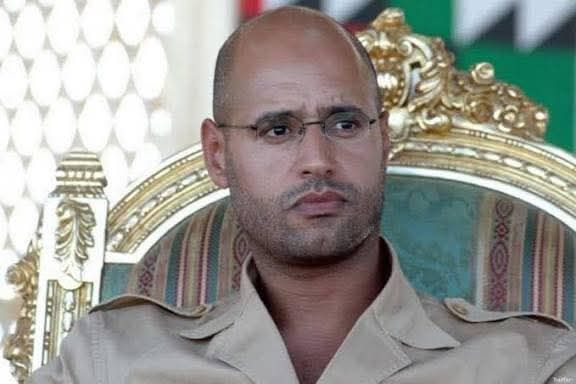
Saif al-Islam Gaddafi, the son of Libya’s former leader Col. Muammar Gaddafi, has reportedly been shot dead, raising new uncertainties in the politically fractured North African nation. The 53-year-old, once considered the heir apparent to his father’s legacy, was confirmed dead by the head of his political team on Tuesday, according to the Libyan News Agency.
Details surrounding the killing remain unclear, with multiple accounts emerging about the circumstances of his death. Saif’s lawyer told the AFP news agency that a “four-man commando” unit carried out an assassination at his home in the city of Zintan. Meanwhile, his sister claimed in an interview with Libyan television that he died near Libya’s border with Algeria, highlighting the confusion over the exact location of the attack.
Saif al-Islam Gaddafi had long been one of Libya’s most prominent and influential figures after his father, who ruled the country from 1969 until being ousted and killed during a popular uprising in 2011. Known for his political skills and public visibility, Saif played a key role in Libya’s efforts to improve relations with Western nations during the early 2000s. He was central to negotiations that led Libya to abandon its nuclear weapons programme, which helped end decades of international sanctions and positioned him as a modernizing figure within his father’s regime.
Born in 1972, Saif was educated in both Libya and abroad, and was widely regarded as a sharp and ambitious political operator. Despite this, he repeatedly denied any desire to inherit power directly from his father, famously stating that leadership was “not a farm to inherit.” However, his political ambitions resurfaced after the fall of the Gaddafi regime. In 2021, he declared his intention to run for Libya’s presidency in elections that were later postponed indefinitely due to ongoing instability.
Following the overthrow and death of Muammar Gaddafi in 2011, Saif al-Islam faced significant legal challenges. He was accused of playing a central role in suppressing anti-government protests during the uprising, leading the International Criminal Court (ICC) to seek his arrest on charges of crimes against humanity. After the fall of the regime, he was captured by a militia in Zintan and jailed for nearly six years.
In 2015, a court in Tripoli, controlled by the UN-backed government in western Libya, sentenced him to death in absentia for his role in the crackdown on opposition protests. Two years later, he was released by militias in Tobruk in eastern Libya under an amnesty law, highlighting the fragmented and complex nature of Libya’s political and legal landscape.
Since 2011, Libya has been divided between rival governments and numerous armed militias, creating a persistent security vacuum across the country. The west of Libya is nominally governed by the UN-backed Government of National Unity, while the east is dominated by forces loyal to the House of Representatives and allied militias. This division has made the country unstable and prone to violent clashes, including targeted assassinations like that of Saif al-Islam Gaddafi.
During his father’s rule, Saif was a prominent figure on the international stage despite holding no formal governmental title. He was involved in high-profile diplomacy and policy-making, earning him a reputation as the “face of reform” in the Gaddafi era. International observers often saw him as a more moderate figure compared to his father, who ruled Libya with a combination of authoritarian control and political maneuvering.
Following his release, Saif al-Islam maintained a cautious public profile, occasionally resurfacing to comment on national politics and assert his role in Libya’s future. Analysts have long considered him a potential figure around which factions in Libya could rally, either in support of reunification or in pursuit of political power, which makes his death significant in the country’s ongoing instability.
The assassination of Saif al-Islam Gaddafi comes at a time when Libya continues to face deep divisions, insecurity, and economic challenges. Militias and political groups continue to compete for influence, often resorting to violence. The killing may further complicate ongoing efforts at national reconciliation and the organization of credible elections, which have repeatedly been postponed due to disputes over political authority.
For many Libyans, Saif’s death marks the end of a chapter tied closely to the legacy of the Gaddafi era, which continues to influence politics, tribal relations, and international diplomacy in the country. His life was emblematic of Libya’s complex journey since the 2011 uprising—shaped by ambition, political maneuvering, international engagement, imprisonment, and attempts at reconciliation in a divided nation.
As Libya grapples with the aftermath of this assassination, the international community, including the United Nations and the ICC, is likely to monitor developments closely. Analysts say that Saif al-Islam’s death could reshape political alliances and affect ongoing efforts to stabilize the North African country.