
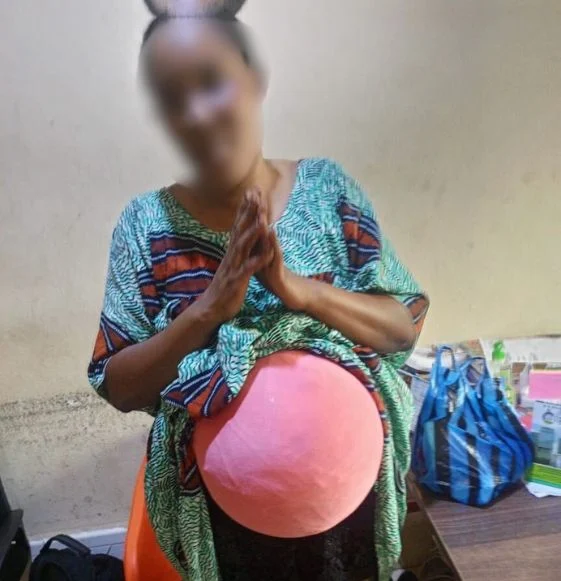
Operatives of the National Drug Law Enforcement Agency (NDLEA) have uncovered what officials described as “bizarre” attempts to smuggle illegal drugs through the Seme land border in Lagos and the Mallam Aminu Kano International Airport in Kano.
The agency said it intercepted a woman who faked a pregnancy to conceal thousands of tramadol capsules and also arrested a foreign national who swallowed wraps of cocaine in a bid to transport them to Europe. In a separate operation in Lagos, the NDLEA arrested a real estate chief executive officer over alleged involvement in drug trafficking.
The agency’s Director of Media and Advocacy, Femi Babafemi, disclosed the arrests in a statement shared on Sunday.
According to the NDLEA, a 35-year-old businesswoman, Rabi Muhammad, was intercepted at the Seme border while attempting to cross into Cotonou, Benin Republic. Officers became suspicious after noticing her unusually protruding stomach.
A detailed search revealed that her pregnancy was fake. Instead of carrying a baby, she had strapped a pink-coloured calabash to her abdomen. Inside the calabash were 3,200 capsules of tramadol, an opioid drug often abused for its stimulant effect.
The statement said she was intercepted on the departure side of the Seme border on February 16, 2026. Officials said the tramadol capsules were intended for sale in Cotonou.
Tramadol is a prescription drug used to treat pain, but it has become widely abused in Nigeria and other West African countries. Security agencies have raised concern about its role in crime, as some suspects arrested for violent offences are found to be under its influence.
The Seme border is one of Nigeria’s busiest land borders, linking Lagos to neighbouring Benin Republic. It is a major route for trade and movement of people. However, it has also been used by smugglers to move goods and illegal substances across borders.
On the same day, NDLEA operatives at the screening point of the Mallam Aminu Kano International Airport intercepted a 41-year-old Ivorian man identified as Michael Gohouri. He was undergoing outward clearance for passengers boarding an Ethiopian Airlines flight to Milan, Italy, via Addis Ababa.
Officials said a body scan confirmed that he had ingested illicit substances. He was placed under observation and later excreted 82 wraps of cocaine weighing 1.49 kilograms.
According to the NDLEA, Gohouri had arrived in Lagos from Milan on January 17, 2026. He reportedly travelled between Lagos and Enugu for three weeks before heading to Kano, where he stayed for a week. It was in a hotel room in Kano that he allegedly swallowed the cocaine consignment.
He was said to have been promised 5,000 euros for successfully delivering the drugs to Milan. Investigators said he claimed his father is Ivorian and his mother is from Enugu State in Nigeria. He reportedly applied for asylum in Italy in 2013 and obtained a resident permit valid until May 2026. He also has a Nigerian National Identification Number.
Airports in Nigeria have long been under watch as drug traffickers attempt to use them as transit points to Europe and other destinations. NDLEA officials say drug syndicates often recruit individuals who swallow drug wraps, a risky method that can lead to death if the packages burst inside the body.
In a related development, NDLEA operatives arrested the Chairman and Chief Executive Officer of Trans Fortress Global Resources, Kolapo Oladapo Raji, at his residence in Ikate, Lekki, Lagos.
The agency said Raji, 57, had been on its watchlist since 2025 following credible intelligence linking him to drug trafficking activities. He was arrested on February 12, 2026, shortly after returning from the United Kingdom.
A search of his residence reportedly led to the recovery of four large bags containing 89.2 kilograms of Canadian Loud, a strong strain of cannabis. A 2024 model Toyota Hilux vehicle was also recovered at the point of arrest.
Canadian Loud is a high-grade cannabis strain that is often sold at a high price in the illegal drug market. NDLEA officials said Raji admitted to financing drug consignments for an overseas associate before setting up his own distribution network after making large profits.
He allegedly told investigators that the huge financial gains he received encouraged him to establish an independent drug distribution channel.
The NDLEA has stepped up its operations in recent years as part of efforts to curb drug trafficking and abuse in Nigeria. The agency has carried out raids at airports, seaports, border posts, and residential areas, leading to several high-profile arrests.
Drug abuse remains a major concern in Nigeria, especially among young people. The Federal Government has repeatedly pledged support for NDLEA’s efforts to reduce the supply and demand of illegal drugs.
Officials say the latest arrests show that traffickers are using increasingly desperate and creative methods to move drugs. However, they insist that improved surveillance, intelligence gathering, and cooperation with international partners are helping to block such attempts.

