
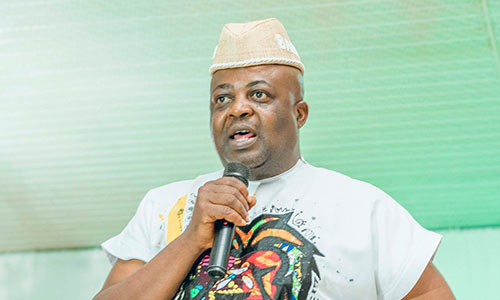
A political storm is brewing around the office of the President of the Senate, Godswill Akpabio, following the resignation of one of his senior aides, Patty Etete, who has alleged sustained hostility, physical assault and administrative problems within the office.
Mr Etete, a former member of the House of Representatives, announced his resignation in a letter dated February 27 and addressed to the Senate President. In the letter, he said his decision to step down was “long overdue” and followed years of what he described as humiliation, discrimination and denial of access to Mr Akpabio.
However, a spokesperson to the Senate President said he was not aware of Mr Etete’s resignation at the time the issue became public.
Mr Etete represented Ikot Ekpene/Essien Udim/Obot Akara Federal Constituency in the House of Representatives from 2007 to 2011. He later became a political supporter of Mr Akpabio, especially during the 2023 general elections.
In his resignation letter, Mr Etete said he played an active role in supporting Mr Akpabio’s senatorial ambition and his bid to become Senate President after the elections that brought President Bola Tinubu to power.
According to him, he was invited to be part of what Mr Akpabio described as his “first eleven” appointees. He said the appointment was initially announced as Special Assistant, but he was later made to serve as Senior Legislative Aide.
Mr Etete described the change in designation as a downgrade and said he accepted it in good faith. However, he said the experience left him feeling embarrassed.
“You invited me to be part of your ‘first eleven’ of appointees, given my roles and contributions both at the senatorial election and the contest for the Senate presidency,” he wrote.
He added that the position he eventually held was demeaning when compared to what he believed had been promised.
One of the most serious claims in Mr Etete’s letter is that he worked in what he described as a hostile environment within the Senate President’s office.
He alleged that he was denied certain privileges and access to the Senate President. He also claimed that he was physically assaulted several times by fellow aides.
According to him, some of these incidents happened with the knowledge of Mr Akpabio.
The allegations have not been publicly addressed in detail by the Senate President. The spokesperson’s statement that he was unaware of the resignation did not directly respond to the claims of assault or hostility.
If confirmed, the allegations could raise serious concerns about working conditions in the office of one of the country’s top political leaders.
Mr Etete also raised concerns about a symposium on the creative economy which he said he coordinated in support of the Senate President’s legislative agenda.
The creative economy sector includes film, music, fashion, art and other cultural industries that contribute to Nigeria’s economy. In recent years, there have been calls for stronger laws to support the sector and protect young entrepreneurs.
According to Mr Etete, the symposium attracted participants from Nigeria and abroad. He said some resource persons paid for their own travel, accommodation and presentation materials, expecting that they would later be reimbursed.
He claimed that more than six months after the event, the interim report of the symposium had not received the Senate President’s attention for legislative follow-up. He also alleged that bills submitted by service providers remained unpaid.
In his letter, Mr Etete asked Mr Akpabio to approve payment of an attached bill covering expenses from the event. He argued that settling the debts would protect the reputation of the Senate President’s office and honour the commitment of what he described as patriotic Nigerians who supported the programme.
The issue of unpaid bills and delayed reimbursements has often caused controversy in Nigerian public offices, where service providers sometimes complain about delays in payment after executing contracts.
Another part of Mr Etete’s letter focused on political mobilisation in Akwa Ibom State. He claimed he helped mobilise over 240 support groups for Mr Akpabio’s ambition and for President Tinubu during the 2023 elections.
Support groups often play a key role during elections. They organise rallies, sensitise voters and promote candidates at the grassroots level.
Mr Etete, however, lamented that promises made to engage and appreciate these groups were not fulfilled after the elections.
He alleged that a former Deputy Chief of Staff in the Senate President’s office told him that unless he pledged allegiance to him, both he and the support groups would not be accommodated.
This claim suggests internal power struggles within the Senate President’s team, although the individuals mentioned have not publicly responded to the allegations.
In a dramatic part of his letter, Mr Etete referred to a vow allegedly made with Mr Akpabio and other political associates before a statue of Mary. Mr Akpabio is known to be a Catholic.
Mr Etete wrote that he, Mr Akpabio, Rt. Hon. Ubong Etiebet and the current Minister of State for Gas knelt before the statue and made a vow concerning Mr Akpabio’s political ambition.
He said the vow was that those who took it would not betray the Senate President, and that the Senate President would not betray them in return.
“Each time I remember how yourself, myself, Rt. Hon Ubong Etiebet and the current Minister for State, Gas, knelt down before the statue of Mary, making a vow concerning your ambition, my heart bleeds,” he wrote.
He questioned whether the vow was meant to be honoured, especially in light of the treatment he claimed to have received.
The reference to a religious setting adds a sensitive dimension to the matter, as religion often plays an important role in Nigeria’s political culture.
Mr Akpabio is one of the most prominent politicians from Akwa Ibom State. He served as governor of the state from 2007 to 2015 before moving to the Senate. In 2023, he emerged as President of the Senate, one of the highest offices in the country.
Since assuming office, he has faced both support and criticism from different quarters. As Senate President, he oversees legislative activities in the upper chamber of the National Assembly and plays a key role in passing laws and confirming appointments.
Resignations and internal disputes among aides are not new in Nigerian politics. However, when such disputes involve allegations of assault and broken political promises, they tend to attract public attention.
As of the time of filing this report, there has been no detailed official response from Mr Akpabio addressing the specific allegations raised by Mr Etete.