
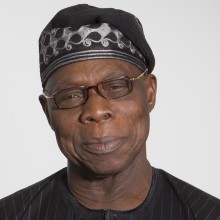
Former Nigerian President Olusegun Obasanjo has dismissed rumours about his death and declared that he remains strong and healthy as he marks his 89th birthday.
Obasanjo made the statement on Wednesday in Abeokuta during a public lecture organised as part of activities to celebrate his birthday. The event brought together political leaders, scholars, diplomats and other guests who gathered to reflect on leadership and development in Africa.
Speaking during the colloquium titled “Burden and Blessing of Leadership: Reflections from Global Africa to the World,” the former president criticised people who circulated a fake letter claiming he had written about his own death.
He said those behind the message were wasting their time because he had no plan to die soon.
“I want to draw your attention to the work of some never-do-well people,” Obasanjo said. “They publish and circulate a fake paper credited to me that I am writing, giving notice of my death. That is their wish and surely not God’s wish for me.”
The elder statesman added that he believes God still has more work for him to do.
“God has assured me that He has more for me to do on earth and He has given me the strength to do it. Those who wish otherwise will be dealt with by God Himself. I dey kampe as usual,” he said, using a popular Nigerian phrase meaning he is strong and doing well.
Obasanjo was born on March 6, 1937, in Abeokuta, Ogun State. Over several decades, he has remained one of Nigeria’s most influential political figures, serving both as a military head of state and later as a democratically elected president.
His latest comments came as he reflected on his life, leadership journey, and the challenges facing Africa.
In his lecture, Obasanjo spoke strongly about what he described as a long-standing leadership crisis across the African continent. According to him, Africa has great potential but has struggled to reach its full development because many leaders fail to serve the people honestly.
He said Africa should be a place of prosperity and peace because of its rich natural resources and human capital.
“By every measure of natural endowment, Africa should be a continent of prosperity, stability, peace and global influence,” he said.
However, he added that the reality has often been different, with many countries facing poverty, insecurity and poor governance.
Obasanjo argued that the major cause of the problem is leadership failure rather than geography or colonial history.
“The primary cause is the failure of those entrusted with power to lead for the people and serve them rather than against them,” he said.
According to him, some leaders begin their political careers promising reforms and accountability but later change once they gain power.
He warned that leaders sometimes weaken democratic institutions and silence critics to protect their personal interests.
“The same young reformer who promised accountability begins to silence the press, harass the judiciary and intimidate civil society,” he said.
Obasanjo stressed that Africa must focus on developing leaders with strong character and values rather than simply training people for positions of power.
“We must invest not only in teaching leaders what to do but in forming leaders who have the values to do the job the right way,” he said.
The former president also used the opportunity to address young Africans, urging them to take democracy seriously and participate actively in governance.
He warned that if leaders fail to create opportunities and stability for young people, the consequences could affect the continent for generations.
“A continent that fails its youth does not merely waste a generation; it plants the seeds of instability that will haunt the next several generations,” he said.
Obasanjo called for leadership that is transparent, accountable and focused on the common good.
During the lecture, the former president shared some personal experiences from his years in leadership. He described leadership as both a burden and a blessing, saying it often involves difficult decisions that affect millions of people.
He recalled a moment near the end of the Nigerian Civil War when he commanded the Third Marine Commando Division.
According to him, his troops were preparing for the final military push while thousands of civilians were trapped in the conflict zone.
“At that moment, hundreds of thousands of Igbo civilians were starving and dying,” he said.
He explained that he had to decide whether to attack quickly to end the war or slow down to avoid worsening the humanitarian crisis.
“No textbook told me what to do. No senior officer was going to make that call. It was mine alone,” he said.
Obasanjo said he decided not to shell Owerri, a decision he believes helped save many lives.
Obasanjo’s political career has spanned several important moments in Nigeria’s history. He first became Nigeria’s head of state in 1976 after the assassination of Murtala Mohammed.
He later handed power to a civilian government in 1979, an action widely praised as a major step toward democracy.
Two decades later, after years of military rule, Obasanjo returned to power when he was elected president in 1999. His administration led Nigeria’s transition to civilian rule after the dictatorship of Sani Abacha.
Obasanjo served two terms as president from 1999 to 2007.
During his speech, he recalled that period and the expectations many Nigerians had when democracy returned.
“When I was elected President in 1999, Nigerians had endured years of military dictatorship and economic hardship,” he said.
According to him, many citizens believed the new government would quickly solve the country’s problems.
“They did not elect a president; some thought they elected a miracle performer,” he said.
He explained that leadership often involves managing high expectations while dealing with complex national challenges.
Obasanjo also spoke about the personal sacrifices that sometimes come with leadership. He reminded the audience that he spent several years in prison during the regime of Abacha.
He was arrested in 1995 and accused of involvement in a coup plot against the military government. Many international observers criticised the trial process at the time.
Obasanjo said the experience taught him the cost of standing by one’s principles.
“True leadership requires the willingness to hold a position when it is unpopular,” he said.
He explained that leaders sometimes have to speak the truth even when powerful people oppose it.
“That can cost friendships, alliances and sometimes freedom,” he said.
Despite the challenges, Obasanjo said leadership can also bring blessings, especially when a leader chooses the right path.
He pointed to achievements during his presidency, including Nigeria’s debt relief agreement with international creditors and the creation of the Economic and Financial Crimes Commission to fight corruption.
These policies, he said, helped improve Nigeria’s financial reputation and strengthen efforts to recover stolen public funds.
According to him, one of the greatest rewards of leadership is knowing that you made the right decision when it would have been easier to do the wrong thing.
As the event concluded, Obasanjo returned to the issue of rumours about his death.
The former president insisted that he remains active and in good health at 89.
He said he believes his continued life and strength are part of God’s plan.
“God did not make a mistake keeping me alive and reasonably healthy at this age,” he said.
Repeating his earlier words, Obasanjo told the audience that those spreading false information about his death should not expect their wishes to come true.
“I dey kampe as usual,” he said with a smile, drawing applause from the gathering.
The birthday lecture marked another moment in the long public life of one of Nigeria’s most prominent leaders, whose views on governance and development continue to influence political debate in the country and across Africa.

