
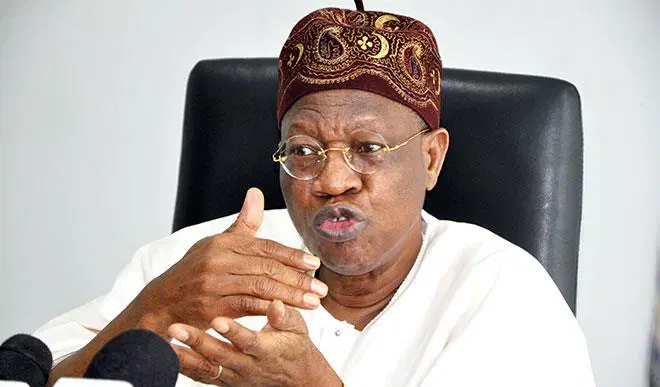
Former Minister of Information and National Orientation, Lai Mohammed, has said that the presidential candidate of the Labour Party in the 2023 election, Peter Obi, was not rigged out of the contest.
Mohammed said the outcome of the election was clear under the Nigerian Constitution and insisted that Obi could not have become president even if he had secured up to 10 million votes.
The former minister made the remarks during an interview on the State Affairs podcast hosted by Edmund Obilo. In the interview, he addressed claims by some supporters of the Labour Party that the 2023 presidential election was manipulated against their candidate.
According to him, the results announced after the election showed clearly that Obi neither came first nor second in the race.
Nigeria held its presidential election on February 25, 2023. The contest was mainly between four major candidates: Bola Tinubu of the All Progressives Congress (APC), Atiku Abubakar of the People’s Democratic Party (PDP), Peter Obi of the Labour Party and Rabiu Musa Kwankwaso of the New Nigeria Peoples Party (NNPP).
The election attracted widespread attention across the country and among Nigerians living abroad. Many young voters supported Obi, and his campaign gained strong momentum on social media platforms.
After the election, the Independent National Electoral Commission (INEC) declared Tinubu the winner. However, the result was challenged by both the Labour Party and the PDP, which alleged irregularities in the voting and collation processes.
These disputes led to legal battles that moved through Nigeria’s election tribunal system before eventually reaching the Supreme Court of Nigeria.
Despite the legal challenges, the Supreme Court later upheld Tinubu’s victory, confirming him as the duly elected president.
Speaking on the podcast, Mohammed said there was a strong online narrative suggesting that Obi had actually won the election but was denied victory.
He said this perception was largely driven by activity on social media platforms, where many Labour Party supporters believed their candidate had been unfairly treated.
“After the election, its legitimacy was being questioned,” Mohammed said.
He explained that if someone relied only on social media discussions at the time, it might appear as though the Labour Party had won the election.
According to him, the reality was different when the official results and constitutional requirements were examined.
“And they did not win the election. Unfortunately, the perception out there was that they won and were rigged out. They did not win and were not rigged out,” he said.
Mohammed also explained that Nigeria’s Constitution sets two main conditions that must be met for a candidate to be declared president.
First, the candidate must receive the highest number of votes in the election. Second, the candidate must also secure at least 25 percent of the votes cast in two-thirds of the states of the federation.
Nigeria currently has 36 states and the Federal Capital Territory, Abuja. Two-thirds of the states means a candidate must secure the required vote spread in at least 24 states.
Mohammed said the official election results showed that Obi did not meet these requirements.
According to him, Obi came third in the election behind Tinubu and Atiku.
He said Obi secured at least one-quarter of the votes in 15 states, while Atiku achieved the same threshold in 21 states.
Tinubu, he said, not only had the highest number of votes but also obtained the required vote spread in 29 states.
“Only Asiwaju had the majority of votes and one-quarter of votes cast in 29 states of the federation,” Mohammed said, referring to Tinubu by his popular political title.
Because of this, he argued, Obi could not have been declared president even if his total vote had been higher in some areas.
Mohammed also revealed that after the election, he travelled with members of his team to several countries to explain the election outcome to international audiences.
According to him, there were concerns abroad about the legitimacy of the election due to the strong online campaign by Labour Party supporters.
He said the delegation met with policy think tanks, international media organisations and other stakeholders in the United States and the United Kingdom.
The aim, he explained, was to present the facts about the election and clarify how the constitutional requirements were applied in determining the winner.
“I took it upon myself and my team to meet think tanks in the US, UK and international media, and we explained to them why Peter Obi could not have won the presidential election,” he said.
Peter Obi, a former governor of Anambra State, became one of the most prominent political figures during the 2023 election campaign.
Before joining the Labour Party, he had been a member of the PDP and even served as Atiku Abubakar’s running mate in the 2019 presidential election.
In 2022, Obi left the PDP and joined the Labour Party, where he secured the party’s presidential ticket.
His campaign attracted large crowds, especially among young Nigerians and urban voters who were eager for political change.
The movement built around his candidacy, often referred to as the “Obidient” movement, became one of the most visible political movements in Nigeria during the election period.
Although he did not win the election, analysts say Obi’s performance significantly increased the visibility of the Labour Party in Nigerian politics.
The 2023 presidential election marked an important moment in Nigeria’s democratic history.
It was the first time since the return to civilian rule in 1999 that four major political parties had strong national candidates competing for the presidency.
The election also saw increased political participation among young voters and strong engagement on digital platforms.
However, it also sparked intense debate about the electoral process, particularly regarding the use of technology and the speed of result transmission.
Several civil society organisations called for reforms to strengthen future elections and improve public trust in the electoral system.
More than three years after the election, discussions about its outcome continue to shape political conversations in Nigeria.
Supporters of different political parties still debate whether the election was conducted fairly and whether the official results reflected the will of voters.
Mohammed’s comments have added another voice to the ongoing discussion.
By insisting that Obi was not rigged out and that the constitutional requirements were clear, the former minister said the outcome of the election should be understood within the framework of Nigeria’s electoral laws.

