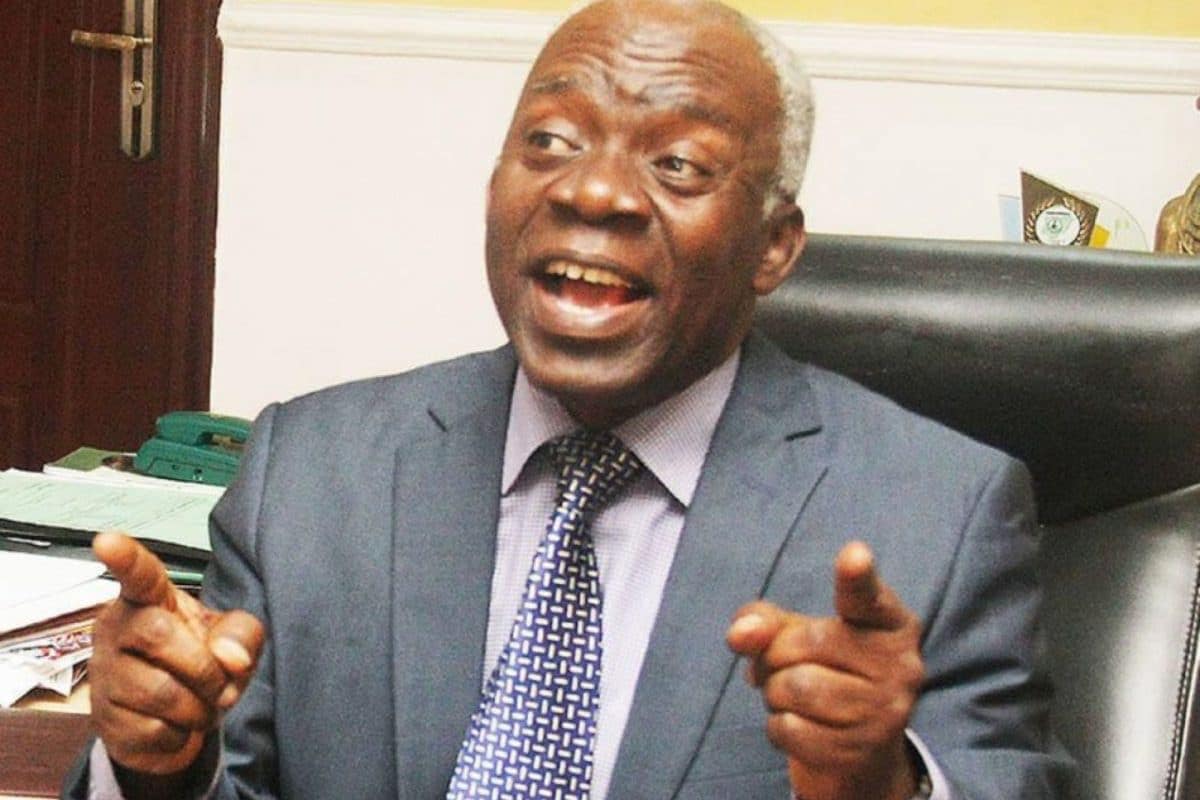
Human rights lawyer Femi Falana has criticized the decision of the Lagos State Government to reintroduce the monthly environmental sanitation exercise that restricts residents’ movement for three hours on the last Saturday of every month.
Falana, a Senior Advocate of Nigeria, described the policy as a reminder of what he called a “primitive practice” inherited from Nigeria’s past military governments.
In a statement released on Sunday, the lawyer said the decision to bring back the sanitation exercise could not be justified, especially considering the large amount of money allocated to environmental management in the state’s 2026 budget.
The environmental sanitation exercise used to be a common practice in many Nigerian states for several years. During the exercise, residents were required to stay at home between 7 a.m. and 10 a.m. on designated days to clean their surroundings.
Security officials and environmental task forces usually enforced the restriction, and individuals found outside without permission risked arrest or fines.
The exercise was introduced decades ago as part of government efforts to encourage community participation in keeping cities clean.
However, in many states, including Lagos State, the policy was later suspended after debates about its effectiveness and legality.
Recently, authorities in Lagos announced plans to reintroduce the sanitation exercise as part of broader efforts to address waste management challenges in the state.
Reacting to the development, Falana argued that the government should focus on strengthening modern waste management systems rather than imposing movement restrictions on residents.
According to him, the Lagos State 2026 Appropriation Law already provides substantial funding for environmental services.
He noted that about N236 billion has been allocated in the budget for environmental matters such as waste management, sanitation programs, and urban environmental services.
Falana said lawmakers approved the funds with the aim of improving the state’s waste management systems.
Because of this, he argued that the government should use the resources to expand sanitation services rather than forcing residents to remain indoors during the exercise.
The human rights lawyer suggested that the government could use the budget allocation to recruit more sanitation workers and invest in modern equipment for cleaning the city.
He recommended the purchase of mechanical street sweepers that can remove heavy debris from roads and vacuum sweepers designed to clear dust and smaller waste materials.
Such equipment, he said, would make urban cleaning more efficient and reduce the need for residents to participate in compulsory sanitation exercises.
Lagos, Nigeria’s largest city and commercial centre, generates large amounts of waste daily due to its high population and intense economic activities.
The state government has in recent years introduced various initiatives to improve waste management, including partnerships with private waste collection companies.
However, sanitation challenges still exist in some areas, particularly in densely populated communities where waste disposal systems are under pressure.
Falana also reminded the Lagos State Government about a legal case that challenged the legality of restricting people’s movement during environmental sanitation hours.
The case involved a resident, Faith Okafor, who was arrested on May 25, 2013, during the monthly sanitation exercise.
According to reports, Okafor was apprehended for allegedly violating the movement restriction that was in place between 7 a.m. and 10 a.m. that day.
She was arrested along with several other individuals and taken before a special offences court.
At the court, she pleaded guilty to the charge of wandering and loitering during the sanitation period and was fined N2,000.
After paying the fine, Okafor later challenged the action in court, arguing that her fundamental rights had been violated.
Okafor filed a case at the Lagos State High Court, claiming that her rights to dignity, personal liberty, and freedom of movement had been breached.
However, the High Court dismissed her application.
Unsatisfied with the ruling, she appealed the judgment at the Court of Appeal of Nigeria.
The Lagos Division of the appellate court later ruled in her favour.
In its judgment, the Court of Appeal held that the restriction of movement during environmental sanitation hours had no proper legal backing.
The court also ruled that such restrictions violated the constitutional rights of citizens.
According to the judgment, a directive issued by a state governor does not have the force of law and therefore cannot be used as the basis for arresting or prosecuting citizens.
Based on the Court of Appeal decision, Falana urged the Lagos State Government not to proceed with the planned reintroduction of the sanitation exercise.
He warned that enforcing movement restrictions despite the court ruling would amount to disregarding a valid judicial decision.
According to him, government policies should respect the provisions of the Nigerian Constitution and the rights of citizens.
Falana also highlighted that modern cities around the world rely on organised waste management systems rather than compulsory sanitation exercises.
Lagos remains one of Africa’s fastest-growing cities, with an estimated population of over 20 million people.
Rapid urbanisation, population growth, and industrial activities have placed significant pressure on the city’s environment.
Managing waste effectively has therefore become a major priority for the state government.
The debate over the reintroduction of monthly environmental sanitation reflects wider discussions about how best to maintain cleanliness in large cities.
While some residents support the idea of community participation in environmental sanitation, others believe modern waste management methods are more effective.
For now, Falana has urged the Lagos authorities to reconsider the policy and instead focus on strengthening professional sanitation services funded through the state’s environmental budget.

