
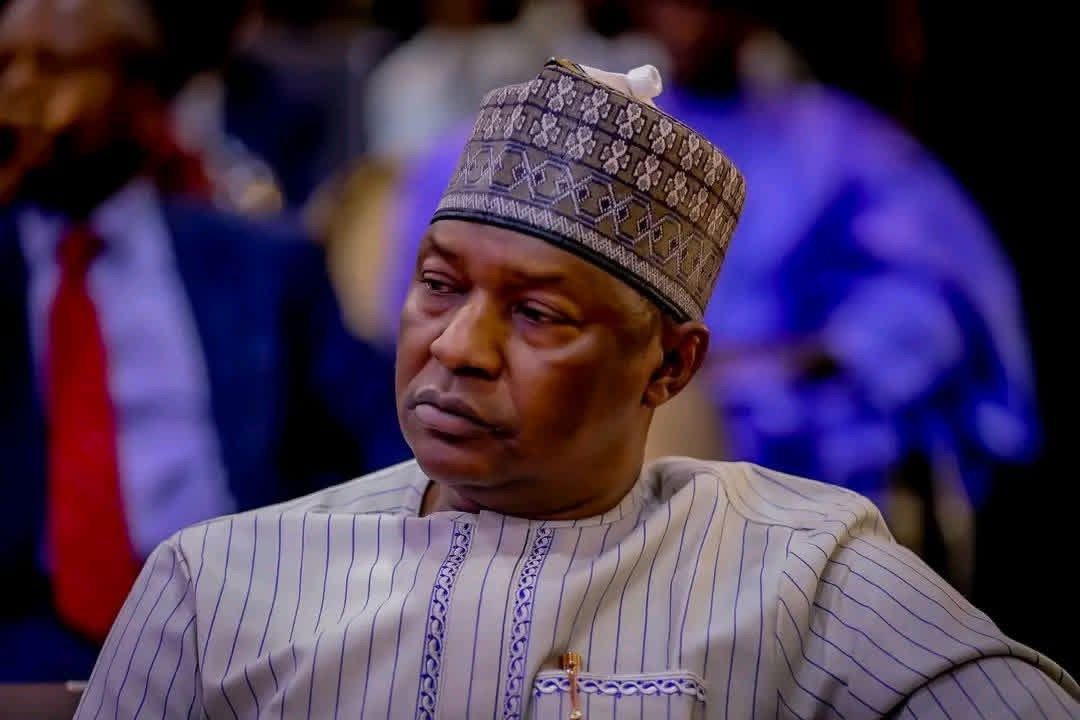
A former Attorney-General of the Federation and Minister of Justice, Abubakar Malami, has said he has no regrets over his actions while in office, even as he faces serious legal challenges after his recent release from custody.
Malami made the statement in an interview following his release on bail, insisting that he remains confident of clearing his name in court. He is currently standing trial alongside his wife, Bashir Asabe, and son, Abdulaziz Malami, over allegations of financial crimes.
The trio has been charged by the Economic and Financial Crimes Commission with a 16-count charge bordering on alleged money laundering. They have all pleaded not guilty.
Malami’s current legal battle began earlier this year when he was arrested and detained by security agencies. After an initial period in custody, he was released, only to be rearrested on January 19 by operatives of the Department of State Services.
The former minister later accused the DSS of denying him access to his family and legal representatives during his detention, raising concerns about due process.
“I was not allowed proper access to my family and lawyers,” he claimed at the time.
His detention drew attention from legal experts and political observers, many of whom called for transparency and adherence to the rule of law in handling the case.
On February 27, the Federal High Court in Abuja granted Malami and his son bail in the sum of N200 million each over separate allegations linked to terrorism-related offences.
The court’s decision allowed both men to regain their freedom after meeting the strict bail conditions.
Speaking in an interview with DCL Hausa published on Wednesday, Malami said that despite the challenges he has faced, he stands by his record in office.
“I have no regrets regarding what I did during my time as a minister,” he said.
He described his experiences in custody—including time spent with the EFCC, in Kuje Prison, and with the DSS—as part of what he believes to be God’s will.
“I believe it is all God’s will, and I accept it,” he said, adding that he remains determined to defend himself against the allegations.
Malami also raised concerns about how the investigation was conducted, alleging that his constitutional rights were violated.
He claimed that security agencies searched his homes and business premises without informing him or allowing him to be present.
“Constitutionally, I have the right to be present during a search,” he said, arguing that such procedures are important to ensure transparency and fairness.
The claims are likely to form part of his defence as the case progresses.
Malami served as Nigeria’s Attorney-General and Minister of Justice from 2015 to 2023 under the administration of former President Muhammadu Buhari.
During his time in office, he played a key role in shaping government policies on justice, anti-corruption, and legal reforms.
However, his tenure was not without controversy. He faced criticism from some quarters over decisions taken by his office, including issues related to prosecutions, pardons, and government contracts.
Supporters, on the other hand, argue that he contributed to efforts to strengthen Nigeria’s legal system and fight corruption.
The case against Malami is being handled by the EFCC, Nigeria’s main anti-corruption agency.
The commission has, over the years, investigated and prosecuted several high-profile individuals, including politicians and public officials.
Fighting corruption remains a major priority for successive Nigerian governments, as it is seen as key to improving governance and economic development.
However, critics often raise concerns about selective prosecution and the slow pace of trials, especially in high-profile cases.
The trial of a former Attorney-General is a significant development in Nigeria’s legal and political landscape.
It raises important questions about accountability, the rule of law, and the independence of anti-corruption agencies.
It also highlights the challenges faced by Nigeria’s justice system, including delays in court proceedings and the need for stronger institutions.
Reactions to Malami’s case have been mixed. While some Nigerians believe that no one should be above the law, others have called for caution, highlighting the need for a fair trial.
Civil society groups have stressed the importance of due process, urging authorities to ensure that the rights of the accused are respected throughout the legal process.
At the same time, there are calls for transparency to ensure public confidence in the outcome of the case.
As the trial continues, attention will be focused on the evidence presented by the prosecution and the defence mounted by Malami and his co-accused.
Legal proceedings in such cases can take time, especially given the complexity of the charges.
For now, Malami remains firm in his position. He insists that he acted properly while in office and is ready to contest the allegations in court.
“I will defend myself against the allegations,” he said.
The coming months are expected to provide more clarity on the case, as both sides present their arguments before the court.