
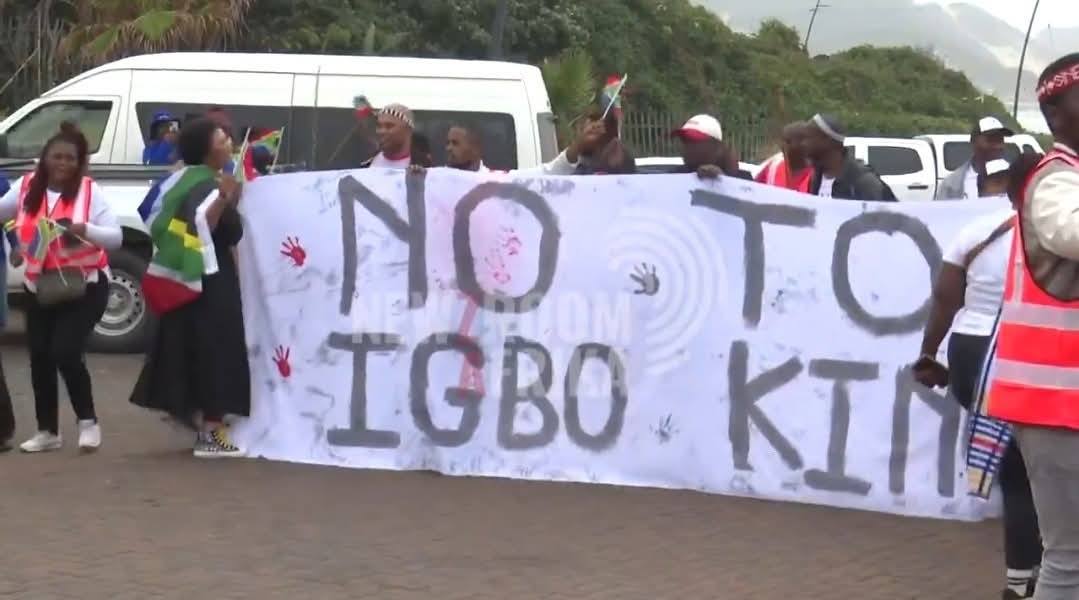
The Igbo Community Association (ICA) in Abuja has strongly condemned the reported attempt to coronate an “Ezeigbo” in South Africa, warning that such actions could endanger Nigerians living abroad and damage relations with host countries.
In a statement released on Tuesday, the group described the move as illegal and against Igbo customs. It also warned that the development could increase tension between Igbo diaspora communities and local populations in foreign countries.
The statement was signed by the President General of the association, Ikenna Ellis-Ezenekwe, and the Secretary General, Emmanuel Chinwoke Onah. Both leaders expressed concern that the attempted coronation had already triggered reactions in parts of South Africa, including protests that were close to xenophobic attacks.
According to the association, while such hostile reactions are unacceptable, the organisers of the coronation must also take responsibility for creating the situation. The group accused them of bringing embarrassment to the Igbo people and Nigeria as a whole.
“It is wrong, illegal, and a direct violation of our customs to enthrone a king in another person’s domain,” the statement said.
Cultural Concerns and Tradition
In Igbo culture, traditional rulers, often referred to as “Eze,” are recognised within specific communities in Nigeria, particularly in the South-East region. These rulers are installed according to long-standing customs and with the approval of local traditional councils.
The ICA explained that the idea of creating an “Ezeigbo” outside Nigeria does not follow these traditions. It said such titles are not recognised by established Igbo authorities and could weaken the structure of traditional leadership.
The group pointed to earlier decisions by the South East Traditional Council, which had issued a directive banning the installation of “Ezeigbo” in foreign countries. This position, the association noted, was later supported by Ohanaeze Ndigbo, the apex Igbo socio-cultural organisation.
By ignoring these directives, the ICA said, individuals involved in such coronations are acting outside accepted norms and risking confusion among both Igbo communities and their host nations.
Safety of Nigerians Abroad
A major concern raised by the association is the safety of millions of Igbo people living in the diaspora. The group warned that controversial leadership structures could make Nigerians targets of suspicion or hostility.
South Africa has a history of xenophobic violence, where foreign nationals, including Nigerians, have been attacked during periods of social and economic tension. The ICA fears that actions like the attempted coronation could worsen such sentiments.
“The leadership of the Igbo community in Abuja will not stand by while the actions of a few individuals in the diaspora jeopardise the safety and reputation of millions of our kinsmen globally,” the statement added.
The association noted that the reported incident had already led to protests in some areas, raising fears of a repeat of past attacks on foreigners.
Lessons from Past Incidents
The ICA also referred to previous tensions in Ghana involving Igbo diaspora leadership structures. In that case, disputes over traditional titles reportedly created friction between Nigerians and local authorities.
According to the group, such incidents highlight the risks of exporting traditional institutions into foreign environments without proper understanding or approval.
“These actions can easily be misinterpreted by host communities as an attempt to create parallel authority structures,” the statement suggested.
The association warned that if similar practices continue, they could lead to diplomatic issues between Nigeria and other countries, as well as stricter measures against Nigerians living abroad.
Call for Government Action
In response to the situation, the ICA called on Nigerian authorities and international security agencies to take firm action. It urged them to stop what it described as illegal coronations and hold those responsible accountable.
“Any person parading himself as an ‘Ezeigbo’ in the diaspora should be arrested and prosecuted,” the group said.
The association stressed that decisive steps are necessary to prevent further escalation and to protect the image of Nigeria and its citizens.
It also called for better coordination between Nigerian diplomatic missions and diaspora communities to address leadership issues and avoid conflicts.
Balancing Culture and Law
Experts say the controversy reflects a broader challenge faced by diaspora communities — how to maintain cultural identity while respecting the laws and traditions of host countries.
For many Nigerians abroad, community leaders play an important role in organising social activities, resolving disputes, and representing their people. However, when such roles take on titles that resemble traditional rulership, they can create misunderstandings.
The ICA emphasised that preserving Igbo heritage does not require copying every aspect of traditional life in a foreign land. Instead, it called for adherence to guidance from recognised authorities in Nigeria and respect for the legal systems of host nations.
Growing Scrutiny of Diaspora Leadership
The issue of diaspora leadership titles has come under increasing scrutiny in recent years. Governments and community groups are paying closer attention to how such structures affect social harmony and international relations.
In countries like South Africa, where economic challenges and unemployment have sometimes fuelled anti-immigrant sentiment, any action seen as controversial can quickly lead to tension.
The ICA warned that Nigerians must be careful not to take actions that could be misunderstood or used to justify hostility against them.
Way Forward
The association concluded by urging unity among Igbo people both at home and abroad. It called on community leaders to act responsibly and in line with established traditions.
It also encouraged dialogue between diaspora groups and recognised Igbo organisations in Nigeria to ensure that cultural practices are upheld in a way that does not create conflict.
As the situation develops, many will be watching closely to see how authorities respond and whether steps will be taken to prevent similar incidents in the future.
For now, the ICA’s message is clear: respect for tradition, law, and host communities must guide the actions of Nigerians abroad, especially in matters as sensitive as traditional leadership.