
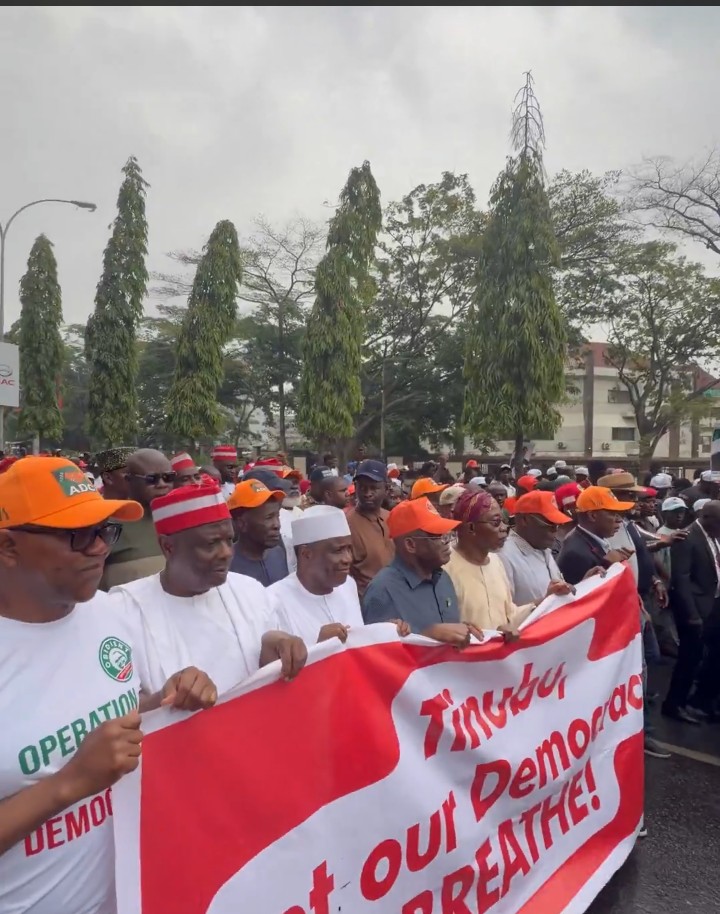
Top opposition politicians, including Atiku Abubakar, Peter Obi, Rotimi Amaechi, Rauf Aregbesola, and Rabiu Kwankwaso, on Wednesday joined a mass protest in Abuja under the banner of #OccupyINEC, raising concerns over recent decisions by the Independent National Electoral Commission (INEC).
The protest, organised by members of the African Democratic Congress (ADC), took place at Maitama Roundabout and drew hundreds of party supporters and political figures from across the country.
Other prominent figures present at the rally included, Aminu Tambuwal, and Dino Melaye. Members of the Kwankwasiyya movement also turned out in large numbers, adding colour and energy to the demonstration.
The protest followed a controversial decision by INEC after a Court of Appeal ruling on the leadership crisis within the ADC. The electoral body announced that it would no longer accept official correspondence from either of the two factions claiming leadership of the party—one led by former Senate President David Mark and the other by Nafiu Bala.
ADC leaders and other opposition figures described the move as an interference in the internal affairs of the party. They argued that such action could weaken political parties and threaten Nigeria’s democratic system.
Many protesters carried placards expressing support for David Mark, with some reading, “In David Mark’s NWC we trust,” showing clear backing for his faction within the party.
Addressing the crowd, Peter Obi spoke on behalf of the party and other opposition leaders, calling on Nigerians to rise in defence of democracy.
According to him, the actions of INEC could set a dangerous precedent if not challenged. He warned against what he described as a possible drift toward a one-party system in the country.
“We are saying that our democracy must not be killed,” Obi said. “We say no to a one-party system. We call on all Nigerians who believe in unity, peace, and security to stand up and defend our democracy.”
His remarks were met with loud cheers from the crowd, many of whom waved party flags and chanted slogans demanding fairness and transparency in the electoral process.
In a surprising move, protesters sang Nigeria’s former national anthem, “Arise, O Compatriots!”, which was officially replaced in May 2024 by the administration of Bola Tinubu with the older independence anthem, “Nigeria, We Hail Thee.”
The ADC later confirmed that the use of the old anthem was intentional and described it as “an act of defiance.” Observers say the move was meant to send a strong message about what the protesters see as a need to protect democratic values and national identity.
Nigeria has a long history of multi-party democracy since the return to civilian rule in 1999. However, tensions between ruling and opposition parties have often raised concerns about the strength of democratic institutions.
The current dispute within the ADC is one of several internal party crises seen in recent years across different political parties. Such disputes often end up in court, leaving INEC in a difficult position when it comes to recognising party leadership.
Many of the protesters expressed fear that actions like INEC’s decision could weaken opposition parties and reduce political competition in the country.
They warned that a strong democracy depends on active and independent political parties, as well as a neutral electoral body.
Some civil society groups have also weighed in, calling for dialogue and legal clarity to resolve the ADC leadership crisis without undermining democratic principles.
As the protest ended peacefully, organisers said the #OccupyINEC movement could continue if their concerns are not addressed.
There has been no immediate response from INEC regarding the protest, but observers expect further legal and political developments in the coming weeks.
For now, the demonstration has once again brought attention to the challenges facing Nigeria’s democracy, including internal party conflicts, the role of electoral institutions, and the need for trust in the political process.